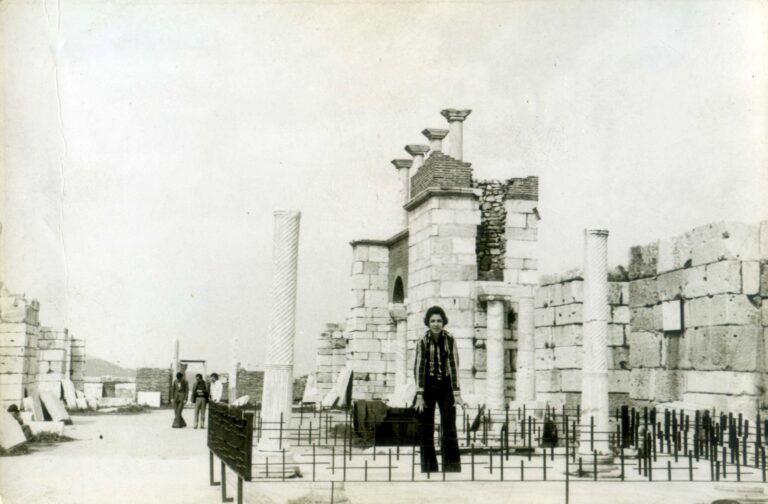
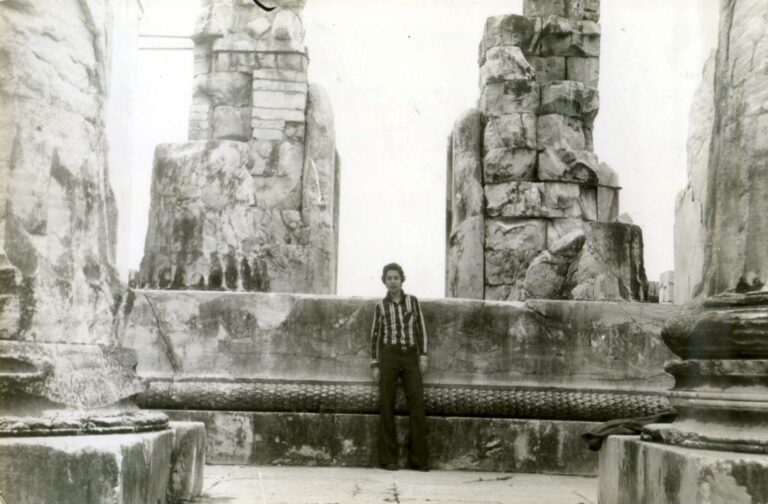
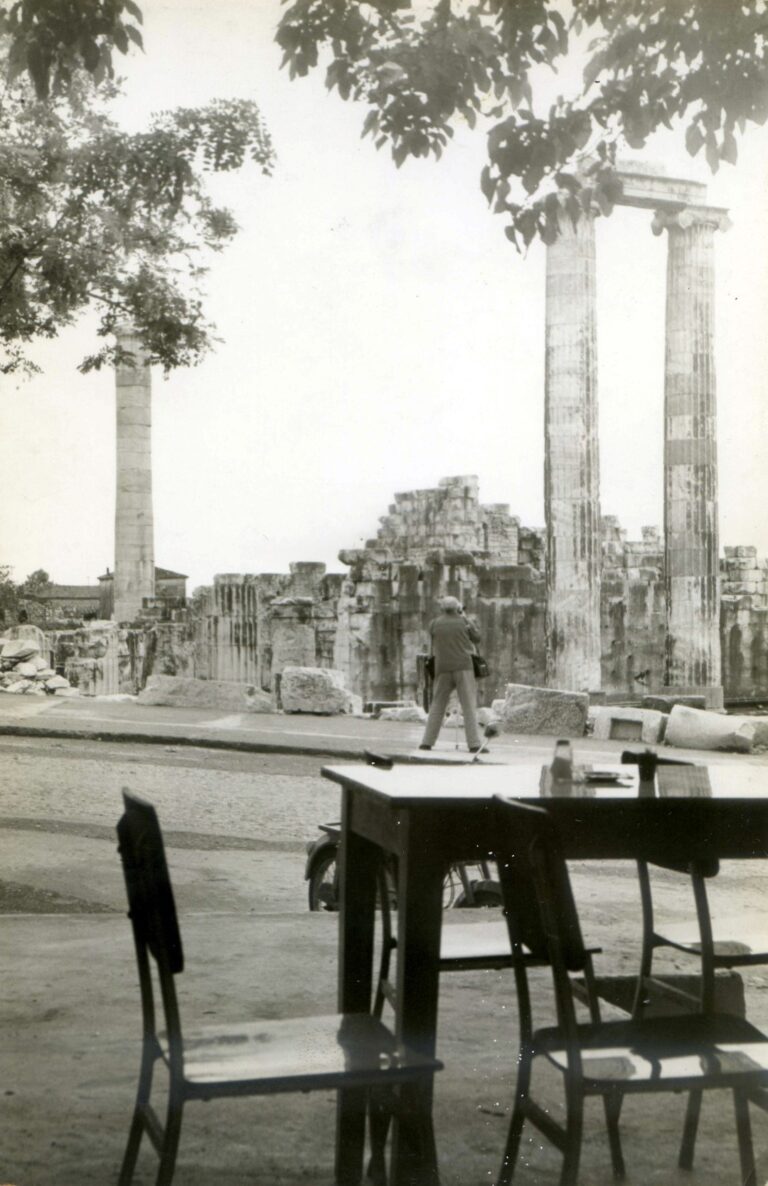
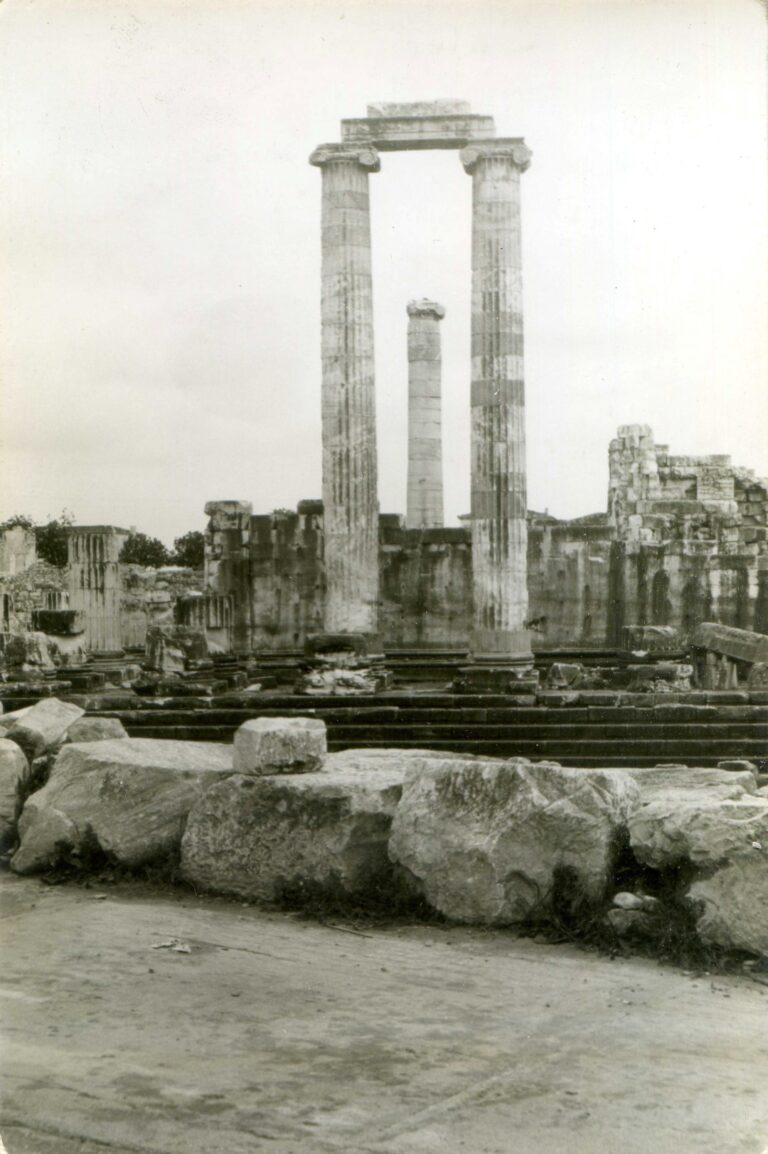
© Copyright photo by Levent Ağaoğlu, 1975, Didyma, Aegean Turkey
by Macit Gokberk, Professor
When the history of Western Anatolia in Antiquity is considered, it is seen that philosophy had a great success in this region, especially in its beginnings, which we cannot find anywhere else, at any other time. As we shall try to show, this achievement will then be a destiny in the development of not only Antiquity, but all of humanity. Therefore, while drawing the historical picture of this region, that is, trying to reconstruct a past period of Western Anatolia in our knowledge, philosophy must be included in this picture. If this is not done, our historical picture will indeed be incomplete.
In terms of philosophy, we can make such a claim for very few regions. At best, next to Western Anatolia , we can put Attica, the Attica region, where Athens will be the center of philosophy for many centuries, in which Ancient Philosophy will reach its classical maturity. But in Western Anatolia, philosophy had to migrate to other places due to major historical events such as the Persian invasion, the revolt of the Ionian cities, and the destruction of Miletus, which first started philosophy directly, and it was almost the end of the Ancient Age in raising thinkers to new centers of philosophy. It is a very fertile region that has never been barren. When we try to indicate the place and importance of this region in Ancient Philosophy with the teachings of the philosophers it raised, it is seen in Western Anatolia. We will see that ‘ has brought many world-class thinkers to the Philosophy of Antiquity from beginning to end.
These thinkers were either the founders of the major epochs that made up Ancient Philosophy, or at least they led to fundamental new developments within these epochs. However, we are not going to give a complete list of thinkers and philosophers raised by Western Anatolia . Only original philosophers who have been truly constructive and creative with their thoughts will be included in this list. But when we review these philosophers, we will obtain a panorama of development not only of Western Anatolian thought in Antiquity, but also of almost all Ancient Philosophy.
This panorama also starts from Ionia. If we open any work that writes the history of Western Philosophy, we see that Thales of Miletus was put at the head of this philosophy . All historians of philosophy have long agreed on this. As a matter of fact, even Aristotle, while drawing a sketch of the philosophy that preceded him in the first book of his “Metaphysics,” says in this first essay on the history of philosophy: “First of all, most of those who dealt with philosophy thought that the first basis of all objects was only in the form of matter. Thales, the original head of this kind of philosophy, says it is water”.
Aristotle, one of our oldest and most reliable sources for the beginnings of Ancient Philosophy , tells us two things here: Philosophy started with Thales and that Thales suggested water as the main-matter (arche).
Accordingly, Western Philosophy begins with a quote from Thales of Miletus: The essence of everything is this. At first glance, this view of Thales, of course, will seem very naive to today’s people, who have been able to get into the very core of the atom and at least have come a long way in knowing and understanding what the origin of material existence is . However, the importance of this view should be sought not in its truth-wrongness, shallowness-deepness, but in the way it is presented, in the attitude that reveals it, in the way taken to reveal it. It was this attitude that started philosophy and showed the way and direction to the whole Western culture until today.
First, let’s try to clarify what this attitude is, how this attitude brought about a revolution that has never been seen before in the history of humanity, and then has expanded its influence to the present day.
What was this attitude of Thales of Miletus that led to a great revolution? To understand this, it will be necessary to take a look at how the Greeks before Thales understood the world and themselves.
Miletos, Miletus: today’s Balat village, south of Söke. – For the life and teachings of thinkers up to Socrates mentioned in this article, see; Waller Kranz, Ancient Philosophy, Istanbul 1948, Faculty of Letters publications.
Before the philosophy initiated by Thales of Miletus , the Greeks had a worldview based on mythos. In such a worldview, it is believed that gods direct all human actions. The worth, worthlessness, cleanliness and guilt of man are always in the hands of the gods, because of the gods’ decisions for man in one way or another. Homer, who is also a Western Anatolian. This worldview, which reached its classical expression in terms of art in the epics of the BC and the tragedies of Sophocles and Aeschylus, was a basis for the ancient Greeks to understand their existence and their place and duties in existence. On such a basis, they have not been asked what they are, their truths and mistakes have not been investigated, and they have been built from opinions based on emotions and fantasy. But to impose one’s life on a worldview is about the essence and structure of man. Each of us has a worldview that carries our life and is therefore the way we understand ourselves and our world.
For the Greeks before the philosophy initiated by Thales of Miletus, their worldview was a pre-existing, unchanging schema. This scheme has not been created by man himself, he finds it ready. This schema is inherited from one generation to the next; it is grown in this staff without being reviewed or discussed; This staff is believed and adopted without question. Because this has always been like this, it has always been seen and heard like this from ancestors and grandfathers. In short: this worldview is a cast of traditions-customs-beliefs.
It goes without saying that we find this kind of foundation of human life not only in the ancient Greeks. This is a period that all humanity is going through, and is still going through here and there even today. As we see alive in the African or Australian aborigines today, there is a natural – or organic – basis of belief that primitive man has also adopted and accounted for: his belief that he comes from this or that totem, his being deceived by it, shapes all his behavior. For him, the world is full of jinn and fairies who do him good or bad. In the basis of many behaviors of modern man, there is a lot of confusion that has not been expressed clearly and has not been reviewed in terms of truths and mistakes.
Here, the first philosophers who appeared in Ionia at the beginning of the 6th century BC shook this mythological worldview, which was the basis and form of understanding the self and the world, which carried the life of the Greek until then, and caused it to dissolve, and replaced it with a worldview with a completely different structure. .
What was this brand new worldview? This is no longer a knowledge that is based on knowledge and accepted as it is without asking and researching the truth beforehand, rather than a knowledge that is based on knowledge, without questioning, without question, as it is, and based on beliefs and beliefs, but rather what one reaches and obtains with their own thoughts, and then sifts them in terms of right or wrong. It was a worldview based on knowledge. In other words: what is done here is to indicate the situation of man in the face of the world with thought, not to understand his attitude in the world as an unchanging scheme, but to find and ground this attitude with thinking, in short: to find and illuminate the world, his place and role in the world with his own mind.
With this, mankind was reaching its freedom. For the world was no longer filled with terrifying daemons, as primitive man thought; man was no longer a slave to the pleasures of the gods, as the ancient Greeks believed; man was now establishing the connection he was in with his own thoughts, he was basing his structure with his own mind. Man was now using the fire that Prometheus had stolen from the gods and brought to himself to be free.
That’s why we called this Ionian philosophy an event that we can’t find the like of it anywhere else, at any other time. Indeed, with this philosophy, not only does the world view of the Greeks, which remained unchanged for centuries, is turned upside down and does not take action, but this understanding, wherever this attitude touches, breaks the frozen tradition-custom-belief schemes of hundreds and thousands of years and causes a fundamental change.
This worldview has been the starting-point for all Western Culture, and has subsequently spread everywhere that this culture has reached, directly or indirectly. We have been in this view since the Tanzimat. Ataturk’s Revolutions is an attempt to adopt this view more consistently, in a more concise and faster manner. Atatürk’s statement “The truest guide in life is science” is the expression of this attitude that appeared on the stage of history in our land 2500 years ago. Murshid means showing the right way. What shows the right path is no longer daemons, gods, blurred opinions that have not been accounted for, but the knowledge that human beings have illuminated with their own minds. Today, China, India, the Middle and Near East, and Africa are increasingly taking part in this view. Thus, this worldview is on its way to be the foundation of the unity of not only the Western World, but all humanity.A world history that embraces all humanity has only now become a reality.
Again, we said that philosophy, which first appeared in Western Anatolia , will be a destiny in the development of humanity. Because the source of many revolutions that have taken place and are still taking place since then is a stance, an attitude expressed in this philosophy. Here Thales ‘ s first glance appears quite naively “The truth is everything is water” mentioned in this attitude, the revolution found its first expression of this attitude began. That’s why Thales is the “father of philosophy”. To put it another way: at the beginning of the 6th century BC in Western Anatolia someone named Thales asks what is that basis from which everything is derived, and is not content with the answer given by mythology – religion, tradition – he thinks for himself, asks himself and gives the answer we know. It is important that he seeks for himself, that he finds himself, not whether what he finds is right or wrong. The proposition “The root of everything is water” may not be true. But the behavior, the attitude that makes this proposition say, opens the way to the nucleus of the atom today, it shows the way.
After explaining the meaning and great importance of Thales attitude, let’s try to see how the Western Anatolian philosophers who came after him walked on this path , what they thought about the structure of existence, the place and role of man in existence, and these main questions of philosophy.
We also have learned from Aristotle above, the first philosophers were investigating what the main-matter, arche, was. To seek this means to investigate the structure of existence, nature. Our senses show us a never-ending change, a becoming. Everything around us is passing and changing. Is this the real truth of existence? Or is there something hidden behind this change, which is the source of all happenings but remains unchanged? If this is the original-truth, then it will be superior to the changing, the occurring. If we also know what real existence is, we will know what is more valuable and what is less valuable, that is, we can list the values we want to achieve in life and adjust our actions according to these values. When we do this, we realize our meaning and role in this world correctly, so we become happy.
There are two interconnected problems here:
- What is the real truth?
- What is a human being in such a reality, what should it be?
In the first period of Greek Philosophy whose center of gravity was in Western Anatolia , the main problem was emphasized. When philosophy had to migrate from Western Anatolia due to the Persian invasion , it first took refuge in Southern Italy, and then settled in Athens, in the middle of the 5th century, for a long stay. It is at this time that the center of gravity of philosophy shifts to the second problem, the problem of man. These two problems, which were first treated individually and separately from each other, will then be handled together in the philosophies of Plato and Aristotle and will reach a synthesis that comprehends both existence and human being.
Philosophy after Aristotle, Hellenistic Philosophy, on the one hand, develops in the form of separating the separate branches of science from the mother-in-law, due to the proliferation of knowledge and gaining a structure that cannot fit into a system of philosophy — until Aristotle, philosophy and science are one and the same thing — On the other hand, he unilaterally focuses on the second problem, the human problem.
For this reason, Hellenistic Philosophy appears primarily as a moral philosophy, and finally as a philosophy of religion or a religious philosophy.
After specifying the development line of Ancient Philosophy, let us try to show one by one the place and main achievements of our Western Anatolian philosophers in this development.
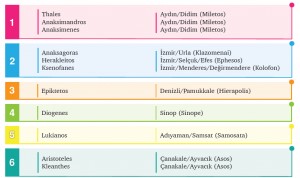
After Thales, the second philosopher is Anaximandros, who is also from Miletus. He, like Thales, deals with the problem of being, and he asks and investigates what are, the essence, the basis of being. For him, real being is apeiron, that which has no limits. “The mother-matter must not be a certain thing like Thales ‘ water, because the certain thing is finite, and the finite cannot be the main-source that creates infinitely, infinitely,” he says. There is no doubt that this concept of aperion is a step forward.
But the third Milesian philosopher, Anaximenes, takes this forward step back, making the main-matter again a certain thing: air. According to him, air is what sustains both the universe and the living thing. The soul of man is also air, as a matter of fact, when the air leaves as a last breath, the existence of man also ends. Anaximenes , first of all, asks , “How is it that from this elementary-matter innumerable objects can arise?” treats the question as a problem. His predecessors did not make this an issue, for Thales water was Anaximandros. They design the apeiron as a living thing, and since living things reproduce naturally, they do not dwell on the occurrence of objects. This understanding is called hylozoism (hyle — matter + zoon — living), the view of “considering matter as alive”.
Anaximenes, on the other hand, attempts to explain this process mechanically: this reproduction, he says, occurs by the condensation and sparseness of the air. Objects, too, are no more than various degrees of condensation and sparseness of the mother-matter.
The fourth of the Ionian philosophers we will consider is Heraclitus (lived approximately between 540-480), who was born and raised in Ephesus, a city not far from Miletus . Heraclitus is from an aristocratic family of Kphesus. Not only his ancestry, but also his thinking is aristocratic. He wrote in a very obscure, dark style. That’s why he was called “Dark Heraclitus ” in Antiquity. He wrote like that on purpose, so that the black crowd would not understand him. He does not like the democratic development that manifested itself in his hometown at that time, he retreats to his corner and despises the mass in its solitude.
For Heraclitus, the arche, the main-matter of being, is fire. It is no accident that he chose fire as the main ingredient. Fire is something that is constantly changing and changing. Here is Heraclitus transferring this feature of fire to the whole being: The Kosmos (universe) is a constant change that never ceases, everything flows along it. “You can’t bathe in a river twice. Not changing, stopping is nothing but an appearance, an error . ” Our assumption that there are permanent things is because the change is according to a certain law. Heraclitus says law as Logos. Knowing and recognizing this law is a duty. Anyone who knows the Logos will take this law as a criterion for his action, make reason (= Logos) dominate his action, therefore he will have acted correctly. The cosmos is loaded with tension of opposing forces, full of war, objects are born from this war, hence “war is the father of all”. Objects are formed from the reconciliation of the opposites in this war, from their reaching a harmony. After a certain time, the universe will return to the main-source, to fire – about to be reborn.
It is this becoming that Heraclitus regards as the real truth. In this respect, his exact opposite is Parmenides. Parmenides from Southern Italy, from Elea (present-day Velia). Founder of the Elea School, one of the most famous epistles of the early period of Greek philosophy. Since he is not from Western Anatolia , we will not dwell on it. However , since the separation between them and Heraclitus will be a major problem of the next philosophy, it is necessary to touch on him briefly.
According to Heraclitus, the real truth was “becoming”. For Parmenides, on the other hand, it is “not changing”, “staying”, it is the “One” that always remains the same, the real truth. Changing, becoming, movement, metamorphosis, thinking about all these causes us to contradict ourselves. It is the senses that show us the change, the senses mislead us. This opposition between this ever-present essence and becoming, which is a perpetual change, will be a major difficulty for philosophy from now on.
Before we move on to this, let us briefly see Xenophanes, whose subject is beyond our problem so far, and who taught the now-mentioned Parmenides. Xenophanes (approximately 569-477) from Colophon (today’s Değirmendere: south of İzmir). Contemporary of Heraclitus . He is not a natural philosopher like other Ionians. He dwells on the subject of religion, trying to cause a reform in the religion of his day with his thoughts. This reform, this understanding that he wanted to bring to the Greek religion – parallel to the philosophy that emerged with the attitude we described above – will never be lost from now on. Socrates, Plato, Aristotle they will always keep this thought and advance it and try to make it happen. Socrates will be sentenced to death for this reason, and Aristotle will be accused of impiety and will hardly save himself.
We see Xenophanes fighting fiercely with the Greek religion’s conception of the gods in human form. This anthropomorphism, the representation of the gods in human form and character, also took a high literary form in Homer and Hesiod. These two had a great place in the Greek education of that time.
Here Xenophanes opposes this understanding and says:
“ Homer and Hesiod ascribed to the gods all the things that are considered crimes and shameful things among mortals. The gods steal, lie, cheat, betray their wives… Then: mortals think that the gods were born like themselves, they dress like themselves, they are in their own shape. The Abyssinians think of their gods as black and flat-nosed like themselves, while the Thracians consider them blond and blue-eyed. As such, if oxen, horses and lions had hands and could paint, horses would draw their gods like horses and lions like lions. However, the gods are neither in the form of lions, nor are they like Negroes, nor are they human-like, in human form, as we see in Greek statues”.
Xenophanes confronts this with his own vision of a purified god: “There is a God; This is the greatest of gods and men, like mortals in neither form nor thinking, this one God is all seeing, all hearing, thinking, and all things effortlessly running. Xenophanes‘s vision of a god can be considered a strong step towards monotheism, monotheism. As we said, Socrates, Plato, Aristotle will also follow the footsteps of this step, and Aristotle‘s vision of a single god will reach a great maturity.
Elsewhere, Xenophanes says, “the rainbow, the sun, and the stars are just angry clouds . ” However, mythology considered them gods. The difference is clearly visible. Xenophanes was born in Ionia, but did not live there. It will be due to the arrival of the Persians (Ionia comes under Persian rule in 545 BC). He tells: He left his homeland at the age of 25 and came to southern Italy, where he lived a life of a traveling poet (this life continued at the age of 92). Sometime towards the end of his life, he also resided in the then newly established city of Elea, where Parmenides, the founder of the Elea School, was then a student.
Because of the political situation in Ionia (Persians, then the Ionian uprising…) from now on, the fate of the thinkers raised by this region will always be like that of Xenophanes. They will not be able to stay in the places where they were born, they will migrate to the places where they can find peace in the Greek world – by the way, always southern Italy at first – and work there.
One of them is the famous Pythagoras , whose life and teachings are covered in legends . Pythagoras is not from the land of Ionia, but from its islands, Samos-Samosian. He immigrated to southern Italy at a young age. After traveling around Anatolia, Phenicia and Egypt, he came and settled in the city of Croton in southern Italy, where he established a religious community that was closely interested in science and art, while also dealing with mathematics and music.
In order to understand the next development from the teaching of Pythagoras, which we will not dwell on because it is not directly from Western Anatolia, we will suffice to state the following: Ptbagorasians made numbers the arche of all existence. The great achievement of the Pythagorean epoch is his discovery that nature is mathematically structured. This understanding will never be lost after that, and will reach the present day. This is the basis of our understanding of nature today: Nature is a mathematically structured order; Therefore, we can comprehend nature best with the measurements of mathematics. Modern technique is a product of this understanding.
This understanding of nature will fully mature in the next century, in the 5th century, and will gain the character of a planned and systematic research. The main four philosophers who also contributed to this new development were Empedocles, Anaxagoras, Leucippus and Democritus. The first of them, Empedocles, is Sicilian, and the other three are Western Anatolians.
This natural philosophy of the 5th century is an attempt to reconcile Parmenides and Heraclitus. The four philosophers mentioned above, like Parmenides, accept that real existence does not change in terms of quality and always remains the same with itself, but on the other hand , they do not deny that being and changing is a reality by giving the right to Heraclitus .
However, in order to accept becoming, it was necessary to consider a change that did not touch the quality of the arche, the main-matter. This kind of change could only be displacement, movement. Also, the real being is not thought of as a single thing like water, air, fire, but as a multiplicity. They themselves do not change, but by their movement they bring about the multiplicity and variety of individual objects.
Let’s leave the Sicilian Empedocles aside and see the other three Western Anatolians.
First Anaxagoras (ca. 500-428). Anaxagoras is also from Ionia, from Klazomenai (present-day Güladası to the north of Urla). He was from one of the aristocratic families of this place. He goes to Athens in 461, where he lives for 30 years. The first great philosopher Athens had ever seen. There are those who say that philosophy came to Athens with it. Thereafter, Athens would be the principal center of philosophy from AD 529 until Emperor Justinian closed the Neoplatonic Akademia, then the only school of philosophy in Athens. He was a close friend of Pericles, so he eventually fell into a difficult position and was forced to leave Athens. Pericles’ opponents accuse him of atheism, because Anaxagoras said that the sun is a heap of fire. However, the sun is considered a god in Greek religion. Anaxagoras also flees to Lampsacus (Lapseki) to escape prosecution, where he is thought to have died shortly thereafter.
Anaxagoras is the greatest naturalist of his days. He has a great reputation as a mathematician. He also had discoveries in astronomy: he correctly explained the moonlight, lunar and solar eclipses. He lived a full scholar’s life away from all kinds of political-practical activities. In this respect, it is a new type. Seeking theoria, which means knowing in order to know, and seeking theoretical knowledge is an attitude that first emerged in Western Anatolia . There was nothing like it anywhere else before that. What happens is always practical knowledge that shows the ways to be walked, the tools to be used in order to achieve a certain set of practical goals.
According to Anaxagoras , arche, the main-matter is a multiplicity in number, the more varieties there are in existence, the more main-matter there are, the more sperm—seeds. Everything has these semen. But how is it that semen in innumerable multitudes combine to form innumerable objects?
Anaximenes explained becoming mechanically: he said that by the condensation and relaxation of air, objects are formed. Anaxagoras, on the other hand, explains becoming teleologically. This is his most original thought. “Just as a statue cannot come into being from a mud heap, and a sculptor has to work according to a plan, so a principle must have played a role in the creation of the universe, which took into account a telos — a purpose,” he says. He calls this principle “nous”, by analogy with the mind – considering the planned work of the mind that shapes it according to certain purposes.
Thus, an understanding that will play a major role in the future, the view that all things happen according to goals, and that the whole being tends towards the realization of a certain purpose, was put forward by Anaxagoras for the first time in the history of philosophy . Because of this success, Plato and Aristotle praise him very much, but they are sad that he could not take his thought to the end.
Because, according to Anaxagoras , nous provided only the first movement, what happened after that was always mechanical, in the form of movements that did not consider a goal. We will find the mechanistic explanation, which is the exact opposite of this teleological understanding, which we first found in Anaxagoras , in the other two Ionian philosophers, Leucippus and Democritus .
These two have long been called the philosophers of Abdera. Abdera was a city in Western Thrace, near present-day Xanthi. However, it is very likely that these two philosophers were not born but worked in Abdera. Leucippos must have been born in Miletus and Democritus in Teos (today’s Sığacık, south of Urla). Then they met in Abdera.
Nothing definite is known about the years and life of Leucippus . He appears to be a contemporary of Anaxagoras . He was a student of Zeno in Elea, then came to Abdera and founded his school there. Here Democritus became his teacher.
Democritus himself says he is 40 years younger than Anaxagoras. So, he is from the next generation. His life is calculated accordingly, and it is thought that he was born approximately in 460 and lived 90-100 years. Democritus traveled and saw a lot: besides all of Greece, he toured Anatolia, Iran and Egypt. He had never been involved in politics and lived a life of a reclusive scholar. He used to say, “I would rather find the cause of something than become a Persian ruler . “ — He’s a brand new type who, like Anaxagoras , is totally devoted to theoria. Aristotle would later consider this way of life as the highest ideal for man. —
His compatriots showed great respect to Democritus . He is rightly regarded as the greatest naturalist of antiquity. Since nothing definite is known about Leucippus‘s life and teaching, it is not possible to distinguish between the philosophies of the teacher and his student. Therefore, rather, the ideas of both are considered together, and their philosophy is called atomism-atomism. Leucippus and Democritus are the founders of the atomist philosophy of nature.
It is not necessary to specify the importance of the atomic doctrine, which is an achievement of the two thinkers raised in the Western Anatolian lands. We always know that this is the main understanding of physics today. If we are stepping into an atomic age today, the first pillars of this development were provided by the philosophy of Leucippus and Democritus .
In this philosophy, atoms are arche, elemental-entities; all beings are formed from these last indivisible elements. Atoms are always of one kind in structure: they are material. They differ from each other only in size, form, location and arrangement. Atoms have none other than these quantitative properties. Therefore, qualities such as sound, color, warmth and coldness are not found in them. Such things are our own sense illusions. We can only grasp the real structure of existence, which is knitted from atoms, with the mind.
Democritus is the first consistent materialist in the history of philosophy. We can clearly see in Democritus how much this concept has matured since Thales , who thought the main-matter as water, and how close it has come to our present conception of nature . However, this atomist understanding of Democritus remained in the background due to the predominant authority of Aristotle , who understood nature as an organisma developing towards a certain purpose , until the end of the Middle Ages. In ancient times , if Epicurus and then Lucretius revived the atomic doctrine, hazel still could not hold on. From the Renaissance, when it reappeared, to the present day, this doctrine has been a chief and very fruitful pillar of the new natural science.
Democritus is materialist in every way. Not only material beings, but also events in the soul, such as thinking, hearing, and will, are nothing but the movements of atoms. These are the movements of only very thin and light fire atoms. If these actions are in moderation, people will be happy; if they are excessive, they will make people unhappy. Happiness results from the soul being in a good, suitable state in this respect. This state (euthymia) is best reached in wisdom. But wisdom is not pedantry, it is the state in which the soul frees itself from vain, unfounded fears and finds peace.
We see from these last thoughts that Democritus , like his predecessors, does not only deal with the problem of nature, but also dwells on man. In this respect it is a crossover type. As a matter of fact, from now on, the center of gravity of philosophy will shift to the human problem. The question that will now be asked and investigated is “What is real existence?” not “What is a human?” is the question. Now, all the problems related to man will be discussed: the structure and functioning of the human soul, knowledge, language, morality, life together, religion, art, all these will be emphasized and the place, meaning and role of man in this world will be tried to be determined with the information obtained.
It was the so-called Sophists, who appeared in the middle of the 5th century, who initiated this change of direction, this new development in Greek philosophy. These are the types that emerged from a very deep and tumultuous socio-political change that Greece was going through at this time (Pericles era in Athens!). These are the teachers who want to educate and enlighten the Greeks, who broke with their traditions and became democratized, according to a new world view, and for this they travel from city to city and give lessons with money. It seems that the Sophists first appear as people who do a practical job. What they want: to raise competent, successful people and citizens in a new worldview and a new political order.
Therefore, what they consider is useful information, manners, not theoria. For the sophists, virtue is nothing but being useful and superior in the field of politics and social life. The democratic development of Greece in the interim also required this kind of upbringing. In a democracy, the citizens should be able to make their voices heard and spread their thoughts and opinions. The main tool for this was the art of rhetoric, deceiving and convincing eloquence at that time. For him, the main thing that the Sophists teach is oratory. Because of oratory, the Sophists felt the need to pay attention to people and to examine people. For this reason, they have looked at the functioning of the human spirit, researched language and thought.
Sophists don’t have such a good reputation. Today, too, we call sophism and sophistry to delusional and devious thoughts. Such notoriety was caused by the later Sophists who degenerated this epoch. But the early Sophists, such as Protagoras , Gorgias, Hippias, are thinkers to be taken seriously. The first of these, Protagoras , is the head of the Sophists, considered the greatest. Here, the greatest of the Sophists is a Western Anatolian , like Democritus , he was born in Teos (Sığacık). He, like Democritus , got up and went to Abdera, where he was Leucippus. He listened to his lectures. Then he comes to Athens, where he stays for a long time. He was a close friend of Pericles and Euripides. In the end – as many philosophers have – he is accused of atheism, and while fleeing to Sicily, his ship sank and drowned.
Sophists believe that it is not possible to know the “real being” sought by the natural philosophy before them, and they claim that no agreement has been reached on this issue. So the Sophists are skeptical. Protagoras has a very famous saying: “Man is the measure of all things” . In this so-called, it is stated that the absolute truth cannot be a truth that will be accepted by everyone and that everyone will agree on, that the truth changes according to the people and that it is relative. Sophists, who approached man with such a skeptical and relativist view, came to conclusions that were very radical and shocking for that time.
A few examples:
- “Men are one by birth, the separation of free-slave is against nature” (Antiphon);
- “There is no such thing as justice, right is what the strong consider right” (Trasymachos);
- “Morality is a trick devised by the weak to overcome the strong” (Kalliques);
- “The gods are beings invented by cunning statesmen to keep their subjects in obedience” (Kritias);
- “I have nothing to prove the existence of gods, so I do not know whether there are gods or not” ( Protagoras ).
Socrates and Plato fiercely fought against this relativism, which the Sophists regarded as destructive, and tried to come up with universal measures and understandings on which everyone could unite.
We will pass on the philosophies of Plato and Aristotle, which brought Greek Philosophy, not only Greek Philosophy, but all Ancient Philosophy to its zenith . They have nothing to do with Western Anatolia directly. Let us remember, however, that in these philosophies, the problems of existence and human, which were previously treated unilaterally, reach a synthesis. In the philosophy after Aristotle , this synthesis will be broken again, and the human problem will be focused on unilaterally.
The philosophy after Aristotle , also called the Philosophy of Hellenism , is primarily a moral philosophy. Philosophy no longer deals with theoria, but for praxis, for action. For this reason, the main question sought to be known is: “What is a right life, which one is it” . When we say a right life, we understand a life that makes people happy. Socrates said that this is virtuous living. In order to be virtuous, it is necessary to rely on knowledge; If we know the truth, our action will be right, and therefore we will be happy.
On the one hand, there is Skepticism – Skepsis – who believes that such knowledge cannot exist in Hellenistic Philosophy. For the skeptic, the thing to do is epoche, not to pass judgment on the truth, so to avoid action. On the other hand, there are two dogmatic epochs that believe such knowledge can exist: the School of Epicurus and the Stoa. Let us briefly mention the Western Anatolian philosophers who took part in this new development .
Skepticism came to settle in Plato’s Akademia at the beginning of the third century, and it left its mark on the Akademia for a long time. Here, Archesilaos , who brought skepticism to Akademia, was born in Pitane (today’s Çandarlı) in Western Anatolia – Aeolis. (316-241)
The founder of epicureism, one of the main epochs of Hellenistic Philosophy; Epicurus also lived and worked in Western Anatolia for a long time . He was born in Samos, and when his family was exiled from here, they came and settled in Kolophon (Değirmendere). Epicurus learns philosophy in Teos (Sığacık). Then there is a famous school of philosophy here that teaches atomic philosophy. Epicurus later teaches in Lampsacus, where he finds great success. Then he went to Athens and founded his famous garden school in 306. What is taught in this garden is that the true life sought is a life based on pleasure (hedone). This is a life that tastes the pleasures that make people happy, which the wise person chooses based on his right knowledge.
Let’s also get to know two Western Anatolians, who played a big role in this era, from Stoa, the most widespread and most clinging tone of hellenistic philosophy . First up: Assos’l in the area of Troy (Behramköy) Kleanthes (331-233). The closest disciple and successor of Zeno the Cyprian, founder of the Stoa. He is famous for his morally disciplined and faithfulness to his convictions rather than his thoughts. He was very poor, working hard during the day and going to Zeno’s classes at night. His life can be considered a living example of the Stoic ideal, because leading a disciplined and contented life is a major advice of Stoic morality. According to this philosophy, in order to be happy, one must be free and independent from within. For this, a person must have been able to free himself from external values such as wealth, honor and reputation, and be able to remain indifferent (adiophoron) in the face of them.
One of those who have lived this moral ideal is the freed slave Epictetus (50-130), the third greatest representative of the Roman Stoa — next to the aristocrat Seneca, Emperor Marcus Aurelius . Epictetus is from Hierapolis (today’s Pamukkale).
Our acquaintance with the Western Anatolian philosophers, whose original achievements had first-class places in Ancient Philosophy, ends here. In any case, Ancient Philosophy is coming to an end; after that, it is a religious-colored philosophy that works to support the birth of religion. The work of philosophy in the service of this religion will continue throughout the Middle Ages. This is the alienation of philosophy from itself.
Philosophy was born in Western Anatolia in order to enlighten humankind’s world, its place in this world, its meaning with its free thought. This light fades in the late Antiquity and the Middle Ages. With the Renaissance — the 16th century — this light will be revived.
Renaissance means “rebirth”. What is reborn here is the light of reason that first shone in the lands of Western Anatolia at the beginning of the 6th century in history .
https://dergipark.org.tr/tr/download/article-file/14357