Home Blog Page 288

Silk Road caravans were also carriers of science.

by Prof. Dr. Süleyman Kızıltoprak / Mimar Sinan Fine Arts University

4.09.2021

The caravans that came to Khiva from distant lands did not only do trade, but also carried cultural and civilizational values. They would take copies of the works of the great mathematicians and sciences of Khiva to scholars in other lands.

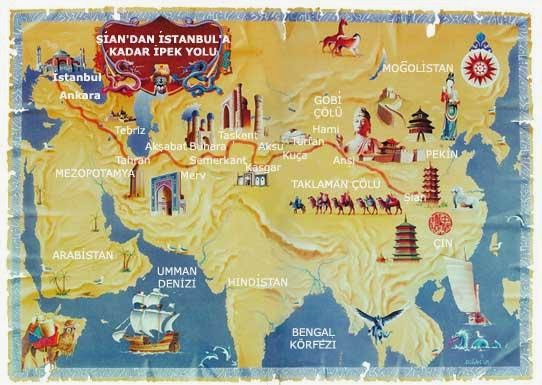
Khiva is an ancient civilization center established 2,500 years ago in the middle of the Karakum desert. It is at one of the crossroads of the Silk Road, near the Amuderya (Ceyhun) river, south of the Aral Sea. This city has been the apple of the eye of many Turkish states in history. As one of the eastern cities of the Oghuz Turks, it met with Islam since 712.

Khiva, one of the favorite cities of great states such as Ghaznavids, Seljuks and Shaybanids, was almost reborn from its ashes despite being destroyed by Cengizhan in 1220. The city, which has been the capital of the Khiva Khanate since 1598, preserves its ancient historical beauties with its wonderful architectural structures in the heart of Central Asia.

The magnificent city has a silhouette described in fairy tales. The night is different, the day is different. The snow that wraps like a wedding dress on turquoise domes in winter adds a different color to the city. The height of the walls, which shine like gold due to the sun’s rays in the summer, is an average of six meters. The length of the walls, which look like a golden necklace in the middle of the desert, is about 10 kilometers. There are four main gates to enter the city: Main Gate, Stone Gate, Garden Gate and Bukhara Gate. The names of the gates are almost like the gate names of the city walls in Istanbul. It is proof that members of the same civilization, such as Edirne Gate, Topkapi Gate, and Mevlana Gate, have similar feelings and thoughts when naming the place. On the other hand, these namings suggest that Istanbul and Khiva have been sister cities since eternity.

52 Meter height Minaret

When you enter the city from the Main Gate, you feel like you are in a dream. Because as soon as you enter, you encounter the magnificent 52-meter-high minaret of the Cuma Mosque and an extraordinary architectural sight. Cuma Mosque is a work of art with 215 wooden columns decorated with magnificent ceramics.

The Kohne Ark, the Old Palace, has an extraordinary architecture. Especially when you go to the terrace, the whole Hive is in front of your eyes. Wherever you look, you will encounter a magnificent ambiance and beauty. Terraces and minarets like these have always been a center of attraction for those who want to discover the secrets of Khiva. Even though the contemporary tourism explorers of ancient cities stay here for days and months to solve the mysteries of architecture when they arrive in Khiva, they still cannot escape the magic of the city.

Civilization Race

Throughout history, Khiva has been in the race for science and civilization in Bukhara. Khan of Khiva Muhammed Emin Khan attempts to build a minaret higher than the 70-meter-high Kalan Minaret in Bukhara, but once it reaches 29 meters, the project cannot be completed due to lack of budget.

Muhammed Emin Han had a magnificent madrasa built in Khiva in his name. The magnificent tiles on the tower-shaped chimneys of the madrasa display their extraordinary beauty towards the sky with almond and pigeon wing motifs in dark blue and blue. While visiting Khiva, which is famous for its palaces, madrasas and mosques, which is the product of centuries of civilization accumulation, you think that you are traveling in a time tunnel.

Khiva, the center of the Khwarezm region, was a frequent destination for all kinds of trade, as it was one of the important points of the caravans traveling on the Silk Road. It was a center where young male military candidates, who were a source of soldiers for Islamic states during the Middle Ages, gathered. From here, hundreds of young (ghulam) soldiers were sent to Baghdad, Damascus and Cairo every year. Nizamülmülk mentions how important these young people are in terms of military service in his famous work, Siyasetname. They are tall, physically strong and handsome, skilled in archery and unrivaled in horse riding. The caravans that came to Khiva from distant lands did not only do trade, but also carried cultural and civilizational values. They would take copies of the works of the great mathematicians and scientists of Khiva to scholars in other lands.

Historical works written in Khwarezm at XVII-XIX. centuries and at the beginning of the XX. century also provide a lot of information about the commercial relations of the Central Asian Khanates with Russia. In particular, the trade of Khiva and Bukhara caravans to Mangışlak, the adventurous movement of these caravans on the roads, the prevention of Bukhara caravans by Khiva soldiers from time to time, their looting, and the arrival of Russian caravans to Central Asian cities are discussed. The commercial relations that existed in the period after the Kungrad dynasty came to power are also discussed in detail.

High agricultural culture in Khwarezm was formed in ancient times on the basis of artificial irrigation and developed, as in Egypt, Mesopotamia and other countries of the East. This high culture has affected the survival and development of science and civilization values ​​in Khwarezm.

Khwarezm is one of the oldest cultural centers. In these lands, where scientists, poets and mystics made great contributions to the development of science, a national understanding of historiography emerged during the reign of the khans. The works written in this context mostly include the history of the Khiva Khans. However, it provides valuable information about the life and culture of the people of the region, and the economic and political situation of the Khanate. When these works are examined, it is seen that many scientists, historians, poets, painters and musicians grew up in Khwarezm. In Khwarezm, one of the great cultural centers of Central Asia, scholars such as Muhammed Musa al-Khwarizmi, Ebu Abdullah al-Khwarizmi, Abu Reyhan Muhammed al-Biruni grew up and enlightened humanity like a sun with their works.

The foundation of Mathematics was laid

Birûnî, like his predecessor Muhammed ibn Musa al-Khwarizmi, is one of the greatest scientists who founded Uzbek science. It is generally accepted that Harezmi laid the foundations of mathematics in the East, in the Turkish and Islamic world and later in Europe with his works. In this context, the strong influence of Birûnî in the following centuries also affected the development of science in the East.

Khwarezm is the birthplace of many poets and writers. Among the historians of Khwarezm, the works and names of Ebulgazi, Şir Muhammed Mûnis, Muhammed Rıza Agâhî, and Muhammed Yusuf Beyânî came to the fore.

Historians of the Khiva

XVII. Khwarezm historiography of the 19th century begins with the Khiva Khan and the historian Ebulgazi.

The tradition of writing historical works in the Uzbek language was widely continued in the Khiva Khanate, one of the Central Asian Khanates. Famous Uzbek poets and historians Şir Muhammad Mûnis and Muhammed Rıza Agâhî continued the work that Ebulgazi started in the 19th century. These great scholars and historians, in addition to writing the history of Khwarezm, also formed a certain school in this field. Muhammed Yusuf Beyânî, a famous historian and poet who lived in the 19th and early 20th centuries, continued this work. Representatives of this school of historiography not only wrote works on the history of Khwarezm, but also translated many historical works from other Eastern languages ​​into Uzbek.

Khiva is a distinguished city of Uzbekistan, which has values ​​and traditions with its people with the same qualifications. It is an open museum with its ancient architecture. The city, which is surrounded by walls built of earth-colored bricks that turn red when the sun’s rays hit, stands in the middle of the desert with all its nobility like a corner of paradise. The people living in the city are like the people of heaven, who are aware of the values ​​of the places they live in and make great efforts to keep their thousands of years old traditions alive.

When the historical artifacts in Khwarezm are examined, traces of civilization for nearly 3 thousand years are witnessed. Even in mosques and madrasas, motifs and decorations from pre-Christian civilizations can be seen. This situation proves that the Khiva has a close relationship with foreign cultures and civilizations, and that it has an open approach to universal values ​​for thousands of years in terms of science, art and civilization.

Hive, which has deep civilization values ​​in the past and is a center of culture and art today, was chosen as the “Cultural Capital of the Turkish World” in 2020. Programs that could not be done last year due to the effect of the pandemic have started again this year. Tourism programs to be held in Khiva this year are of particular importance.

It’s time to see the Hive.

@suleymankzltprk

Source: https://www.star.com.tr/acik-gorus/ipek-yolu-kervanlari-bilimin-de-tasiyicisiydi-haber-1650523/

Turkish Image in Europe

by Professor Erol Göka

Sociopsychology of European View of Turks [1]

[For Europe, Turks have been seen as “barbarians among us” for centuries. Germans, Normans, and Hungarians also came to Europe as invaders, but eventually integrated. The Arabs also resisted until they were expelled from Europe. The Russians were in a marginal position between assimilation and exclusion. Turks, on the other hand, took place only in their own part of Europe. They neither tried to impose their beliefs nor adopted Christianity. They were admired when they were strong, and hated when they were weak. Pushed from Europe for three hundred years, they could only hold on to its extreme and decided to “Westernize”. It is difficult to find another people who have had such a contradictory and confused relationship with Europe for so long. envy and resentment, Emotions arising from prejudices, such as fascination and fear, complicate the solution of the problem.] (Yerasimos, 2002: Foreword)

In general, it can be said that there is always a skeptical, timid, hesitant and unfriendly view towards “Turk” in Europe. This view is clearly felt in the social and political spheres all over Europe today. This view towards the Turks is actually a part of the general xenophobia in Europe and has been formed in a historical process that embodies the concept of “threatening foreigner”. This fact, ” hermeneutics” (hermeneutics)It falls within the scope of a psychodynamic approach as well as a historical understanding. Although there are racial, religious, economic and social dimensions of Turkish hostility in Europe, it is also necessary to take into account the elements of community psychology, which form the infrastructure of all of them and have a very old foundation.

In order to understand and interpret the psychological elements correctly, first of all, it is necessary to analyze the historical process of the European communities, which have removed the word “Europe” from being a word that defines only a geographical area, and the historical adventures of European communities, which have been able to meet on a common ground despite many differences among themselves.

Turkish: The “Other” That Europe is Using to Define Itself!

The origins of Europe’s encounter with and hostile attitude towards foreigners can be traced back to the 4th century AD. During the mass migrations that started in the 4th century and lasted until the 13th century and greatly affected Europe, the concept of “nation” did not exist in Europe yet, and the concept of foreigner was used to describe communities living outside the domain of Greek or Roman sovereignty in this period. With the beginning of the migration of tribes in 375, the Huns captured a significant part of Northern Europe and the European experienced the first concern of survival in the face of this threat. It was during this period that the European started to use the word “barbarian”, which is a phonetic equivalent of the “dark, aggressive human figure whose language he does not understand”, which comes to life in his imagination when the word “foreigner” is mentioned (Erdheim, 1984).

In the conditions of this period, Factors such as race, ethnicity and religion are not yet decisive in the acceptance of the Turk as a foreigner and the hostile attitude towards the Turk. During the migration of the Huns, Europe was the scene of many wars and massacres for about a hundred years, and “the very sight of them scares people, they can ride a horse very well, use weapons, are extremely brutal and aggressive” (Dollinger, 1999). caused fear and hostility to take root. It caused an indelible fear and hostility to take root in the minds of Europeans for centuries. It caused an indelible fear and hostility to take root in the minds of Europeans for centuries.

This article aims to examine how the European identity is formed by mediating the Turkish image. We include historical information only for this purpose. In order to understand the abstract conflict that has taken place between the “foreigner from afar”, that is, the “other” since their encounter with the Huns, the mentality of the Europeans must also be examined with the methods of group psychology, which we have discussed in this book. The theme of the “other” has so far occupied an extensive place in philosophy and sociology; whereas the subject is basically within the domain of psychology. For this reason, we would like to focus on how a psychological perspective can be useful for us in examining the formation and behavior of large group identity, and in addressing the problem of the “other”, by using the European encounter with the Turks as a means.

Redefineding International Relations in The Light of Psychology

In recent international relations publications, it has been suggested that the realistic approach, which argues that political decision is rational, makes macro-level analysis, and asserts that the main actor is the state, is out of date, and instead it is suggested that macro-level analysis and micro-level analyzes should be combined, events are multidimensional and cyclical, not just cause-effects. An approach has been proposed, which advocates understanding with the processes that are thought to be present and focusing on an interdisciplinary approach (Hudson, Vore, 2002). While there is an evolution in this direction in the discipline of international relations, micro-level, individual and “intrapsychic” (inside psychology) such as psychology and psychoanalysis. Studies investigating ethnic groups and nations, group-leader relations based on group processes have also increased in disciplines examining processes, and the knowledge in this field has begun to be used in the resolution of conflicts between large groups.

For example, the theories emerging from social psychology, in relation to international conflicts, against the arguments of the realist approach, “mutuality” in international relations. He brought propositions emphasizing the importance of human and human factor. According to them, international relations and especially conflicts are the result of the functioning of some psycho-social processes arising from the collective needs or fears of the communities, rather than a rational decision that emerges as a result of an objective evaluation.

Conflict in international relations is a phenomenon that operates in inter-communal processes rather than conflicts between states. International conflict does not arise because of the great harm caused by one side using force over the other, it consists of an alternating process between the two sides that has multiple phases and is shaped by mutual interaction. In addition, international conflicts are not a series of behaviors in which actors mutually influence and react to each other, but are self-replicating, provocative, it follows an interactive course with a multiplier dynamic (Kelman, Fisher, 2003).

From this point of view, it is possible to argue that psychology and psychoanalysis can be used, among other disciplines, to understand international conflicts that are seen to be effective at the international level (Volkan, 2005). Psychological and psychoanalytic analysis by avoiding psychological reductionism is thought to contribute greatly to understanding the conflicts that arise between large groups such as nations and ethnic groups (Göral, 2005).

Large group identity is the identity of the individuals who make up a group, internalized in the growth and socialization processes and intertwined with their personal identities, the existence and effects of which are not known when faced with a significant threat, but which are in fact as decisive as individual identity of “mental representations” that determineIt consists of a set of codes. In his “tent model”, Volkan (1995: p.40) envisions the large-group identity with an image on the clothing representing the individual identity of the person, with a tent cloth covering all the members of that group, and with the leader as the pole of the tent. This tent cloth actually brings individuals together under the “sense of we-ness”, creates a border between the outside and the inside of the tent, and protects the group against the threat from outside. However, if there is a tear in the canvas or a jolt in the pole, the group’s sense of we-ness increases and individuals perceive more clearly that they are living under a tent. Even in these situations of danger, large-group identity becomes more important than the personal identity of individuals.

In our opinion, Volkan’s understanding of the tent model is quite easy to understand and useful, but it does not shed sufficient light on the psychologically impulsive origins. In order to examine the psychology of the formation of a large group’s identity in more detail, the concept of “projective identification “, which we have included in the article “Projective Identity as a tool for comprehending human relations” in this book and which we have discussed with our friends elsewhere (Göka et al., 2004), is very useful. seems useful. Let us briefly recall the concept of projective identification.

“Object relations” in post-Freudian psychoanalysisMelanie Klein (1946), known as the founder of the theory, observed the effects of the infant’s experiences in her relationship with her mother, to the great existential anxiety created by her fragmented perceptual world, and formed a theory from the conceptualizations she came up with. Projective identification is one of the basic elements of this theory. Many perspectives on projective identification have been developed after Klein, and today the concept has risen to the level of one of the key concepts in understanding human relations, with more detailed observations, going far beyond the way it was first put forward, and enriched with other perspectives such as communication theory. The area defined by projective identification, It includes almost all human relations and covers the dynamics and communication types in early childhood of what we give and receive in relation to the other person and how we make this exchange.

Today, we can easily accept that projective identifications inevitably take place in our relationships, as we bring them with our human being, that is, they arise directly from our being human. Projective identification of being human, socialization, “self” (egoA well-understood understanding of the place of ) in the development processes and forms of relationship will contribute to the understanding of the nature of psychopathologies (mental disorders), psychotherapeutic (for the purpose of mental treatment) relationship and psychotherapy process, as well as many problems in human relations. Moreover, thanks to the efforts of other theorists who developed Klein’s view, projective identification will become indispensable in the development of the identities of large groups (community, community, institution, nation) and in understanding the relations they establish with each other.

According to Melani Klein’s first psychoanalytic conceptualization, projective identification is one of the defense mechanisms that human infants develop in order to cope with the difficulties they experience in the first months of their lives. The infant projects negative mental representations that are not yet integrated in order to survive and survive the destructive influence of the aggressive instinct inside. He lives them as if they are coming from outside. Man reflects the evil within himself to the outside by projection; He tries to get rid of it with the illusion that “I am not the bad one, he is”. It identifies the other person with the bad material it reflects. He begins to treat her as if she is suitable for the material he reflects, thus forcing him to accept this identity that he reflects, and often making him accept it. The reflections coming from the baby also play a major role in this behavior of the mother, who, feeling guilty, is eager to feed her baby as soon as possible.

The reason why post-Klein theorists argue that projective identification is valid in all kinds of human relations and in the identity formation of large groups and their relations with each other, based on this theory, is that they see the origins of our effort to get rid of the burden of negativities within ourselves and to impose them on the other person in order to create a purer identity for ourselves. . Humans and human groups always use this mechanism to which the human infant resorts. Indeed, projective identification plays an important role in the formation and development of nations as a large group. Establishing a sense of we-nessIn order to be one fist and gather around idealized features, the society must reflect the evil inside and create an enemy/evil outside.

If we go back to the mood of the European who came face to face with the Huns, which is our main subject: Based on the theory of projective identification, it can be said that Europe, which was incapable of ensuring its unity and agitated by the civil wars of the pagan tribes, for the long time leading up to the establishment of the Roman Empire, only struggled to survive in this process and kept the xenophobia that developed in parallel with this in community psychology.

While the Roman Empire politically brought the peoples of Europe together, it attained the core elements of a more institutional identity with which it would define itself together with European consciousness (and unconsciousness), Roman Law and Christianity. In the early periods of the Roman Empire, as mentioned earlier, the identities of those living within the empire’s borders were determined by ethnicity, race, and not defined by differences in religion. As Christianity became more and more the most important unifying factor, the definition of foreigner came to mean those who held both extra-imperial and non-Christian beliefs.

Later, with the Renaissance, adding Greek humanism and aesthetics to the unifying elements of Roman Law and Christianity, Europe had the chance to define its identity in a historical process. However, there is one more thing missing for the establishment of an identity, which is where to put the negativities in it, especially the elements related to violence and aggression. The solution to this problem of the European identity will come from the Hun attacks. Thanks to the Huns, who threatened its existence, the European established the “other” of his identity as Turks. In the same period, the victories of the Muslim Arabs against Europe also contribute to the formation of the European identity (Göka, 1999).

Thus, the image of “Muslim” was added to the image of “bad Turk” that started with the Huns, but with the Arab victories, the Turks began to push the gates of Europe again, this time as the leader and standard-bearer of Islam, so that the “Muslim” was no longer needed for the European and made the Muslim identical (Balivet, 2005: p.15).

European identity has now consolidated its “other” during the Crusades and Ottoman expansion. The Turkish image, which constitutes the “other” of the European identity throughout the process until today, will complete its existence for the European, reflect and convey all kinds of unsettling features in itself, It will serve as a psychological reservoir to which In order to create his own identity, the European will pour all the negative qualities in himself onto the Turkish image, clear himself of negativities, and perceive the Turkish reality by mixing it with this negative material that he reflects.

We have now reached the negotiation stage in the process of accession to the European Union. Obviously, the diplomatic language and international relations discourses do not allow the socio-psychological dimensions of the process to be sufficiently revealed. But this dimension is too important to be neglected. We tried to analyze what happened on the Turkish side in this process before (Göka, 2004). Now, in this article, as an introduction, we will focus on the Turkish image in Europe, which is the basis for Europeans to perceive Turks today. Let us consider the historical process in a little more detail this time.

New Thousand Years, Old “Other ”

The Europe of the new millennium is a continent where the majority of the people are extremely poor, live in very difficult conditions and face the danger of starvation. Resources are extremely limited and the productive class, exploited by landowners and warriors, is also spiritually exploited by priests (Huberman, 2000). In this period when people feel weak against the forces of nature and it is believed that God’s anger can cause various disasters, the church has an absolute importance in obtaining God’s approval. The church establishment uses it; it has great power and influence on people (Subaşı, 2002). As seen by the 1000s AD, there are extremely collective fears in Europe that hold the continent’s communities together; hunger, Besides disease and war, all kinds of strangers are also feared (Delumeau, 1985).

The behavior that has traditionally existed in Europe since the ancient empires, to devalue and humiliate all kinds of foreigners, to attribute to them being dangerous as well as all kinds of negative qualities, was shaped as a reflection of negative features such as sinfulness, ugliness and evil against their neighbors living on the same continent during this period. . People perceive the starting point of the borders of their own small country as the starting point of the “foreigner” and expect all kinds of threats and evil from those beyond these borders. Even among villagers and urban residents living in the same region, there are similar feelings of insecurity (Subaşı, 2002). When the superstitions of this period are examined, It can easily be seen that it is shaped according to such attitudes.

A stranger should look at the milk bucket with the belief that it will spoil the fertility, be in the same environment while milking or making butter, enter the kitchen or the barn, eat the crust, which is the most useful part of the bread, without meeting certain conditions (give the baby blessed water and say “God bless you”) it is strictly forbidden to touch it (see German Dictionary of Superstitions”). Moreover, foreigners are considered to be the harbingers of the plague and war, which was very feared at that time.

The foreigners mentioned here are the “local” foreigners who live side by side on the same continent, on the same land, and are neighbors of Europeans, and it can be said that these foreigners cannot have the same effect on the European as the Turks did. In addition to these, social fears fueled by the belief in the end of the world in the millennium and increasing the influence of the church on people also accelerate the situation. With the belief that the “enemy of Christianity” will emerge and that terrible peoples from far corners of the world will attack Europe, in line with what is written in the Bible, Europe has begun to wait for the arrival of its new fear (Glaser, 1999). The new foreign, non-Christian, remote, whose fear and hostility are defined, probably the attacker coming from the East is a foreigner (Subaşı, 2002).

For such reasons, Turks come first in the concept of “all kinds of foreigners” and the psychodynamic mechanism that Europeans will use against foreigners is shaped as projective identification. According to this; It is the Turks who suffer the most from the reflection of all kinds of negative features such as sinfulness, ugliness and evil; Because the Turks, who came from the steppes of Central Asia and started to spread from Anatolia to the West, were very different from both Arab, Iranian, Kurdish co-religionists and Christian communities. “Oddly enough, the Turk, who appears everywhere, is in many respects described in a very similar way by both Christian and Muslim sources. It is as if the ‘exoticism’ of the Turk is as clear as daylight for both Arab and Iranian allies and hostile Christians… One point that everyone unquestionably accepts is the value of the Turk as a warrior” (Balivet, 2005: p.19). There are many known accounts of medieval historians about these warrior qualities of the communities that first encountered the Turks.

Although the tolerant and just administration of the Turks in their powerful, hierarchical state causes admiration such as “Turkish oppression is a child rather than Arab justice” or “I prefer a Turk’s turban to a Latin headdress”, the main thing is hatred and fear from them.“When Turks refuse to give up their strong cultural differences and identities, which do not fully coincide with strict Muslim behavior, disagreements, misunderstandings and suspicions arise on the side of their coreligionists.

Moreover, it leads to a rift with the former Arab-Muslim powers of the Mediterranean, with Christians who have been accustomed for centuries to maintain a certain status quo, but who are not familiar with the customs of the steppe peoples. At that time, severe criticism and contemptuous exclusion that formed the negative Turkish image and that black portrait that would last throughout the Middle Ages and much later begins… A strong sense of identity, customs that bear the strong stamp of nomadism, war and Central Asian shamanism, distinguish Turkish peoples from time immemorial. are their distinctive qualities… These customs are; It continues after Islamization and is against Muslims who strictly adhere to the orders of religion; It does not bother the Turks, who, in addition to their Muslim names, retain their special nicknames that literally represent shamanic totems… Even though foreigners are startled by the peculiar customs and body language of the Turks, they have to obey them in order to make an alliance or a truce with them.”(Balivet, 2005:pp.25-27).

The languages of the Turks are strange, their physical appearance is foreign, their clothes and customs are strange.“Christian and Muslim sources are united in vilifying the identities of the Turks, which, depending on the situation, are found to be startling, even disgusting, and almost always threatening or frankly frightening… When speaking of Turks, ‘unconscious Turks’ (etrak-ı bi-idrak), ‘dirty Turks’ Greek, Armenian, Latin or Syriac writers join Arab and Persian writers who use derogatory terms such as (etrak-ı na-pak) with similar insults. Some speak of the Turkish ‘oppression’ and the ‘violence’ of the steppe peoples, others describe the Turks as ‘the devil’s people’, ‘bloodthirsty wild beasts’; while others emphasize the ‘barbarism of their way of life’… The greed, ruthlessness, sold-out, disloyalty, etc. of the Turk, who raids only to gain loot and material wealth, etc. often emphasized(Balivet, 2005: pp.31-34, p.58). Yes, an “other” has been found again, to which the European can pour all his evils for the construction of identity.

When it comes to Europe of the Middle Ages, with the definition of the concept of the foreigner, the view of the foreigner has also undergone a transformation. Due to the importance of the notion of religion with the stronger “other”, the feared foreigner in Medieval Europe is this time “non-Christian”.

Among these, it is Muslims who threaten Europe’s material and spiritual existence the most, and although the fear of Muslims was against the whole understanding represented by the Arab tribe, as it was mentioned before, the real fear of Muslims is literally “Eastern”, which Europe recognizes in the migration of tribes.

It was embodied by the threat of “Muslim Turks” along with the figure of the “aggressive man coming from By reusing the European primitive psychic mechanisms, he identified the distant foreigner as the scapegoat for his inability to establish his own internal integrity, and with the Seljuk Turks’ capture of Jerusalem in 1076, He was able to establish the first unity and alliance in his history against the “other” he defined as “Muslim Turk”.

Thus, in the 12th and 13th centuries, Europe established the unity it had never been able to establish in its history in the form of the “Christian European People” against the “Muslim other” – that is, the Turks – and the new projective identification process that started on this occasion lasted from 1147 to 1270. During the 6th Crusade, which was the first time, the barbarian was the greatest comforter of the Europeans in legitimizing all kinds of atrocities against foreigners.

In addition, Europe has hardened its attitude towards non-believers within itself, and has started to slaughter Jews in the continent in addition to the Crusades it has been carrying out against foreigners (Subaşı, 2002).In the 12th and 13th centuries, the new projective identification process that started with the “Christian European People” against the “Muslim other” – that is, the Turks – that it could never establish until that time in its history, and the 6 Crusaders that lasted from 1147 to 1270.

Throughout his expedition, he was the European’s greatest comforter in legitimizing all his atrocities against the barbarian foreigner. In addition, Europe has hardened its attitude towards non-believers within itself, and has started to slaughter Jews in the continent, in addition to the Crusades it has been carrying out against foreigners (Subaşı, 2002).During the 6 Crusades that lasted from 1147 to 1270, the barbarian was the European’s greatest comforter in legitimizing all his atrocities against the foreigner. In addition, Europe has hardened its attitude towards non-believers within itself, and has started to slaughter Jews in the continent in addition to the Crusades it has been carrying out against foreigners (Subaşı, 2002).

Social classes that became evident in the 19th century with the migration of exploited peasants from the countryside and the emergence of craftsmanship as a new source of income; new occupational groups such as artisans, craftsmen and merchants began to emerge. With the establishment of towns and urbanization in parallel with these developments, Jews began to operate predominantly in the listed occupational groups (Pirenne, 2002).

The Jews, who started to increase their influence in social life, were targeted by the Church as enemies of religion and those who sucked the blood of the people; they were forced to change their religion, to be baptized, and a large number of Jews who did not accept these were either massacred or forced to commit suicide (Subaşı, 2002). In this period, against the Jews who were excluded from social life in the 12th century and started to live in the ghettos of the cities.

The definition of “inner foreigner” in Europe took the form of a definite exclusion from social life, with the introduction of strict rules such as wearing signs indicating that they were Jewish on their clothes. It can be said that the prototypes of the systematic, organized and institutional coercion and oppression applied against the foreigner in Europe in the Nazi era were already visualized long ago, 8 centuries ago. Europe, not content with such exclusion, blamed the Jews for the social disasters and punished the Jews by burning them or expelling them from their countries, on the grounds that they caused the great plague epidemic that took place in the 14th century (Fried, 1999). The fact that he reflects bad qualities by putting himself in a bad mood has further developed his insecurity.

Centuries of Accumulation: Foreigners That Need To Be Exterminated

By the turn of the century, Christianity was now literally the sole and common unifying element of European societies, above all differences. The Church, with the help of historical enmity accumulation, shows Judaism and Islam as the biggest threat in this period. According to the Church, these foreigners who are “anti-Christians”, whether they come from within or outside of society, must be destroyed or converted before the Empire of God can be established. For these reasons, not only Jews and Muslims, but also scientists with discoveries other than Christian teachings or countless women accused of witchcraft were massacred and targeted by the Church or the public (Subaşı, 2002).

The 15th and 17th centuries were the periods when Europe saw the Muslim Turks as the greatest threat. Beginning with the Ottoman advance in the Balkans in the 15th century, Europe’s concerns for survival in the face of this “aggressive foreigner from the East” re-emerged. Modern Europe will perceive the Ottomans in the same way as the West perceived the Turk in the Middle Ages: the dangerous enemy to be feared and to be eliminated, to be feared. However, behind this fear and hostility, there is often a certain admiration.

The following words of the Austrian ambassador in Istanbul in 1560 reveal everything clearly:“When I compare the Turkish system with ours, I shudder to think about the future… On the Turks’ side are the resources of a mighty empire, the experience and training of war, experienced soldiers, familiarity with victory, frugality and prudence. On our side, there is general poverty, personal wealth, powerlessness, impaired faith, lack of tolerance and education. Our soldiers are disobedient, our officers are greedy, they do not care about discipline; dishonesty, recklessness and immorality are knee-deep… Since nobility, offices and ministries are the rewards of talent and virtue among the Turks, deceitful, lazy and sluggish never rise; They are respected and despised: these are the reasons why the Turks succeed in whatever they do, become the superior race, and expand their reign day by day. Our methods are very different. We do not attach any importance to virtues. It all depends on soy. This is the only way to reach high positions. I could talk more about this elsewhere. You should not share what I have said with anyone, you should keep it to yourself.”(Busbecq, 2002: pp.61-62; pp.103-104).

With the conquest of Constantinople in 1453, Europe fell into a complete depression, and the economic and cultural systems that sustained it were faced with the threat of collapse. Indeed, the conquest of Constantinople, the capture of the metropolis is a theme that will never be erased from the identity-forming memory of the West. After Iznik, Antakya and Jerusalem, the conquest of Constantinople by the Muslims is the greatest trauma for the Western consciousness (and unconscious). People lament after this trauma and rituals are held in churches. The theme of the fall of the metropolises as a literary or religious inspiration, a subject of political thought or a sign of apocalypse was especially engraved in the memories of the Middle Ages. As contemporary reflections of this intellectual field about identity, The Greek-Orthodox megali idea, which focuses on the retake of Constantinople, or the Israeli-Arab conflict over the ownership of Jerusalem can be cited as an example (Balivet, 2005: p.88).

One of the important roles of the Turks’ capture of Constantinople in the construction of the European identity is that they were thought of as Trojans and that Mehmet the Conqueror said, “In the past, Greeks, Macedonians, Thessalians, Peloponnesians destroyed these places, after all this time they were often unfairly treated. and I avenged the Asians they persecuted by punishing their grandchildren”. After the conquest of Constantinople, the European consciousness will compare the Turks with the Romans, and the belief that these warlike, contented people who take care of their subjects can establish a universal monarchy will settle in the unconscious of the people, starting with the observations of the travelers (Yerasimos, 2002: p.23).

In the 16th and 16th centuries, both the migration of European peasants to the lands under the rule of Turks, who had a more just and soft administration understanding, and the conversion of thousands of Europeans to Islam, the European view of Turks became more hostile and it was a material and moral threat, It has caused him to see himself as an aggressor who needs to be united against. Realizing the brutal and exploitative aspects of its own feudal order, Europe found the solution by reflecting these to the other side and tried to achieve its cohesion in this period with this reflection. In addition to all these, some geographers, historians, travelers and diplomats emphasized the positive aspects of the Ottoman Empire in their works on the Ottoman Empire, It deepened the fear of the Church, which felt responsible for ensuring the integrity of Europe, and forced it to take new steps.

In the face of this great and serious threat that it could not cope with, the Church invited all Christians to pray to God every day to ask for help against the Ottomans, and even to ring the Turkish bells at certain times of the day in some parts of Europe to remind the danger and keep people constantly on alert. implemented the application. While all this is being done, Europe is unanimous that the Turk is a threat, but beyond that, European dignitaries have a more important concern: how the European people recognize the Turk… Because now the “aggressive man from the East” is destroying the existence of Europe. threatens both the substance and the mana platform. Then reflection will come into play again. After the Mohac War, the Ottoman sultan had 2000 cut heads erected in front of his tent as a sign of victory.

Integration against a common enemy has been tried to be achieved by creating a common concern (Delumeau, 1985; Dollinger, 1999).Integration against a common enemy has been tried to be achieved by creating a common concern (Delumeau, 1985; Dollinger, 1999).Integration against a common enemy has been tried to be achieved by creating a common concern (Delumeau, 1985; Dollinger, 1999).

This great fear of Turks in Europe; it is a fear that has been processed by the church elders and inflated with various methods and for certain purposes (Subaşı, 2002). This mechanism shows that the “other” called “Turk” played the main role in ensuring the unity of Europe in the Middle Ages. This “unity against the dangerous other” behavior was effective even in the 16th century, when sectarian quarrels began to take place in Europe. Sultan Suleiman’s First Siege of Vienna failed and during the stagnation period of the Ottoman Empire, Europe started to make progress in the technical and cultural field, but the “Muslim Turk” remained indifferent to these advances that would shape the world civilization. The defeat of the Second Siege of Vienna in 1683, in the memory of the European.

It has a place as the salvation of Christianity and all European culture.  In the period between the end of the 16th century and the beginning of the 18th century, this role given to the Turks came to an end, the faults of the Turks were examined rather than their virtues, and their Eastern customs were criticized. From the Turkish type, which was admired as much as feared, to the Turkish type, which was hated as much as it was despised. It is clear that this change is a result of the decline of the Ottoman Empire and the rise of Europe (Yerasimos, 2002: p.30).It is clear that this change is a result of the decline of the Ottoman Empire and the rise of Europe (Yerasimos, 2002: p.30).It is clear that this change is a result of the decline of the Ottoman Empire and the rise of Europe (Yerasimos, 2002: p.30).

Another important development that emerged in Europe in the 19th century is the emergence of the concept of “nation”. The Ottoman Empire, on the other hand, started to weaken in the same period; The Turkish image was identified with the “sick man” in the eyes of the Westerners, and it began to be perceived as a foreign object that caused severe national crises due to its weakness in Europe. It was realized at that time that there would not be a single European empire in the era of nation-states, and that many nation-states would emerge, and a structuring accordingly began. With nationalism, which is the official ideology of the nation-states age, nations have competed with each other, even sectarian wars have become power struggles and moves to come of age.

Europe, which sought the “other” after the advance of the “aggressive man from the east” stopped, this time, it went into divisions within itself, and after each division, it produced new foreigners for itself and started to reflect on these foreigners that it had created within itself for centuries. After the 1650s, that is, after the emergence of the social structures that laid the foundation for the establishment of nation-states, new definitions of foreigners were made with the social and political conditions of the period (Schöneberg, 1987; Wagner, Zick, 1993). “Stranger” is now defined from the perspective of ethnocentrism. Undoubtedly, within this definition, Turks are still foreigners, but due to their lack of threatening power, Turks were seen as a “neutralized enemy” at that time.

The economic infrastructure of the nation-state age is industrial capitalism. The machinery of capitalism operating in the infrastructure in Europe will plunge the society into sharp class conflicts in the form of bourgeois and proletariat. In this period, reflection came into play again, the feelings of hatred and enmity between the classes within the country were again reflected on the “foreigner”, and this defense mechanism, this time, served the functioning of capitalism and paved the way for the outbreak of two world wars (Claussen, 1994). Indeed, it is possible to find the hatred and enmity projected on the Turks in all of the Enlightenment thinkers in this period, and this is very sad.“Thus, the image of the Turk in the minds of the West has turned into a harmful entity that should no longer live.  From now on, the era in which the Turks are models will come to an end and the West will believe in its own universality. Pascal writes, ‘How painful it is to meet so many unbelieving and infidel Turks who practice what they saw from their ancestors’” (Yerasimos, 2002: p.32). Anti-Turkish sentences emerge from the pen of Diderot, Montesquieu, Voltaire, Chateaubriand and Hugo; In this period, the Turk turns into a scapegoat, on which the sins of the West are burdened and must be sent to the depths of Asia.

The ideals of the Enlightenment period, which started in the 18th century in Europe and added a new dimension to the return to Greek humanism in the Renaissance and Reformation Movements, and the concepts of freedom, equality, fraternity, science and technology, which came to the fore with the French Revolution, are the new symbols of modernity and Europe.  European-origin modernity creates an aura of attraction all over the world and spreads rapidly. However, this aura of attraction is also combined with hostile feelings towards Europe, which is trying to spread modernity through colonial methods. European-origin modernity could not bring peace, freedom and brotherhood to the world, on the contrary, it increased tensions and conflicts and caused two great wars to break out around the world.

Therefore, modernity, which affects the whole world, does not have a positive effect on the functioning of European consciousness. The power gained from the developments in science and technology has led to the invasion of a scientistic, positivist ideology in the minds of the European people and racist theories that see the rest of the world as primitive-savages. With this theory, white Europeans are declared the highest of creations, and the European lifestyle and civilization are accepted as the pinnacle of human history. Along with these acceptances, new definitions of foreigners emerged: non-white Europeans; those who are behind or below Europeans in terms of culture and civilization, intellectual abilities and even spiritual values; that is, the rest of the world’s people. The position of the European against these foreigners; congenital, biological and genetic, depending on its natural superiority, it is the authoritative, “master” position that knows “right” to dominate and exploit secretly and openly.

While it is claimed that whites take on the role of “missionary” against other races that are “less civilized”, in fact, the economic goals of colonialism are educational, religious, etc. It was tried to be covered with the understanding of “mission” (Egger, 1994). Turks are also one of the races that oppose all kinds of progress, are psychologically inferior and will never be able to get rid of this quality. European anthropology sees Turks as a primitive people, devoid of all kinds of pleasure, indifferent to all kinds of arts, lazy, insensitive, incapable of doing anything, and indulging in the most disgusting pleasures, and Turkish as a primitive language (Yerasimos, 2002: pp.41-42) .1994). Turks are also one of the races that oppose all kinds of progress, are psychologically inferior and will never be able to get rid of this quality. European anthropology sees Turks as a primitive people, devoid of all kinds of pleasure, indifferent to all kinds of arts, lazy, apathetic, incapable of doing anything, and indulging in the most disgusting pleasures, and Turkish as a primitive language (Yerasimos, 2002: pp.41-42) .1994). Turks are also one of the races that oppose all kinds of progress, are psychologically inferior and will never be able to get rid of this quality.

European anthropology sees Turks as a primitive people, devoid of all kinds of pleasure, indifferent to all kinds of arts, lazy, apathetic, incapable of doing anything, and indulging in the most disgusting pleasures, and Turkish as a primitive language (Yerasimos, 2002: pp.41-42) .“The primitive Turk will always remain at the level of an animal. He is a civilized savage. If you scrape off the outer polish, you’ll find the Tatar underneath. Education cannot quench his wilderness.” “The Turkish empire is worse than reactionary and is a phenomenon against history. It has always been and always will be a land of war.

Turks are real Huns who are descended from Genghis Khan, Tamerlane and Atilla. Their lifestyle is always militaristic, so they can never look at the world differently. Their dominance is based on slavery, concubinage in their homes and harems, on the enslavement of non-Turkish non-Muslim races. They maintain their dominance through wars and massacres.” “Turks are indeed very low on the intelligence level chart… History has shown us that Turks do not have the capacity for intelligence. That’s why they can’t rule the country. How can qualified peoples like Indians and Egyptians listen to the advice of the uncivilized Turk? A Turk cannot be a leader, he is completely incompetent and his mental faculties are not developed. (cited by Yerasimos, 2002: pp.43-44).

With this definition of foreigner, another legitimation has been made and this legitimation effort has saved Europe from the conflict of contradictions with the values it has produced, a new conflict of values and interests, by reflecting some inferior qualities to the “other”. Racism, which flourished on this very fertile ground, and defining the foreigner in an ethnocentric way became an integral part of the European view and hostility towards foreigners since the 19th century, and this situation has now reached its zenith in the 20th century.

The European, who looks at the Turkish with the turn of the century, is happy to see that the reflections he has made for centuries work. The Ottoman Empire, which was disintegrated after suffering a heavy defeat in the First World War, brought the Christian elements to join Europe and the European consciousness, on the one hand, and on the other hand, it led to the revival of the image of the “cruel Turk”. The Turks, who fell in love with re-establishing a modern republic from the ashes of the empire, evoked mixed feelings in the European consciousness. They are still standing, and this greatly angers the European consciousness:“The European mentality draws conclusions from data by observing and examining objects in their own environment.

But what to do when it comes to a special race like the Turks and a special country like Turkey? Is it possible to talk about a homogeneous nation with a language, history, customs and traditions that come from the same root, in short, whose homeland is Turkey? Never, never has it been, and never will be.”(as cited in Yerasimos, 2002: p.40). However, the fact that the Turks adopt modernization as an ideal, and especially that some of them call the modernization process “Westernization”, pleases the Europeans and satisfies the European egos.

The fact that European scientists are so eager to do research on Turkish modernization and that these studies attract great attention is because the inferior qualities reflected in the reflection process are accepted by the reflector and their internalization shows that the reflector achieves his goal. However, this situation did not change Europe’s perception of Turks as foreigners and threats. The Turk, who entered Europe with force, coercion and threat yesterday, has started to enter this geography this time with the invitation of Europe itself; Europe is now the “door to the hand in need”. Along with the Turks who went to Europe as workers in the 1960s, Europe perceived the Turk as a different threat this time and fell into the idea that he had entered into its body as a Trojan horse that carried the accumulation of centuries. This time, the concept of “foreigner outside” has left its place to a concept of “foreign inside”, which has been redefined especially for Turks, due to the large number of immigrants from Turkey in this period.

This period’s conceptualization of the inside brought along the risk of destroying the culture of the Europeans and the civilization they had built over the centuries. After the Second Vienna Defeat, the hostility against the Turks eased, and it flared up again as the Turks entered Europe, this time in a different way. Turks, who became the target of neo-Nazi movements in Germany, especially in the 90s,have been subjected to deliberate exclusion culturally and politically. Again, the European chose the way of relaxation by reflecting his own brutality and phobias on Turks without any difficulty, with a habit from history.

Meanwhile, with the collapse of the bipolar world in the same period, the balance established between the capitalist and socialist camp has been disrupted, and a new need for the “other” has emerged for the entire West. September 11, 2001 is a milestone declaring this new “other”; It is now clear that the new “other” is “Islamic terrorism”. When we look at our subject from the perspective of Europe, we see that the discourse of Islamic terrorism reinforces the already negative Turkish image in Europe. The foreign enemy within Europe, It is not only Turks but all Muslims, but historical memory and the European Union process that has been underway for a while brings the Turks to the fore again. For the European, the sure way to get rid of the Turks cannot be found.

Turks who want to join the European Union are nothing but the growing danger of the “foreign inside” in the eyes of the European who has such a historical background about themselves. Even in these difficult situations, the Turks once again left Europe with a stalemate. The projective identification mechanism that the European has operated throughout its history has become useless because of the Turks’ attitudes that do not care at all about the material projected to them and follow their own way.

The European consciousness is concerned about not finding a new solution for itself. With the Turks’ demand to enter the European Union coming to their doorstep, they do not know what to do in the face of this situation where the old mechanisms do not work, but on the other hand, the traces of the old hostility and fears cannot be erased. If he throws the Turks into himself, he has to vomit his old projections and project his own negative sides to someone else (for example, the USA). If it fails to achieve a new process of reflection and self-locking, the result is utterly disastrous.

Again, a Europe facing the threat of its own integrity, and the former scapegoat Turks as the reason for this… The stage today is no longer the battlefields, but the negotiation tables.

[1] This article, originally published with the title “From the battlefields to the negotiation tables: The Turkish image in Europe” (with Dr. M. Beyazyüz, with Dr. FV Yüksel- Türkiye Diary, Fall 2005, 82: 5-18.) was later published. Then it was rearranged and included in the 2006 edition of the book “Human Part, Part” published by Aşina Kitaplar. It was removed from the book with the arrangement made during the publication of the book by Vadi Publishing in 2019. The text you are reading is from 2006.
Source: http://www.erolgoka.net/avrupada-turk-imgesi/

RESOURCES

Alman Batıl İnançları Sözlüğü. Handwörterbuch des Deutschen Aberglaubens. (1984). Berlin und Leipzig (1928), zit. in: Fremd ist der, der heute kommt und morgen bleibt“, Integration, Bayaz A, Damolin M, Ernst H (Hrsg), Beltz Verlag, Weinheim und Basel. (Aktaran Subaşı,  2002).

Balivet M. (2005). Ortaçağda Türkler.   Güntekin E. çeviren.  İstanbul, Alkım Yayınları.

Busbecq O. G. (2002). Türk Mektupları.  Özkan H. çeviren. İstanbul, Ark Kitapları.

Claussen D.(1994). Was heißt Rassismus?, Wissenschaftliche Buchgesellschaft, Darmstadt. (Aktaran Subaşı,  2002).

Delumeau J. (1985). Angst im Abendland – Die Geschichte kollektiver Ängste im Europa des 14.-18. Jhdt’s. Reinbek, Hamburg. (Aktaran Subaşı,  2002).

Dollinger H. (1999). Schwarzbuch der Weltgeschichte. 5000 Jahre der Mensch des Menschen Feind. Komet, Frechen. (Aktaran Subaşı,  2002).

Egger A. (1994). Rassismus und Ethnozentrismus- Beobachtungen und Reflektionen. In: Fuchs G, Schratz M (Hrsg): Interkulturelles Zusammenleben- aber wie?, Österreichischer Studien Verlag, Innsbruck. (Aktaran Subaşı,  2002).

Erdheim M. (1984). Fremd ist der, der heute kommt und morgen bleibt. In: Bayaz A, Damolin M, Ernst H (Hrsg), Integration-Anpassung an die Deutschen?, Beltz Verlag, Weinheim. (Aktaran Subaşı,  2002).

Fried J. (1999). Endzeiterwartung und Fortschritt. In: Tausend Jahre Abendland-Die grossen Umbrüche. Suhrkamp Verlag, Frankfurt am Main. (Aktaran Subaşı,  2002).

Glaser H. (1999). 1000-Europa erwacht. In: Tausend Jahre Abendland-Die grossen Umbrüche. Suhrkamp Verlag, Frankfurt am Main. (Aktaran Subaşı,  2002).

Göka E. (1999). Helsinki’den sonra Avrupa’yı düşünmek. Avrasya Dosyası  5:4: 248-266.

Göka E. (2004). Avrupa Avrupa duy sesimizi: AB karşısında Türkiye’nin kültürel ve psikolojik konumu. Euro Agenda Avrupa Günlüğü  3:5: 231-249.

Göka E., Göral S., F.V. Yüksel. (2004). Birbirimize ne yapıyoruz? İnsan ilişkilerini kavramanın bir aracı olarak yansıtmalı özdeşim. Avrasya Dosyası  10:1:279-315.

Göral S. (2005). Türk Ermeni meselesi:  Mağduriyet psikolojisi ve büyük-grup kimliği. Stratejik Analiz  6:66:89-96.

Huberman L. (2000). Feodal Toplumdan Yirminci Yüzyıla. İstanbul, İletişim Yayınları.

Hudson V.M., Vore C.S. Vore, (2002). Dış politika analizinin dünü, bugünü ve yarını. Göka E. Kuşçu I. derleyenler. “luslararası İlişkilerin Psikolojisi” içinde. Ankara, ASAM Yayınları .

Kelman H., Fisher R. (2003). Conflict analysis and resolution. Sears D., Huddy L., Jervis R. derleyenler. “Oxford Handbook of Political Psychology” içinde. New York,  Oxford University Press,ss.316- 320.

Klein M. (1946). Notes on some schizoid mechanisms.  International Journal of Psychoanalysis  27: 99- 110.

Pirene H. (2002). Ortaçağ Kentleri. İstanbul, İletişim Yayınları .

Schöneberg U. (1987). Gruppenpsychologische Hintergründe der Fremdenangst und Fremdenfeindlichkeit. In: Ausländer und Massenmedien. Bestandsaufnahme und Perspektiven. Bundeszentrale für politische Bildung. Band 253, Bonn. (Aktaran Subaşı,  2002).

Subaşı, Ç. B. (2002).  1000’den 2000’e tarihsel süreç içinde Avrupa’da yabancı düşmanlığı. Stratejik Analiz  7: 27: 144-154

Volkan V.D. (1999). Kanbağı Etnik Gururdan Etnik Teröre. İstanbul, Bağlam Yayınları.

Volkan V.D. (2005). Uluslararası ilişkilerde psikanaliz ve psikanalizde uluslararası ilişkiler. “1. Psikanaliz ve diplomasi arası işbirliğinde engeller”  Stratejik Analiz  6:62:52-57.

Wagner U,  Zick A. (1993). Den Türken geht es besser als uns. In: Psychologie Heute 7. (Aktaran Subaşı,  2002).

Yerasimos S. (2002). Ne Mutlu Türk’üm Diyene. Yerasimos S. yayına hazırlayan. “Türkler: Doğu ve Batı, İslam ve Laiklik” içinde. İstanbul, Doruk yayınları, ss.15-57.


Turkey and Humanity: Being Clear Like Water, Being Exciting Like Water, and Being Saintly Like Water…

By Recep Ali Topçu – Adell Armature&Valve Factories Inc. | Chairman of the Board

Copyright photo by Levent Ağaoğlu, Danube River bank at Russe, Bulgaria.


Water as an inspiration in the journey of becoming a human being that leaves a mark …

There is a nice saying. Man becomes human when he is, not when he is born. Man is human to the extent that he is enlightened and enlightens the people around him. Every living thing wants to develop and evolve.

Life is a journey of evolution. Life is walking, life is development, life is entrusted. We always have a desire to rise materially and spiritually in life.

It is in our hands to improve our enlightenment process, our life journey. If we do not start by raising our own quality and building our own personality, we cannot do anything. So how can we be bright people? How can we light our way? What do bright people have in common? Who and what should we look for while determining our road map in our walk to light and enlightenment? Who should we sample from? How should we calibrate ourselves?

Right here, we encounter water, our indispensable source of life, our raw material, our essence. Water is indispensable for enlightening our spiritual world as well as our biological life. Our main ingredient. What can we learn from luminous water in order to be a bright person? Let’s try to find answers to these questions together, inspired by the water, our source of life, returning to our core values, making them valuable, feeling like water. I believe that it will not be very difficult to reveal these values ​​that are in our essence and to make them livable, and it will take us to the top of the steps of humanity, and will make us distance in the journey of the perfect human.

Regardless of where we are in this world where we are our guests, our priority should be to be a quality person once. One of the most beautiful sources of inspiration that we can take advantage of and learn from while achieving our goal of being a quality person is water. We know that water is one of the most important and beautiful gifts that our Almighty Creator has sent for us, the guests of the world. When we get to know him, we will realize that he has many lessons we will take.

There are many lessons we can learn from water …

Water is indispensable and the source of life. Man and all living things were created from water. The universe was raised with water. From time immemorial the reason for existence has been water. The survival of living beings also depends on water. It is the life water of the first tree planted. Water is the life elixir of the creature thirsty in the desert. Every drop of water is precious. No matter what we drink except water, we cannot quench our thirst. Creatures that lack water wither and lose their vitality. Drained trees die as well as deaths in humans. Like water, we must learn to penetrate the veins of people, bring it to life and be indispensable. What are we sources of as humans? Will people feel a lack if we leave our environment? I wonder which works and which operations cannot be completed without us? What solutions are we part of? By increasing our qualities, repositioning ourselves in terms of being valuable and valuing, will bring beauty to ourselves, our institutions, our country and the whole humanity.

Water, which is the source of life, is clear, transparent, clear, inside and out, its essence and word is one. Therefore, while we are going to our goal of being a quality person, it is necessary to be pure like water, to unite our inside-outside, our actions and our discourse, and to reach integrity. The way to ensure trust and stability is through the unity and integrity of internal and external action and discourse. Openness, transparency and reality are among the most important values ​​of today. Sincerity, sincerity is one of the most beautiful universal human values ​​that crystallize and clarify our world. The curtains do not act on the things behind them. Those who have these values ​​are valuable. It becomes worthless over time without values. The combination of discourse and action makes us valuable.

When the water comes, it makes you happy, when it leaves, it hurts. Its existence is the source of life. Everywhere the water steps is refreshed and beautiful. When it comes, it brings life to the thirsty plant, the thirsty animal in the desert, and the human being. With his arrival the joy skyrockets. Trees rejoice, celebrate, open their leaves, wear their green clothes. The earth rejoices and turns into a green cover. The seed rejoices and bursts out of the ground.

What should we, as humans, do to make us happy when we come and sadden when we go? Can we beautify the place where we take a step? The person who delights when he comes is oxygen, he is a positive, bright-spirited, bright-faced, energetic and decent person. It illuminates the place it comes from, the heart it enters, makes it happy, expands the atmosphere and makes everyone happy with its arrival, and leaves a mark when it leaves. However, people with negative spirits darken their environment and bored people and environments. Our dark world needs light people, bright faces and bright faces. When they go, they are happy and leave a work, not a trace. What can we add to where we come from? What do we leave when we go, trace or work?

Water is of good quality. The quality line is always the same. It is not variable. Sometimes it is, sometimes it is not. We should strive to carry this feature of our raw materials, we should have a personality with values ​​and definite lines.

Water beautifies the place it comes from, refreshes, enlivens, makes it green, makes it happy, and establishes civilization. Human beings have the task of beautifying their immediate surroundings, streets, avenues and our world, starting from within themselves just like water. When we question ourselves, are we a part of the beauty of the world or, on the contrary, are we in the problem, part of it?

The water does not disappear where it goes and comes from, after fulfilling its duty and responsibility, it evaporates and returns to where it came from, that is, the sky. As human beings, we can produce works and leave traces that will not disappear where we come and go.

Water has a memory, soul and consciousness. He understands the love and attention offered to him and gives a voice to it. Water receives positive and negative information around it and reacts accordingly. If the molecules of the water can distinguish between those who love and those who do not, we need to be a bridge between these people. If the water responds to what is said to him, is it possible that a person who is a piece of water does not respond to a beautiful word or sweet language? We say sweet tongue takes the snake out of its hole. Can we reflect the love given to us to the people and animals we have relationships with, and make them happy?

Can we act in the center of love, increase our capacity of love and include all people, animals, plants, nature and the environment in our scope?

Water is love, love, beloved. The water of our heartland is love. Dear people, nice words cherish people in hearts. A sip of love that we sincerely give to each other will return to us an armful. The fire of love in us wipes out all hate. It is nice to be a brick by using love as a mortar in the newly formed structure of the world. It is love that gives meaning to life.

The body where water is located is the source of warmth for its place. The human being is created as a drop of water, the human skin sensations carry warmth, providing warmth to the body as long as water is present. With death taking place and water withdrawing from the human body, the body cools, solidifies and hardens. It is the water that gives people warmth and vitality. We, too, must warm the way we enter into dialogue, the environments with our warm, heart and hypnotic expressions.

Water is generous, it always gives. By looking at the water, we should share some of what our Mawla gave us with other people, living things and plants, we should be generous.

Water is unifying, rejuvenating, water embracing. Since water is a community of people, animals and trees have been meeting and meeting points. Water does not discriminate between those who come to it, it is a democrat. He approaches everyone at an equal distance, has no prejudice. It provides unity in essence. Water does not discriminate against the people, living things and plants it serves, and behaves equally. Serving all people, animals and plants without distinction of color, language, religion, geography, and its balanced and harmonious behavior give a message of tolerance and uniting. When we treat all humanity and living things equally, we can be a winner just like water. Can we create a meeting point between our existence and people?

Continuity is essential in water. It is fluid, not broken. Water always flows and flows. It is the continuity of raindrops that makes streams into the world. Sometimes there are waves, sometimes drops, sometimes sweet, sometimes salty, it becomes rain, it becomes a river, it flows. When the drops accumulate, it becomes anticipated. In order for us to be successful as human beings, we must be stable, orderly and maintain continuity in our work and relationships that we feel like water. It is not the drops of water that pierces the marble, but its continuity.

Water flows, finds its way. It is important to find the right path. Roads are precious as life, gentle as life. They either consume life or add life to life. Some are straight, some are curved roads, some are deflecting roads, some are straight, some are curved roads. Every being has a way, every road has an end. The paths entered usually determine the results and the situation beyond. We can only become successful in life by taking the right way.

Water carries the energy of the source it originates from, the rock it touches, and the leaf it licks. Biologically, people have become a source of peace in their souls and souls with the energy they carry, as they are means of being. As human beings, which of the universal human values ​​do we carry, to whom do we charge energy?

Water is determined, does not tire, does not give up. If there is an infiltration even on the 10th floor in order to reach the land that it is in love with, how can it do it, eventually it will go down. Though the softest and thinnest, nothing can dissolve hard and hard things like large rocks as well as water. We will be more successful in life if we are determined, determined and willing in life. We don’t get stuck in small bumps and holes

The water has a natural beauty, it is sparkling. He is happy. It can be in three forms as solid, liquid and gas. Inspired by our essence, water, we should love our natural state given to us in creation and be happy with it. We should strive to live the beauty of living our lives with what we have and what is deemed appropriate for us, not caring about the physical characteristics of others.

Water is calm, dignified and saint. It is seated. His personality and stance are clear. Thinking we are water, as a drop of water, we can stand with our values ​​that make us who we are, calm, dignified and dignified. We can deserve to be saints like water.

The water is humble, its eyes are always below, it is in the ground. He wins with his humility. It does not stand above. As humans, the more we are humble, the more we can earn. Energy, love and good things always flow from top to bottom. Nothing will flow to us when we see ourselves above people. However, if we see ourselves inferior to other people and our interlocutors as required by our humanity and civilization, love, energy and knowledge will flow to us. The lower limit of civilization is to accept at least the same level as the other.

Although water is present in everything, many do not manifest themselves. It doesn’t stand out too much. He makes himself felt with what he does. We should be able to be different with the work we do with us, we should not make a lot of effort to make ourselves noticed, sometimes we need to stay in the background, learn to say we instead of me and reset our ego.

Water is mobile, it does not like stasis. It is always in motion. It evaporates from the sea, reaches the sky, becomes a river, flows, becomes a river. As soon as the water stops, they say it smells and makes worms. We, as human beings, must be active. We have a beautiful proverb called Where to move, there is abundance. Stasis is killing our cells. The moment we stop pressing the pedal of the bike, we fall. Then there is no stopping, continue the journey with love, enthusiasm and excitement.

“Water does not compete with anything, but it passes everything,” says the famous Chinese scholar Chuang Tzu. The wise person is like water, he is the person who does not compete with anyone but goes his own way, but because of this, he is superior to everyone.

Water carries the energy of the source where it was born and the way it came. Sometimes it pierces dams and mountains. As human beings, we must be energetic. We must always renew and develop our energy. Whether we are old or young, we must keep our souls young and energetic.

Water is flexible, finds its way, it reaches its destination at the end of the day. By looking at the water, our strength and our mind may be enough to align, to be flexible, to round our sharpness and angular directions, to be flexible.

Water has no pointed sides, so it has been continuing its journey in nature for years. When I picked up a handful of stones from an intermediate stream, although they were all different in color, size and style, they were always rounded and had no sharp points left. They were able to team up with their new structures and travel together to reach where I prevented them from traveling. In order to move forward in life, to be a team, to create a community in harmony, we can roll our sharp points without losing our basic features, and we should not hesitate to pay some costs during the journey.

Water knows how to stand upright without standing up. It exists in three forms in solid, liquid and gas states, but it cannot be compressed in any way in terms of volume. It fits the glass it enters, the container it enters, the environment it enters without losing its water properties. It takes the shape of it, it integrates with it. It does not cause any problems. But it certainly doesn’t come to squeeze. As humans, we have the qualities that can fit many environments. We have the ability to adapt to many environments without losing our values ​​and character.

Water is soft. It is hard, solid, not fragile. Nothing in the world is as soft and thin as water. In order to be successful in life, we must be mild-tempered with the lesson we learn from water, and we must knit our relationships with people based on softness and love, as Lao Tse says, “Nothing in the world is as soft and thin as water. But nothing can dissolve hard and stable things like large rocks as well as water. “

Water has no specific pattern. As human beings, we must be open to development, flexible and able to adapt to the environment we are in, with the lessons we learn from water. The abilities necessary for adaptation have been given to man in his creation.

The water is bright. When we see water in a dream, we interpret it for good. As human beings, we can make correct decisions and make choices to the extent that we increase our level of illumination. Each of us is light travelers, light seekers. As we increase our level of illumination, we will be more successful, we will reach higher steps in becoming a real human being and evolving with the structure that shines around. Our inner luminosity will reflect outside, with our face,

Water is the only blessing that can stand before the fire. It removes the heat. It extinguishes the anger. With the lesson we learn from water, we can extinguish angry people and act more sensibly.

Water is clean. Water begins its journey around the world immaculately. It does not absorb any pollution and does not contain any pollution. As he completes his journey and missions on our blue planet, evaporates and returns to the sky again, it is clean again. He always makes his journey purified and clean. In this world, where we came to be clean with birth, we should stay clean and continue our eternal journey cleanly. We should be purified from feelings such as hatred, hatred, selfishness and selfishness that pollute us, and replace them with feelings such as love, brotherhood, and tolerance.

It cleans the water. It cleans the place it touches, the objects it touches and the skin it touches, and it gives relief. As water cleans the dirt we see with the eyes, it cleanses the spiritual dirt, it relaxes us by taking the static electricity accumulated in our body. Because it is a cleanser, we tell the flowing water of the bad dreams we see in our dreams, we wait for it to take it away, we believe. It is water that prevents odors in toilets and toilets. For water, Muallim Naci says: “Water is a means of purifying both material and spiritual dirt. It is necessary for the cleansing of the soul and body. Water cleans everything, but it cannot clear disgrace. ”

As human beings, how much can we clean the people we touch, the places we touch, the environment we work in, and how clean can we keep?

Water is a source of healing. People with biological and psychological diseases have been healed from time to time with his warmth and sometimes with his voice. People who complain of constant headaches, your friends, most of these pains are caused by dehydration during the day. Drinking mineral water is the basis of being resistant to diseases. With the natural minerals in the water, we meet some of our body’s daily mineral needs. When we question ourselves, we wonder to whom, how much and when can we be healed with our existence, our approaches? Can we rid them of the issues and diseases they are uncomfortable with?

Water is the unity of differences. It was formed by the miraculous combination of two elements, which we can describe as fire and gunpowder, and reached a structure that purifies, gives peace and gives life. Here we see that elements of very different structures can come together if people wish, and they can create a much different, much stronger result by creating synergy.

Water helps the body and the living being that is bored, tired and sad. When we are bored or tired of reading, the first thing we do is to wash our faces. It brings water to our skin. Could we, as human beings, be able to cure the problems of the troubled people suffering from thirst and hunger in the world we live in, and to light the enlightenment of their darkness?

There is a perfect coincidence and cooperation between water molecules. They cling tightly to each other. They become a team. They don’t let each other go easily. It is as if they say, “There is mercy together, and there is torment in separation.” The glass is a few mm. excess water does not flow from there, it does not fall from there even though it is liquid because they hold on to each other. Can we humans hold on to each other as pieces of water, support each other like bricks in a building? We can be a team and make life better by holding each other tightly.

In this way, we make our lives easier. In fact, all of us living on the blue planet are a family together with all that is inside. Just as our hand in our body does not oppose our feet, we should be a part and complement of harmony, integrity in our home, workplace and world.

Until today, even a gram of water has not been produced or copied artificially. What superior values ​​and qualities do we have that make us who we are and cannot be reached and copied by humans? It is its values ​​that make the brand a brand. It is the spirit and values ​​that make human beings human. Those who do not have values, who do not live with their values ​​become worthless. Perhaps it is time for us to reposition ourselves, to gain new qualities. Starting from today, we can take action to gain ourselves new qualifications and values.

Water consists of two different elements, Hydrogen and oxygen, which are in conflict with each other and cannot be found together. One is fire and the other is gunpowder. However, water has combined these two different elements in such a way that a completely different drink has been formed. Here, we must learn to be together with different people in life, to head towards our goals together, to achieve success within differences.

Water is present and essence in everything in humans, animals, soil, fruits. However, it is invisible, does not make its presence felt. It has disappeared in the whole. It does not make an effort to be seen or felt. The river loses its presence in the sea, it does not make you feel. It becomes one with the sea, unites and integrates with the big part. Can we reset ourselves in the face of the life we ​​give to others when it comes to us? Can we stand back and render ourselves invisible? Can we rise from I consciousness to our consciousness?

Water is a mirror, reflects the energy, positive and negative thoughts loaded on it, and gives sound. Can we reflect the same approach in life to people who approach us with good intentions and positive thoughts? Can we even respond well to those who do evil, those who know?

Water is always giving, it tends to give rather than take. It is based on living rather than living. He seizes happiness in giving and eventually evaporates back to the sky he came from. People can find happiness only by giving, by living rather than living. He can attain peace with the virtue of giving.

Water is the source of greenery, the source of the environment. When talking about green factory, green product, can we be a green person like water, the source of greenery? Just as a green factory has some qualities that a green product should have, what qualifications should we have as a “green person”?

Those who drink spring water quench their thirst. Pınar never ends; because it experiences a process of harmony and movement with nature. We should never end, we should not experience failure syndrome.

As a result, there are many lessons and sources of inspiration that we can learn from water as people who are in a state of constant development and evolution. Looking a little more, you can see many similar sources of inspiration in your life. As you get to know water and love water, you can witness the existence of many dimensions.

Since our essence is water, these properties are present in us, our yeast and our raw materials. It should not be very difficult to reveal these beautiful qualities that fall on us as a drop of water, that are in our yeast, that are in our essence, that are put into us in our creation, and to turn them into our attributes. Now imagine that we are “water”, and we feel “like water”. Special like water, beautiful like water, clear like water, beneficial like water, indispensable like water, bright like water …

We can add light, tolerance and success to our lives by internalizing the beauties that can be inspired by water. We do not make excuses from Water, we can become more beautiful people with the lessons we take from it, and we can add beauty to the people we communicate with and our world. We can turn into a resource that distributes beauty like a transformer, and we can glorify our human qualities.

May your path be clear, your journey blessed and your light abundant. Be indispensable like water, living like water and saint like water.


Turkey and Humanity: Supreme Art in A Drop of Water

By Recep Ali Topçu – Adell Armature&Valve Factories Inc. | Chairman of the Board

https://www.linkedin.com/in/recepalitopcu/

Copyright photo by Levent Ağaoğlu Bozdoğan Roman Water Arch in Istanbul, Turkey


What does a drop of water tells us?

What secrets can we discover when we look at it deeply beyond physics, chemistry, and biology?

Everything, life begins with a drop of water, dries up as our water recedes, and the journey to another realm begins. Let’s look at ourselves, search for our essence and open the windows of contemplation. Let’s travel together to get to know ourselves, discover our essence, enlightenment and be friend our self. Let’s try to understand and make sense of a drop of water, its sublime art, perfect design and its adventure. Say what?

On this journey Quran verses and the words of the Muhammad and many scientific determinations, the approaches of Sufis, the knowledge and wisdom of the Anatolian people guide and shed light on us. Learning our nature will add a different richness and meaning to our lives and help us to make sense of life. When we learn where and why we came from, we will understand our lives better and we will be able to taking more confident steps towards the future and the horizon.

In order to build our future on more solid foundations, person should see and know himself/herself, and try to think about the adventure of walking on the street between birth and death, and the marvel of art in its creation.

The sublime art in a drop of water, the perfect design points to us the wonder and artist of the work, the artist, our supreme creator (cc).

We can call the adventure of leaving the world with the arrival of a drop of water to the world, right?

What are we, why were we created, where and how did we get here, where are we going?

The phrase “to know yourself” voiced in Yunus Emre‘s lines below, directs us to seek our essence.

Knowledge is knowledge,

Knowledge is knowing yourself,

If you don’t know yourself

This is a nice reading.

One of the clearest signs pointing to the power and greatness of Allah (cc) is actually the human being himself/herself. Because person is a small world and the world is a huge person. If person thinks himself/herself own astonishing states all his/her life, perhaps person can understand very little of his/her wondrous existence. However, we are generally unaware of this. In the rapidly consuming world, we forgot very important skills such as thinking and contemplation, we were made to forget.
However, Hak Teala orders the person to contemplate on himself/herself and says, “There are many proofs for the existence of God in yourself, will you still not see? “(Quran – Zariyat 51/21).

Allah Teala (cc), again says in many verses,

“Don’t you think?”

“Don’t you see?”

“Don’t you think and take a lesson?”.

That is why contemplation is a great worship.

Contemplation is not to imagine something that does not exist, but to see the meaning in beings. It is trying to see the manifestations of Allah (cc) in things and to understand the wisdom in them.

How beautiful it is to accept the blessing, to respect it, to try to see and feel the one who gave it in that blessing, to open the windows of contemplation and to feel excited by saying “Suphanallah, how great you are, Ya Rab” in every beauty, to increase our awareness and to invite other people to this excitement discovery. People who can do this can reach the truth without being stuck on the screen, reasons, and succeed in ordering their world and eternal life.

For this reason, contemplation rooms were built in mansions in the past, and these spaces without windows would only have windows showing the sky. In it, the work towards understanding and making sense of life, the meaning in beings, the right and the truth, and the windows of contemplation to increase awareness were opened.

We learn that the source of life is water, and that all living people, animals and trees were created from water with the verse

“We created everything living from water”

in the Qur’an of our sublime book, Enbiya. Then, getting to know water more closely and in detail will enable us to understand its spirit and essence, to know and feel life, ourselves. The best place to see the manifestation of the name Hayy of Allah (cc) is seen in water.

For this, we need to look at the water with the eye of soul, to listen carefully to it and those who tell it, to look at the deep, multidimensional structure of the water, behind the two-dimensional face of the water H2O dress, its soul.

We see the reflection of the name Hay of our Supreme Creator and the craftsmanship of its art in every molecule of water. Allah (cc) created the nature of water, who does not obey the laws of physics in many aspects, does not care about chemistry, with such an anatomy and physiological structure that it can fulfill what is expected of its. A fire, hydrogen and oxygen molecules, one of which is gunpowder, combine to turn into a miracle blessing with a soul. When you take it out, there is nothing left for life in the universe.

Then we can compare life as a drop of water to traveling the world’s ocean, right? We can call the adventure of leaving the world with the arrival of a drop of water in the world.

The cycle of water is similar in its life adventure as normal water, not as living. It falls on the earth as a drop of clouds. Then it takes its journey either to the seas or to the depths of the earth. Then it evaporates, rising back to the sky.

This small drop of love falling into the mother’s womb would carry all my DNA codes and genes passed down from generation to generation and carry the secret of my future shape.

As humans and animals, each of us came to this realm as a drop of water, took our first step. We fell into our mother uterus as 100% water, just like a drop of rain. This small drop falling into the mother’s womb lovingly would carry all my DNA codes and genes passed down from generation to generation and carry the secret of my future shape. Then we loaded on soul and body, we got into flesh and bones, we traveled, we became fetuses and our water rate dropped to %85. When our life journey in the mother’s womb was completed after a certain period of time, our death there took place and continued with our arrival in this world. Our water rate has dropped to %70-80.

We became babies, we made the people in our world happy and happy with our arrival, we became golden balls.

We developed and became young, then we always flowed and flowed. Then we grew up and became old people. Other water drops merged with our brothers, we became rivers, we traveled, we became the sea and we reached the ocean of humanity. We left drops of water behind us as our tracks, to represent us, bearing the same DNA codes. Over time, our water began to withdraw, the water in our cells decreased, our water rate started to decrease to %50. In other words, the water reaching the branches and the water reaching the leaves gradually decreased.

When it comes time to leave this world, our water will be drained and we will continue on our way by cleaning it with water to go to other realms, we will reach the eternal realm.

At the end of our life journey, which we started as a drop of water, we will find our crack.

For this reason, our ancestors in Anatolia used to say “the water has found the crack” instead of the expression “died” that we use today. So we can say that life consists of “the journey to find our crack”, right?

When we stepped aside and opened a window of contemplation in the realm of thought and looked back, each of us was a drop of water. If it is to reach our present state from a drop of water, what a development, what a great work, and a wonderful art on that scale, isn’t it? If person looks at himself/herself, he/she sees mind-boggling things. All these creatures, that is, each of us is the sublime artistry of Allah in a drop of water.

At one point I picked up a sweet, soft little chick and said to it “Chick, how beautifully you were created. A month ago I was going to eat you as an egg and you would go down on my stomach. What about now? How did you end up like this? Can you tell me something? These feet, these feathers and a thousand and one patterns on them, these beautiful eyes, these nails… each one is wonderful. How did you come into existence from nothing, without any external intervention, no additional material entry? What about your voice, in a shell, who created you? The chick told me, “It’s so big, so powerful. First I was born as an egg from my mother. Then my mother turned to the right and left for 30 days under the heat of a thousand. I was made of a liquid, inside my shell Allah gave me all flesh, bones, feathers, nails, eyes. Allah created me out of nothing”. It jumped out of my hand and ran into its mother’s warm embrace.

Allah is the Creator, a life sacrifice to Allah. Every creation is loved because of the Creator.

Allah (cc), who created a chick from an egg, also created me from a drop of water. And thousands of people, thousands of animals, thousands of trees continue to create each one in a separate design, not being the same. Every second 300/350 people come to our world, and so many people sail to the eternal salvation and find its crack. It continues on its way, on its journey, falls on the ground, about to turn green again.

For Allah’s sake, as members of our great family, we greet all creatures with deep respect, all our water brothers created from water. We love them, we love our Creator, who created them. Just as we will not waste a drop of water, we also accept aquatic creatures created from water as brothers to some extent, and we cherish our hearts.

The sublime art, perfect design and noble decoration in a drop of water point to us the wonderfulness and artist of the work, its artist, our supreme creator Allah (cc).

We can call the adventure of leaving the world with the arrival of a drop of water to the world, right? A drop of water takes us out of being “I”, to the fellowship of water, to tawhid, to the existence and unity of our Mevla (cc). The sublime art in a drop of water, perfect design, trying to understand and make sense of its journey will glorify us to universal values and be instrumental in reaching the truth.

We invite you to visit the thematic water Ab-ı Hayat Water Civilization Museum located in the head office building of our Adell Armature company in Istanbul-İkitelli, and to internalize the themes of “finding our crack and water fellowship” on centuries-old works. We believe you will enjoy and love. (http://www.adell.com/blogs/blog/tagged/su-medeniyeti-muzesi)

Be clear like water and enthusiastic like water. Good looking to you and your water brothers.

Recep Ali Topçu

Turkey and Humanity: Let’s Meet in The Water Brotherhood

By Recep Ali Topçu – Adell Armature&Valve Factories Inc. | Chairman of the Board

https://www.linkedin.com/in/recepalitopcu/


As living beings, can we unite in our common root, Water, in Water Brotherhood? Can we integrate people first, then animals and trees? Can we contribute to the peace of the world?

Supreme Art in a drop of Water.

Although we look different, the essence of all of us inside is a drop of water that fell into the mother’s womb with love. All living beings are created from a drop of Water, connected to life and each other by means of water. We are all water descendants.

The biggest common point of 8 billion people, millions of trees and billions of animals is Water.

There is no difference between all Water siblings, whose essence is water, created from water. A drop of water that falls into the mother’s womb lovingly enters the realm of life by embracing flesh and bone. Later, with the withdrawal of Water, he died and travels to other worlds.

“I am a handful of soil and a little bit of water. What should I brag about, that’s what I am. ” Isn’t our heart architect Yunus Emre, who has defined this reality very well?

Our Supreme Creator (cc) has created humans, animals and trees in the form of different colors and races, as they develop closer relationships among themselves. Each of them forms the world garden like a different color flower that makes up the spring. Although it has no value in itself, it comes together like an orchestra and forms a group that gives peace to the hearts with sweet melodies.

We are all parts of the same whole.

Gautama Buddha defines the world family as: “The whole world is one family for those who have love in them.”

Nazım Hikmet, on the other hand, defines life together in another beauty. “Living is one and free like a tree.

And this longing in brotherhood like a forest is ours. ”

See how Eşref İnanç expressed our brotherhood in his poem:

We are the colorful flowers of the same country

We are the patterns on the carpet

We are one with the homeland in the flag, in worry

We are those who are seduced by the epic of separation.

Although technology, lifestyle, geographies, cultures, color, language and religions separate people, all living things bear the traces of water, which is its raw material. They show the properties in the water’s DNA.

Our view of these differences and the meaning we attribute first determine the life quality and peace of individuals, then countries and the world. Therefore, we look at the differences, Water and all living things from this perspective and believe with all our hearts that attributing deeper meanings will provide great benefits for a sustainable world.

The world citizenship approach that our grandfather Oğuz Kağan put forward centuries ago with the discourse “Our sky dome, our sun flag, our world homeland” still carries its freshness and originality today.

Can we evaluate Water, Water Brotherhood as an element that will bring our world family to unity and integrity? Can we use it as a means of hugging each other? Can we carry the understanding that once held the world together as “the ant does not hurt the master” and embraced the whole world with its compassion, to today’s world?

Something needs to be done in response to the course of our world, which lives under a roof of the same sky, which goes to disintegration and produces many human problems. What values ​​should we use in this opposing stance so that we can take the lead role in change, transformation? What can we do in the light of lessons learned from the past and new paradigms? What can we put in front of all the world’s humanity as a common value?

Let’s consider these questions and our responsibilities together with the focus of “Water and Water Brotherhood“, let’s evaluate them together. I hope it will find the attention it deserves in the eyes of social engineers, sociologists, psychologists, literature and philosophy circles in the future, due to the importance of the subject, it is discussed in various aspects and its area of ​​influence expands.

Water is the only element to which all living things can unite, it is the greatest common value.

The similarities coming from the water bring us, the world family, that is, humans, animals and trees, closer together. When we get clear of what we have learned in the world, ego, negative thoughts and feelings, we integrate and embrace each other. The important thing is to be able to return to the factory settings and the DNA codes of Water.

In fact, we generally display similar behaviors as humans and all living things. Because these are the properties in water’s DNA.

As we reach the values ​​in our creation, we realize how valuable the features that separate and marginalize us are actually not as a separation but as an element of wealth.

Differences are actually important and necessary in terms of forming molecules that are more intimate amongst us in small spaces, small units. Water particles can only come together to form rivers, seas and oceans. It seems impossible for any community without unity to achieve its vision. Societies where differences are not perceived as wealth are doomed to disintegration and failure.

In the past, 72 nations have lived together for centuries in the Anatolian lands and have shown the best example of ambient life culture to world history. 72 nations, 28 languages ​​and 10 religions were able to live together on the same land, on common values, values ​​of justice and equity.

Even though differences that cannot be used literally separate people and living things from each other, Water; It invites all living things to be pure like water, to be saints like water, to be one, unity, vitality, integrity and humanity, which is a permanent value.

How should we approach differences?

How should we understand and make sense of differences so that our world can reach peace and brotherhood? We think that all the peoples of the world should think about this question sincerely and seek a solution. Our approach to differences stands out as one of the important factors in determining our quality of life.

Generating new syntheses, not hostilities, out of differences enriches us. In order to grasp this understanding, Water Brotherhood, we must benefit from Anatolian culture and develop content to export this culture. Common values ​​bring people closer to each other.

We should aim to be able to understand ourselves better and become more mature individuals by taking advantage of the richness of differences.

Today, although we accept differences, technological opportunities as a great advantage for the development of humanity, we should not allow it to develop, grow and develop in a way that will harm our unity and integrity.

We must know our limits and limits and continue to contribute to our world family unity and integrity by staying within those boundaries.

Unfortunately, our approach to differences today leads to disconnection in our relationships with our environment.

We should not fade the colors that differences add to our world with our own hands.

We cannot survive by constantly blaming others and keeping an account of the flaws of the people around us.

We can come together as all humanity without breaking away from local culture and characteristics.

As we develop our Water Brotherhood, our world will be embellished with love and peace and will turn into a rose garden. The abundance and power of the unity, Water Brotherhood will be reached. Here is the way to leave a more peaceful world to the guests who will come to our world after us.

Let’s not think that as we are separated and lonely, we will be happier and we will bring peace to the world.

Even if people get money, wealth and authority as soon as possible, they will realize that it is not what they are looking for. We will surely see that these do not work, in fact we are seeing this when we look sincerely. Therefore, we must have a Water Brotherhood approach that will ensure the awareness of the world family without further delay. When we reach the level of awareness of the brotherhood of water, when we try to harmonize our tolerance and respect with all living things, our life will gain meaning and our life will be enriched with the awareness that we are a drop in the ocean, in unity.

Let’s understand and make sense of the Water Brotherhood for a sustainable world, a future.

Let’s understand and make sense of the Water Brotherhood for a sustainable world, a future.

As Lydon B. Johnson points out in “We cannot change the past, but we can win or lose the future,” we can build the future from today. We can use Water Brotherhood as an important component.

We have lived the blood, womb, milk and religious brotherhood in our lives from the past to the present, and we continue to do so.

In order to counteract this negative course of our world where unrest, loneliness and tensions increase, let’s add the “Water Brotherhood” to these brotherhoods and develop our brotherhood circle in a way to encompass and encompass all living things. The value that those who cannot expand the scope and scope of the concept of brotherhood can add to our world and put into their future does not seem.

Having a deep civilization of brotherhood, Anatolian and Turkish people, as the heart of the region and the world, have the experience and potential to carry these beautiful values ​​to all hearts.

With the expression of Sabri Tandoğan as the brain, let’s bring love to people who are far from light and love in our world. Let us bring them the most beautiful flowers of heart that are made of love, love, friendship and pure feelings. Our heartfelt world is Allah (swt) and Hz. Muhammad (pbuh) will be so filled with his love that the whole universe will fit within the boundaries of that love, the brotherhood of water, from the smallest pebbles on the ground to the stars surrounding the sky. With its mountains, seas, sky, trees, flowers, animals that add life to our lives and colorful beautiful people. Just like Yunus, we will say “Forgive the created one, because of the Creator” and we will be embraced as our water brothers to bring all souls together with faith, belief and universal values. Wouldn’t it be nice if we could remove “contempt” from our lives and point of view and replace “tolerance”?

We will approach happiness as long as we develop and strengthen the human vein, the water connection, which we will catch, instead of the differences that separate and alien us from each other.

Each of us is a “nothing” by ourselves without each other.

The Water Brotherhood is an important occasion to expand our network.

The world is more beautiful with Water Brotherhood. Water makes us family, unites us. It carries all living things to the understanding of valuable water brothers. As a world family, we are beautiful when we are all together. We are strong together.

The Water Brotherhood is the most beautiful garden that can bring together members of the world family, members, and water brothers. That a marbled pattern our Turkey, our stubbornness to try to parse the world, combining a love of water and brotherhood …

Our Prophet (saas) said, “All people are Hz. They are the children of Adam. ” He actually summarizes the event with his hadith-i sharif, right?

In water, human becomes “we”. Water that recognizes ourselves and returns us to our core causes us to connect more deeply to the rest of the universe.

We must treat all people, animals and trees well. Because, as a valuable member of the world family, each one deserves first class treatment from birth. The greatest miracle in the world is a man, an animal, a fly, a tree. Each one of us is a miracle with our existence. Each living thing is unique in its creation and in terms of its attributes, the latter does not exist. It deserves respect and respect.

Man, created from a drop of Water, looks at a drop of water with respect, and respects and respects his brothers and sisters created from a drop of water like himself. Every living thing is created from a drop of water, just like us. Therefore, I think that if we accept every living thing, every tree as our water brother whose essence is the same as you, the dimension of our relationship with those around us will be balanced. Every water brother deserves respect, right?

Time is the time to realize the Water Brotherhood and take it forward. How nice it is to be aware of those around us and to have a sense of compassion. How nice to be the other, being aware of others, our little friends animals, other water brothers, and empathizing.

How nice it is to be able to say “You are from us, we are, glad you are” to everything around.

How nice it is to reflex respect for all living things, my water brothers and sisters, and live with them in brotherhood.

If you want to be more empathetic, develop our empathy, and expand your network of inclusiveness, believe in Water Brotherhood, include all people, animals and trees in your network.

Every communication with those who are different from your group will improve your perspective and increase your empathy and emotion.

The whole world where we surpass the feelings of the self and overcome all the feelings of hatred, anger and hatred is my friend. .

Our similarities are more than our different features. We are all more alike than we think.

The Water Brotherhood should not be just a dry pretense and thought. Western approaches cannot be an example and measure for us. We can say good things, but if we don’t live, we can’t be believable.

To learn the art of living as a brother.

A drop of Water, a sibling created from Water, a member of our world family, the consciousness and maturity of looking at each drop as a living being will enable us to look at life from a completely different perspective.

Martin Luther King makes a perfect determination with his remark, “We learned to fly like birds and swim like fish. In the meantime, we forgot a very simple art; living as brothers.” Do you think it’s time to learn the art of living as brothers, or is it passing?

Let’s listen to this voice of Come Water, this universal invitation. Let us unite with the “Water Brotherhood” bond as members of the world family living on the same earth under a single sky, and be one and alive. Let’s realize that we will get stronger, get rich, and solve our problems.

Come, let us grow the love that is the Water of our heartland, let it disappear like the darkness that disappears with the coming of light, let the hate, enmity, lovelessness disappear as the ice melts when seeing the fire. In our country, in our world, in any place where the sun rises and sets, the heart is sad, without water, a hungry heart, a human, an animal, a tree.

Your bride, let us sprinkle the seeds of brotherhood, love and affection in the field of the world in order to eliminate the troubles in our world where the seeds of separation, polarization, separation, hatred and anger are sown.

Come, let’s develop the unity and understanding we need among all living things through the water bond, let’s build a sustainable future. Let’s develop a counter stance and set an example to the whole world with the path we will open. With the motto “Showing by living is the best worship”, let’s first be friends with our 100 trillion cells, each of which is a Water island, with our Water brothers, who add life to our lives, all people, animals and trees, and live in a friendly way. Let us be the representative, carrier and world ambassador of love, Water Brotherhood and affection.

Let us grow our little ones and rosebuds with this love and consciousness starting from small. Let’s make practices that will enable people, animals and trees to grow in love. Hoping for the benefits in the future, we, as a company, make such an application for our little ones in our Museum. We work with all our strength for the happiness of the big family that we are connected with.

In our Adell Ab-ı Hayat Water Civilizations Museum, young students share their love and brotherhood by saying “precious water brother, I love you” to each other. We believe that this moment will leave traces in the memories of many that will have lifelong effects.

We want to carry our Water Brotherhood work to the whole world and to ensure the change and transformation of our world in this direction. Would you give me a hand? How would you like to be a wholeheartedly shareholder of this good intention?

Greetings to the “ant does not hurt” masters who respect the ant’s right to life,

Greetings first of all to those who can live in peace with themselves, with their surroundings and with all living things.

Greetings to those who love because of the creation of all creatures,

Greetings to those who are enemies of enmity and can increase love, peace and tranquility.

Greetings to our vast volunteer Water brothers and sisters who treat all living things with love and respect.

Be pure like water, enthusiastic like water, and saint like water.


The world’s most beautiful palace, according to the golden ratio

Written by Salman Haqqi, Personal Finance Editor

25 August 2021

From England’s iconic Buckingham Palace to Germany’s Disney-like Neuschwanstein Castle, palaces are found in every shape, size, and style all over the world. But which palace is statistically the most beautiful according to science? Using the golden ratio, our experts sought to find out.

The analysis identified the 25 most popular palaces around the world and noted down the dimensions of the front of each residence. Next, our experts compared each palace’s measurements to the golden ratio – a mathematical ratio that indicates a balanced and aesthetically pleasing composition.

From this, our experts were able to determine how close the palace’s dimensions are to the golden ratio, which is 1.61803398875. In essence, the smaller the percentage difference, the more statistically beautiful the palace.

The top 10 most beautiful palaces worldwide, according to the golden ratio

Of the top 10 most beautiful palaces in the world according to the golden ratio, the continents of Asia and Europe are home to five each. Two of the top 10 most beautiful palaces are located in France – Château de Chambord and Palais des Papes – in seventh and eighth place, respectively.

1. Topkapi Palace, Turkey

With a height to width ratio working out at 1.572 – just 3% off the golden ratio – Topkapi Palace, found in Istanbul in Turkey is the most statistically beautiful worldwide.

This luxurious palace, surrounded by pavilions, gardens and four courtyards, is the former primary residence of the Turkish royal family between 1478 and 1853. The impressive spectacle, which is now a large museum, is among the UNESCO World Heritage List, so it comes as no surprise that this palace takes the top spot.

Source: https://www.money.co.uk/home-insurance/most-beautiful-palaces

What’s Turkey all over the world.

What Turkey represents, you can find all inside www.booksonturkey.com. Turkey is not only in Anatolian peninsula, the origins are in deep Asia. The cultures are shared altogether with many countries in three continents mainly Asia, Europe and Africa. So this is a great heritage for all humankind.

What Turkey means to my understanding is the World. Because the geography of Turkey is full of genes of humankind. Because Turks are famous for their hospitality and from the regions in Caucasia, in Balkans, in northern steps and in the south, in Africa, north Africa, Middle East, Inner Asia, all humankind accumulated in this peninsulas of Anatolia and Balkan peninsulas of Turkey.

So, I decided to share this human adventure with humans all over the world, to share my experiences. Because this comes from my exporter profession as I have been travelled to 32 countries within 32 years. Lately, before the pandemic, I was in India, stayed there almost a month in Egypt, in Iran and Qatar as well.

So these are the last 3 countries that I have paid a visit. I want to share all this information inside www.booksonturkey.com

Have a good day all my friends, good day to all of you.

Life and Water. Water that generates life.

When hand in hand, hands become stronger together, rather than hand over hand.
Handling makes the distances short, you reach the result quickly.
We will develop the brotherhood of blood, especially the blood feuds, and the brotherhoods of water (creator) rather than blood (race), by overcoming the brood-blood deer of the young people, in a state of being “mixed in hands” of our citizens.

The name given to his son by the late Hasan Ali Yücel, one of our Mevlevi ministers, is CAN, and the name Can Yücel gave to his daughter is SU (Water).

Life and Water…Water that generates life.

While following the traces of the reflections of the metaphysical dimension of water in thought, our paths will probably extend to Asia, to the depths of Asia, to Turkestan, Siberia, Japan, China, and India.

Silk Road Religions, Richard C.Foltz, Medrese Publications 2006; In the Index part of the book (pp. 223), there are around 70 water references, and the translator of the book, Aydın Aslan, can be interviewed in time.

In our reflection, the spirit of water can be detailed by following the subject of water step by step.

The source is always the East floating in deep waters.

If we can identify and evaluate the references related to WATER in the foundations of our intellectual history that took shape in Asia during the 500-year period (780-1273), our journey to discover our own culture will be crowned with Transoxiana Thinkers. Here we capture the idea of ​​the river (WATER), fluid and fertile like water.

• MUSA EL KHAREZMI Transoxiana 780-850
• IMAM MATURİDI Transoxiana 852-944
• FARABI Transoxiana 872-951
• EL BIRUNI Transoxiana 973-1048
• Ibn Sina Transoxiana 980-1037
• MAHMUD OF KASHGAR;1008-1105
• YUSUF HAS HACIB;1017-1077
• NIZAMULMULK Khorasan 1018-1092
• AHMET YESEVİ Transoxiana 1093-1166
• MEVLANA Khorasan 1207-1273

What thoughts did he accumulate about water until our history of contemplation came to Mevlana?

It is interesting that when we found a geography surrounded by water on three sides, we stayed at the bridgehead while our feet were always on the ground, we did not wander around, we did not step foot, we did not leave a piece of black money. The most extreme point we have reached in Europe is the waterway edge in Budapest, and so is Vienna, which we besieged.

Triangle thinking method is probably the most advanced version of the dialogue, questioning, questioning and thinking method developed by Socrates. Lower-Middle-Upper, Introduction-Development-Conclusion, Thesis-Antithesis-Synthesis, earth-sky-water, birth – life – death

When a straight line is drawn between two points, the angle does not form, but in triangle formation, there are three different angles, these angles can narrow and expand, establishing dominance in the field by establishing triangles in the football game, not getting the ball to the opponent.

The triangular structure can turn into a circular loop, the fact that our world is round was rejected by medieval Western thought. But Islam was capable of this knowledge.

There is only one line between two points, three lines between three points and which one is correct, let’s say there are three people, in the case of voting, a majority is formed, but in a two-person vote, unless two people agree, a decision cannot be made.

Resources:

• What I Wrote to Water
• Waterways.. Turkish Tribes
• WATER at Yunus Emre Divan
• Water Corpus
• Rumelian Water Culture
• WATER References in Göktürk Inscriptions
• Water and Square Fountain in Anatolia
• Place names starting with Water
• Etymology of Words that start with Water
• Our Water Place Names: 982
• Life and Water. Life generating Water.

Brotherhood of Water

by Recep Ali Topçu, Ab-ı Hayat Water Museum

1. To promote water, to make people love water by emphasizing that it is a gift sent to us by the creator. The one who knows and loves protects. It does not waste, does not consume without account. It carries it to future generations.

2. Water; It is clear, transparent, natural, warm, embracing, life-giving and lively. The water brother strives to be like the water in its essence and yeast. It strives to live without being polluted, to stay in the flow, by remaining pure as it was in its creation and coming to the world, and aims to leave permanent traces behind as an eternal world.

3. We carry water to love and peace, not to war, hatred, quarrel. We want to increase peace, love and unity in people’s lives first within themselves, then within people, then in the life of the world, together with all those inside.

4. We will continue to invite to the water brotherhood. The effects of segregation due to race, color, religion, language, geography, gender, social class, even sports team, political party and similar reasons have begun to be felt more and more every day.

Behaviors in which we distinguish between “us” and “them” only lead to insecurity, intimidation and loneliness in our people.

While separation leads to seeing each other as a threat, to fear, insecurity and anxiety, to fighting, hatred, narcissism and unhappiness in our globalized world, reconciliation and cooperation lead to level, harmony, development and happiness.

On the other hand, cooperation and water brotherhood will be enough to turn all these negative feelings into positive results.

Our brain will balance “liking” what is similar and feeling uncomfortable with “different”. A person feels safer in environments where he knows, knows and trusts, and in groups with similar souls and people. The knowledge, approach and belief that each of us is created from a drop of water, which we accept the whole world as an environment, will remove the uneasiness and will bring the fruits of being connected to each other by water bond, kinship of water bond, and unity of water brotherhood.

5. Let’s love water, let’s love all living things and everything created from water, let’s dominate the brotherhood of water and turn our world into a garden of love. Otherwise, if we can’t do this, our world will be narrow for us, right? Let no one be left without a heart who does not understand water and souls created from water.


Yoruks, Turkish Nomads and Atatürk

by Levent Ağaoğlu

Anatolia and Rumelia is a geography that overlaps with the lifestyles of the Yoruks. Turkish language, which carries all this life as a treasure, is actually a software language; Let’s see when it will come to life.

The philosophy of the Yoruks, Turkish nomads has not yet been written.

Today, nomads continue their authentic lives in the mountains of eastern Macedonia. Adopting and practicing immigration as a lifestyle, the nomads transformed Rumelia into a Turkish geography as a result of these habits and activities and showed their presence in every part of the geography.

As a result of their combativeness and warlike character, Rumelia-Balkans have existed as a Turkish geography for centuries. The main thing for the nomads is nature, people, living things in nature. Their character, which does not distinguish between people, is the main reason why Turks live in Rumelia in harmony with different nationalities.

There is no ideological spectacle in the view of the nomads, they look at them as human beings, as creatures. There is a parallelism between the mountains of the Taurus Mountains and the steep mountains of the Balkans, and this parallelism is the main reason why the Yoruks lead a comfortable life in both geographies.

They lead a life in harmony with nature. The customs and traditions brought by thousands of kilometers from the depths of Inner Asia, by opening them for generations, came to life together in the geography of Anatolia and Rumelia, and preserved their vitality.

The nomads departed from the Caspian Sea, Iran to Iskenderun, and came to Anatolia. They live in Iskenderun, in the Taurus Mountains. The first place where the Kayı tribe came from is Bilecik and Balıkesir, and they spread to Central Anatolia and Marmara. They settled down in Bilecik. Goat and sheep are indispensable animals as it is easier to bring them as a flock during migration.

Turkmen and Yoruk are brothers. If the Turkmen cut down trees, the Yörük must have transported them with oxen. Now Turkmen cuts it, Yoruk carries it by truck. The nomad immediately declares the place where he settled as his homeland and embraces it. He defends his animal and property at the cost of his life. He shares his bread and gives a place to those who want a place. It has survived in this difficult geography.

He took advantage of every part of the animal. He made shoes from horse skin. Since nomads take care of sheep and goats, moist plains are not suitable for this life. The nomads weave sacks and rugs from the hair of goats to put the wheat. It would be more robust and long lasting. They make medicine for themselves and their animals by boiling the gum of the pine tree. They make mattresses, pillows and knives from sheep’s wool.

Photographs by Professor Nevzat Çevik of Akdeniz University, Antalya

Nomad Ataturk

Atatürk is a person who grew up in the Yörük region of Rumelia. Nomads settled throughout Rumelia. Nomads are settled in the steep mountains, hills and plains. In particular, Greece and Bulgaria are the geography where the Yoruks were completely settled by the Ottomans.

The culture that developed as a result of these settlements and settlements is the nomadic culture settled in cultural cities such as Skopje, Thessaloniki, Plovdiv, villages, plains and mountains.

The reason why the Ottomans preferred this is that the nomads had a very high adaptability to the geographies and they were combative people. Atatürk’s grandfathers and ancestors were active in this way in the geography of Rumelia, sometimes they settled in Skopje, sometimes in Thessaloniki. Both cities are towns where the Yörük culture is dominant.

It is this Yörük culture that has deep ties on the basis of the developed Turkish culture, which is settled in Skopje, Plovdiv and Prizren in the cultural centers of the Balkans, and the Turkish language has also gained a highly developed and advanced dimension in these centers.

In terms of culture and art, these cultural centers are highly developed. As a Yörük descended from ancestors, Atatürk has a movement and spirit structure shaped in this geography, and he has shown and revealed these features in any case.

Nomadism is the basis of the nomads. It is an enriching act. When we look at Atatürk, it is basically a trend from Anatolia to Rumelia, a movement in Rumelia after nomadism, arrival in Kocacık, going from Kocacık to Skopje, Thessaloniki, and after Thessaloniki to Tripoli due to his military life. .

Prof. Hikmet Özdemir’s book “Atatürk in War and Peace” contains a map of the places Atatürk went. Tripoli, Damascus, and then Lebanon, Palestine, and of course Austria, Germany. Finally, there is a movement from Istanbul, from Istanbul to Samsun, from there to Erzurum, from Sivas, from there to Kırşehir, from Ankara to Ankara, and then to many domestic trips, telling about revolutions and change, national sovereignty, and always going. At the heart of this, the phenomenon of Yörük, which is the basis of these movements, is also a spirit and a philosophy.