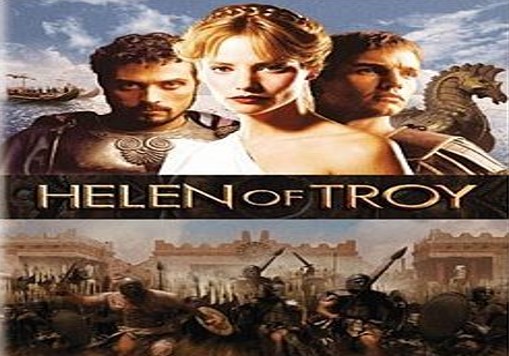
The most famous of the Greek mythical figures, the most beautiful Helena (or Helene as Homer puts it), not only has been the heroine of thousands of tales and stories, her personality has also been interpreted from various views and aspects, causing endless debates. In Helena’s personality, the love of the ancient Greek world for beauty is expressed, as well as the contrast between the beautiful and the good, that is, aesthetic values and ethical and moral values.
As a matter of fact, poets and writers after Homer (including Plato) considered it immoral that a woman could be a factor in all these wars and such a conflict between the East and the West, and they preferred to explain the abduction of Helena in a different way. It is Homer who created Helena, this type is most clearly, most vividly and vividly portrayed in Homer’s epics, so that even the later interpretations are always based on the narrative foundations laid in the Iliad and Odyssey. That’s why, without going into the stories and legends of Helena, how can this beauty be in Homer’s epics?
Let’s see it come up.
The battle on the plain of Troy is an angry moment: Menelaus and Paris go to war one-on-one, and the winner will take Helena away, so this endless war will come to an end by itself. The elders, led by Priam, the king of Troy, are watching the battle in the tower above the western gate. Suddenly Helene appears (Il. III, 154 ff.)
To the tower that Helene went out to see
They softly said these winged words:
“The Trojans and the Achaeans had such a
It is not shameful for women to suffer for years.
She compares her to the immortal goddesses staring at her face.
But still, I wish he could get on the ship,
Even if he goes, he will trouble us, our children.
not sting”.
Priam also speaks sweetly to Helene, and calls out:
Come here, girl, sit down,
look here, your ex-husband, kin
your relatives, your friends.
I don’t think you’re to blame, the gods are the real ones,
they piled up the war that made me cry blood.
A more civilized, more humane view and behavior cannot come to mind, and it is surprising to find such a thing in a text about three thousand years ago. However, this civilization, this humanity belongs only to the Trojans, while the Achaeans are harsh, rude, arrogant, barbaric in the Greek words. Helene has become a bride from Troy, she is a woman who weaves fabrics in her room, while making beautiful embroideries, thinking of her homeland, ex-husband and daughter and longing. Own
blames himself. He responds to Priam’s words (Il. III, 172 ff.):
I’m both afraid of you and counting
you, my dear father-in-law,
I wish I hadn’t come here with your son
my house, my shelter, that coy girl I raised
If I hadn’t left my relatives and dear comrades.
I wish I had agreed to the black death.
This did not happen, what should we do?
Look, I’m melting away and shedding tears.
“Dog-eyed,” he calls himself. He has great love and respect for Hector as well as Priam. He complains to him with the same regret (Il VI, 342 ff.).
Helene is a fully conscious person. she criticizes paris she. She does not want to comply with the call of the goddess Aphrodite, who kidnapped Paris from a one-on-one battle with Menelaos, she is disgusted to return to Paris’ bed and is brave and brave enough to oppose the goddess, challenging her (Il. III, 399 ff.):
Is it you again, goddess,
why do you always want to seduce
me?
Tell me, what is your intention,
take me farther, to Phrygia,
to a well-kept province of quaint Meionia.
to drive?
over there, a man of mortals?
is there?..
Go and settle down next to Paris yourself.
Get out of the way of the gods,
never set foot in Olympos again,
look at him, worry about him,
Let him make you his wife or his slave in the end.
Such an insult to God has never been seen in any other text. However, it can be understood with the deep psychological view of Homer, no different from the novelist.
In the Odyssey, Helene is seen as a respected queen, a good housewife, and a loving mother. When Telemachus goes looking for his father and arrives at Menelaus’ palace, he receives the warmest and most cordial hospitality from Helene. The clever woman hugs him as if she were her own child, loves and caresses him, counts many memories about his father Odysseus, criticizes the events and himself (Od. IV, 261 vd.).
He has a superior attitude, a humane behavior that understands Telemachus and shares his pain, gives him a medicine that will make him forget all his pains, gives him a life that he has made with his own hand, and finally the young man is enchanted by Telemachus, telling him that he will worship Helene like a goddess from now on (Od. . XV, 104 ff.).
Homer had said all there was to say about Helena, and no one could add anything to Homer’s portrait of Helena. The objective opinion, the popular vote and the criticism of Helena by others are made through the mouth of Eumaios, the shepherd of Ithaca (Od. XIV, 68.)