Home Blog Page 284

Psychology of Turks

Mar 19, 2020 | Interview |

by Professor Erol Göka

© Copyright photo by Levent Ağaoğlu, Malta Bazaar, Fatih, 1975

Psychology of Turks A historical psychological study. But when we look at the resulting picture, it is understood that the Turks are a warlike, nomadic nation that carries civilization rather than creating civilization, is obedient, fond of ostentatious and pompous. Aren’t these some negative traits? (Isn’t a Turk worth the world?)
So that’s what it looks like from where you look? Also, there have been so many publications against the Turks in the last period that in my work, when faced with determinations that do not glorify the Turks, “Is this it?” the reader may say. My books on the Turks came out at a time when the Turks were trying to be stabbed and the article 301 was being discussed.

Some men, who thought they were funny, tried to make fun of the so-called Turks, Turkishness, in the articles they wrote. The behavior of our people, which they make fun of, which we can completely explain in terms of socio-economic or historical conditions. Our people have been destroyed. You migrated to big cities in a very short time like twenty years, people living in the patterns of tradition in Anatolia.

Urbanites lost their old traditional behavior patterns before they could gain new behavior patterns. It was unfortunate that my works, which were the product of years of effort, came out when the books that made fun of people trying to hold on to life came out. But now the reader knows us, knows the scientific orientation of our work and the sincerity of our intentions. Also, aren’t you bored of the hostility Ms.Handan ? I’m so bored, I want the skullcap now.

My job as a scientist is to put on a skullcap. Besides, I am a Turkish intellectual. I am in favor of the modernization of the Turks, and I do not think that modernity will “make us not who we are”. Just as we have been Islamized according to ourselves, we will modernize according to ourselves. This is how it will be, whether we want it or not. I am in favor of the modernization of the Turks because modernity now determines the basic orientation of humanity. Societies will modernize. I am TurksI want them to make their own modernization quickly.

This is an attitude in favor of the Turks. Showing the fetters that hinder our modernization efforts as Turks, saying let’s get rid of them as soon as possible, calling for an intense reflection on what our negative sides are and how they can change and transform… These are what I am trying to do.

You say  that the carelessness of the Turks towards their language is an expression of their tolerance that hurts them. If you have to interpret it as a psychiatrist, do we have a lack of “self-esteem”? Some kind of inferiority complex? If so, what is its historical background? Why do we oscillate between extremes of self-esteem and underestimation?

No, don’t do it, it’s not exactly like that, no such conclusion can be drawn from what I said about our carelessness to our language. You journalists are more stuck in the present. I am trying to make observations that span the entire Turkish history and draw conclusions from it. Interestingly, the Turks have strived for “world domination” in every historical period, and they thought that they would find relief when they conquered the whole world.

Don’t look at the wretchedness of our situation, our unconscious wants it now. A community with such great desire can get into strange moods when it begins to perceive the reality of the current situation a little. I guess it’s this kind of mood that you call oscillating between extremes.

– How would you describe the Turkish identity? Is geography the common denominator here? religion? language? Who is Turkish?

Hmm, for one thing, we cannot talk about a generally accepted identity as “Turkish identity”. First of all, we must reveal which Turkish identity it is. There are currently two Turkish identities. One includes everyone living within the borders of the Republic of Turkey, our legal system calls all citizens, whom it says to be free and equal, “Turks”. There is also an “ethnic Turkish identity”. The identity of people who feel ethnically and historically Turkish. These are the people I have studied in my books, namely ethnic Turks.

If you are asking what determines the ethnic Turkish identity, my answer is very clearly the mother tongue, Turkish. Old Turkish beliefs and ethnic identity are also very important, but it is the mother tongue that determines it and transfers it to generations. In this case, the people we call ethnically Turkish are those whose mother tongue is Turkish, in the shortest definition.

By the way, thanks to you, we have also said that being Turkish does not mean being from one race. It’s very important here. Even academics in Turkey are talking about a race when they talk about ethnicity. However, ethnicity does not mean race, it is an identity situation formed by the mother tongue and the basic beliefs stemming from the common life culture throughout a long history.

Who is the “other” for a Turk? Kurdish? Armenian? Arab? American? Or is it European?

“Turk” has two kinds of “other”. One is the neighboring Turkish tribes, that is, Turks who are not of his tribe; the other is because of the Turks’ desire to dominate the world and rule the world, he was the greatest power person in the world at that time. We can call this latter the “absolute other” of the Turk. The “absolute other” of the “Turk” is the one who prevents his world domination, that is, the one who is dominant in the world at that moment.

This choice of “absolute other” probably stems from the old beliefs of the Turks, which placed themselves at the center of the world and their rulers, the representatives of the Gök-God, in the management of the world, the difficult natural conditions they lived in, and the mood created by being surrounded by crowded Chinese. Our ancestors probably thought that the Chinese made up the rest of the World.

They thought that they had no choice but to dominate the whole world in order to survive in this difficult world and to have the products of their civilization. Material conditions determined both their desire to rule and their warrior spirit. This mood has been passed on to generations, and has survived to the present day by transforming into Turkish group behavior. We always wanted to dominate the world, but for some reason we always started from our brother right next to us.

The fact that our “other” is another Turk makes our history the history of sibling rivalries. The fact that our “absolute other” was dominant in the world at that time causes problems in our foreign policy. Now do you understand why “Europe, Europe hear our voice in the matches. “These are the footsteps of the incoming Turks”? Why do most Turks dislike the USA at all? Why do science fictions about the war between the Turks and the Americas attract the attention of our people and sell well?

– You say that one of the most important features of the psychology of Turks is that Turks never become fond of their identities and languages? Doesn’t the emphasis on “Turkish identity” lie behind many of the contradictions we experience in our own geography today?

As a requirement of their role in the history of civilization, Turks are tolerant towards other civilizations, religions and languages. Tolerance can sometimes reach the level of indifference or indifference. The basis on which I base our not being as fond of our identity and language as other ethnic communities stems from our role in the history of this civilization. Yes, contrary to popular belief, Turks are not ethnic and religious fanatics. But they are also human after all, they have an ethnic identity to protect in the final analysis.

The reason why Turks appear as ethnic and religious fanatics in today’s panorama is another feature of them, although in reality it is the opposite. Because of their segmented social structure, they cannot get rid of sociopathy. Our society is constantly producing mafioso formations, sociopathic gangs. The actions of these gangs are being attributed to the Turks. When we compare what is going on in our country with other parts of the world that are experiencing ethnic turmoil and bloodshed, it can be better understood what I mean.

– What is the importance of nomadism in Turkish psychology? You say we were nomads until 200 centuries ago. That’s why you say our cities are like construction sites. Can’t we get rid of the feeling of nomadism?

No, we were not saved. Worse still, there is no glimmer of hope that we will be saved any time soon. The mood and mentality of the nomad is completely different from that of the settled person. It seems as if it will take centuries for us to learn about settled, urban life. In fact, settled cultures were able to learn the necessities of settled life after centuries.

– Is nomadism the reason why the first question we asked each other was “Where are you from”?

Yes, without any doubt, it is from nomadism that we keep asking those who come before us, saying that “it is not a shame to ask”.

– You point to nomadism as the reason why Turks cannot produce philosophy? Is established order necessary to produce philosophy? Or isn’t the time period when we settled down enough to start producing philosophy?

The nomad thinks but does not produce philosophical thought, because he does not need it. It is necessary to stop for contemplation, for philosophical thought, to concentrate and record thoughts on a certain point. In the verbal mind of the nomad, whose body is constantly changing, there is no need for a mental migration in the volatile verbal mind of the nomad, it is sufficient to try to understand the place and time he is in.

Also, the nomad is not good with writing; he is a person of oral culture and love. The brain of the oral culture person is very different from the one living in the written culture. It is because of all these that we do not have a thinker who can reflect what is unique to us in the history of thought and philosophy or who can make a name for himself as a Turk. Of course, there were thinkers of Turkish origin such as Farabi and Ibn Sina in the history of Islam, but they werethey are not rightly referred to by their ethnic origin, they are considered within the Islamic thought.

– Doesn’t the feeling of nomadism also bring a constant feeling of anxiety? To have nowhere. No sense of belonging anywhere?

Of course, nomadism means living in a constant state of anxiety. Some romantic writers bless nomadism for living in the bosom of nature, but out of ignorance. If they had tried to live with the nomads, they would not have lasted a day.

According to your interpretation, the feeling of “Let them say this for me” is important for Turks. Is it caused by some kind of feeling of worthlessness, or is our sense of worth something visual rather than internal?

No, Ms. Handan, it’s not because of a sense of worthlessness, it’s because of a cultural code. We Turks are people of the pre-capitalist potlatch culture. Even the most bourgeois of us lacks the rationality of the market. Whether we are rich or poor, we do what we do to show others, to show off, to brag.

Why do Turks prefer chatting to reading?

Don’t forget to read, you need to be literate to read, and that’s why you need to be good with writing. However, we belong to the oral culture, we love to talk. Research now clearly shows that people of oral culture have a different brain structure than people of written culture. For this reason, we are not good with writing, we want our children to be educated, but we do not see reading itself as a good thing.

Are you saying that Turks received only 2000 patents in 130 years, and none of them contributed to world science and technology? What is the reason of this?

Our oral culture and our nomadism… Although we have trained important scientists for the world of science, we still cannot be creative. Civilization “watch the best, the strongest, the newest!” We’re trying to catch up with the formula. There is no real scientific initiative, the transmission mentality continues. Regardless of whether we can digest all the products of civilization, we are scrambling, but we do not develop it ourselves. This is why we flock to the technology fairs opened by Western countries in our country, and when there is a cheapness campaign for the devices that come out with the latest technology, we crush each other. We love the technology itself, but we don’t contribute to it. Despite our long and undoubtedly glorious history, we are perhaps the only great nation that, as Talat Halman said, has not made a single scientific invention, not a single geographical discovery.

– You say that oral culture is the biggest obstacle to modernization and it develops not the personal conscience but the social and external conscience. Is our conscience also for others?

There is a connection between writing and the internalization of conscience. Writing causes a brain development that enables us to look at ourselves and others as separate entities and to make relatively objective evaluations. In oral culture, on the other hand, what the inner conscience does, can provide custom or command. This is what we call external conscience. Therefore, the Turks, who can establish the most regular armies in the world, are unable to advance in traffic by respecting each other.

–  What is potlatch culture? What is its importance in Turkish psychology?

Potlatch culture is a concept used to describe the relationship systems in the pre-capitalist world. In full Turkish, it can be called “han-ı loot”. In this culture, obedience, glory, honour, ostentation and pomp are more important than anything else, rather than market rationality. On the face of it, there are positive aspects such as brotherhood and solidarity. Westerners have been struggling for hundreds of years to transition from potlatch culture to capitalism. We, on the other hand, have not yet realized that we are immersed in the potlatch culture up to our necks.

– Do Turks really skip grades more easily than other nationalities? Why do you think ostentation and pomp are a characteristic of Turkish psychology?

Easy skipping is also a feature of potlatch culture. The absence of a deep-rooted bourgeois class in Turkey, the constant change of our top taxpayers, the formation of our wealthy people are obvious examples of easy class advancement. The passion for ostentation and pomp is constantly flowing through us everywhere, from birth to weddings, from our curiosity about buying a house and furnishing it badly, to our competition to send our children to luxury schools, and even to the mawlid ceremonies that are taught after death.

– How do you explain the fact that sibling rivalries are more common in our geography than in other geographies?

There are two reasons for this. The first is our warrior mentality, which tries to solve every problem by destroying the one in front of us, and the other is our lineage-style organization and the inability to establish a civilization of our own. Until the Republic, we were accustomed to rule with the strongest neck to the head. We both obeyed but did not fully embrace the rulers. The fact that the rulers were both tolerant and receptive and close to other civilizations and other communities in order to realize the great Turkish ideal and to dominate the world, always drew the anger of the tribes that were not in the administration.

– You say that meeting with Islam added vitality to the structure of the Turks, who were doomed to disintegrate. How did Islam achieve this?

We have always been lost among other civilizations due to our feature of not claiming our language and identity. Until he entered the circle of Islam. For example, we see in our earliest inscriptions that some of our Ancestors dissolved into Chinese culture. We all know that those of us who went to the west from the north of the Caspian became Christians and evaporated. We would have ended up like them, but the fact that almost the entire Turkish world became Muslim, thanks to his easy reconciliation with both our previous beliefs and our warrior mentality, prevented our extinction process. The fact that we became the head of Islam very soon after converting to Islam and that we started to strive for Islamic civilization provided opportunities for the solution of many of our fundamental problems.

– Well, but you also say: The sibling rivalry, which is thought to be reduced by entering under the roof of religion, has survived to the present day by taking on an Islamic guise and taking the name of the Alawite-Sunni fight. Is not there a contradiction here?

No, there is no contradiction. When the Turks converted to Islam, a brand new situation arose in their history. For the first time, the white-bud and the black-bud were united in the same belief system. However, because the Turks became Muslims, segmentary social structures did not suddenly change. While the dominant tribes preferred Sunni Islam in Muslim Turkish states such as Karahanlı, Gazneli, Harezmli, Seljuk and Ottoman, other tribes both embraced their old beliefs and embraced Hz. They moved to the pro-Ali opposition wing. The efforts of the dominant tribes to settle and settle the nomadic Turks also increased this conflict. We are still experiencing the troubles and pains of the same process.

– Why do Turks really like picnics so much?

Many evaluations can be made on this subject, and each of them may have some justification. But according to my analysis, our old beliefs play a major role in our love of picnics, as do many of our behaviors. Following the call of our old beliefs from centuries ago, we put the sanctity that we attribute to trees, forests and water on our agenda again during the picnic experience.

– Is there anything you want to add?

The themes and evaluations I have made in “Psychology of the Turks” are explained in a very convincing way, I think. But I admit that this topic is quite complicated and controversial. For this reason, in my previous books “Turkish Group Behavior” and “Human Part Part” I have discussed at length the methodological problems of studying large communities. I would recommend to the still unconvinced and curious readers to go to these books.

Source: http://www.erolgoka.net/turklerin-psikolojisi/


Zerzevan Castle Roman Border Garrison in Mesopotamian Turkey

Interview with Assoc. Prof Dr. Aytaç Coşkun by Levent Ağaoğlu, 11-12 September 2021

© Copyright photo by Assoc.Prof Dr. Aytaç Coşkun

LA: Were there similar Roman forts east of Zerzevan Castle?
LA: Was Zerzevan Castle located on the border of the Roman Empire?
LA: You said the cult of Mithras is of Persian origin, is there an Indian influence as well?
LA: It’s important that the excavations are done by ourselves. There are no westerners.
LA: Within the Roman Empire, there are both London and Zerzevan castles. The European Union has divided this unity of thousands of years. it is significant
LA: The Orkhon Inscriptions also suffered the same fate. He was silent between 740-1886, his language was resolved after 1150 years.

LA: Your presentation was very impressive. I visited your university in 2018.

AD: Thank you very much for your interest. Thank you for inviting me. I came from Ankara for 1 year in 2005, it’s been 16 years. We look forward to seeing you again, of course, both to Diyarbakır and to Zerzevan Castle.

LA: Thank you very much

LA: It’s important that the excavations are done by ourselves. There are no westerners. There are both London and Zerzevan castles within the Roman Empire. The European Union has divided this unity of thousands of years. It is significant. The Orkhon Inscriptions also shared the same fate. He was silent between 740-1886, his language was resolved after 1150 years.

AD: I am very glad that you liked the presentation and your interest. We have made many publications in Turkish and English about the Zerzevan Castle. Of course, I can send an introduction letter in English. It is about both Zerzevan Castle and Mithras Temple.

LA: I would be very happy and satisfied. Thanks.

LA: I would like to publish your new articles about the new developments on Zerzevan Castle. My site is entirely in English and is progressing rapidly.

AD: Of course. A new article about the cult of Mithras in Zerzevan has been published in Turkish. This article can be translated into English and published on your site.

LA: I felt the grandeur of Rome and Sassanid in your presentation.

AD: They are constantly at war in this region.

LA: Malatya, which I know, was the border garrison of Rome, and people along the border are always combative in their struggle for life, they do not give up.

AD: Gümüşhane, Malatya, Gaziantep were the real eastern border of Rome, we are in the buffer zone, a region in constant war. Those magnificent rich cities like Zeugma owe their existence to this region.

LA: If the buffer zone is, yes, thousands of years of war.

LA: Rome was born in Italy, continued in Turkey and finished in Turkey again. The end date is actually 1922. Ottoman was the continuation of Roman.

LA: The Murat Pasha Mosque in Aksaray in Istanbul was built in the name of the person who changed his name to Murat as heir to the last Roman emperor who converted to Islam.

LA: So, Eastern Anatolia was actually under Iranian rule throughout the Roman centuries, we took it from Iran and Turkified it. So this is the root of Iran’s hostility.

AD: Southeast was under Roman rule rather than Sassanid. Settlement in Anatolia starts from the Persian period, in the years 546-334 BC, Persians dominated Anatolia for 212 years. The Parthians and Sassanids are the continuation of the Persians. The Parthians and Sassanids are also trying to hold more eastern and southeastern Anatolia, but they are not fully settled in the region like Rome.

LA: Isn’t the Roman-Sasanian border between Antep and Urfa?

LA: Then the most permanent civilization in Anatolia is Rome.

AD: The original border is west of the Euphrates, but the buffer zone of Rome in Southeastern Anatolia is still in Roman hands.

LA: It is interesting that Rome creates a buffer zone within itself.

AD: Its easternmost border is Diyarbakır- Mardin- Syria line.

AD: Diyarbakir and Mardin are in Rome. Amida, Zerzevan in Diyarbakir, the border region with the strongest fortifications, which is the most warring; Dara in Mardin.

LA: Did Rome build the Diyarbakır city walls?

AD: It was built by Eastern Rome around 330 AD. Of course, it has undergone many repairs later on.

LA: When Constantine made Istanbul the capital in 330 AD, it means that the city walls were being built in Diyarbakir simultaneously.

AD: The same periods were also called Constantiniye in Diyarbakir at that time. Some sources also say that the city walls were built around 348.

LA: Shortly after visiting Beijing, the capital of China, I also visited Diyarbakir. The subject that intrigued me was the stones of the old Stone Houses in the center of Beijing and the walls of Diyarbakir, the same dark gray color, that means they are locally found.

AD: Basalt is a volcanic rock. Diyarbakir is built on a basalt plateau. The area where Zerzevan is located is limestone, therefore limestone was used there as well.

LA: The fact that Istanbul and Diyarbakir are surrounded by walls shows the great importance that Rome attaches to Defense.


Mithraeum at Zerzevan Castle, Diyarbakir, Mesopotamian Turkey

by Assoc.Prof Dr. Aytaç Coşkun

© Copyright photo by Assoc.Prof Dr. Aytaç Coşkun

2nd-3th century AD

Mithraeum was carved into the main rock, nearly in the north of the Zerzevan Castle. On the eastern  wall of the structure, there are columns carved into the main rock , two large niches in the middle and two small niches on both sides. Paint residues can be seen on the belt rising above the two columns around the big niche in the middle. Probably on the aforesaid belt there were symbols belonging to Mithras religion. The plaque on which Mithras’ sacrificing the bull scene was carved, was also placed in the big niche in the middle. The crown beam motif as one of the symbols of Mithras is carved on the eastern wall. In one of the small niches there is a rather smoothly carved water or blood bowl and a pool on the ground right in front of it.

The water or blood bowl and the pool are connected to each other with a channel through the wall and it is known that water or blood was used in the Mithras religious ceremonies. In addition there are four symmetrical points on the ceiling for hanging the animals during the ceremonies. The hanging points must have been used to sacrificial rite in Mithras rituals. The structure is the first and only Mithras temple to be found on the eastern border of the Roman Empire. At the entrance gate of the structure, the inscriptions and symbols are clearly visible.

The god Mithras, of Persian origin, is the god of concepts of  “agreement and friendship”, which means “mediating”. Mithras is the god of the sun and the cult is based on worshipping the sun. It is alo the symbol of light, war, justice and faith. In the 2 nd  and 3 rd centuries AD, it became rather common in the Roman Empire. In the 4th century AD, it was banned with the spread of Christianity.

The Mithraism mystery religion was quite common especially among the soldiers, merchants and aristocrats in all the lands where the Roman rule was dominant. Its teaching is about the creation of the world and is also known as the god who controls the universe. The religious ceremonies were secret and closed to the outside. The person to participate in Mithras religion had to draw twelve persecutions. The members of this religion to which only men are accepted had to go through seven stages. The ceremonies were held underground in caves or temples.


Zerzevan Castle, Diyarbakir, Border Garrison of Roman Empire in Mesopotamian Turkey

by Assoc Prof Dr. Aytaç COŞKUN.

© Copyright photo by Assoc Prof Dr. Aytaç COŞKUN.

Zerzevan Castle is in Diyarbakır province, Çınar district, on the Diyarbakır-Mardin highway. The history of Zerzevan Castle, which is the border garrison of Rome, dates back 3 thousand years to the Assyrian Period (882-611 BC). It is also likely that residential area located on the King’s Road during the Persian period (550-331 BC) has been used with an eye to provide road safety. At Roman Period, in the 3rd century AD the main military settlement was built during the Severus Period (198-235 AD).

It can be said that the city walls and buildings of the settlement were restored in the periods of Anastasios I (491-518 AD) and Justinian I (527-565 AD), and some of the constructions were reconstructed and thus the present final state was obtained. The settlement was used until 639 which is the conquest year of the region by the Islamic armies. In this best preserved military settlement, there is the last Mithras Temple found in the world. The structure is the first and only Mithras temple to be found on the eastern border of the Roman Empire.

In the southern area of the military settlement surrounded by walls of 1200 meters in length and 15 meters in height, there are architectural remains such as observation and defensive towers, church, administrative building, arsenal and rock altar. In the north, street-alleys and houses can be observed. Water cisterns, underground church, underground shelter, Mithras Temple have also been identified in the area where residences are located.

There are canals providing water to the settlement, ceremony basins and stone quarry outside the city walls in addition to the rock tombs and vaulted tombs in the necropolis area. Zerzevan Castle has both an aboveground and a large underground city. Zerzevan Castle and Mithras Temple was inscribed on the UNESCO World Heritage tentative list.

The excavation and restoration studies at Zerzevan Castle, which began in 2014, are still being carried out with the permissions of Ministry of Culture and Tourism and under the chairmanship of Doç. Dr. Aytaç COŞKUN.

T of Turkey

  • Töre’dir ; It is Tradition
  • Tefekkür’dür; It is Contemplation
  • Tasavvuf’dur ; It is Sufism
  • Taarruz’dur ; It is Offensive
  • Teşebbüs’dür ; It is an Undertaking
  • Taahhüt’dür; It is a Commitment

© Copyright photo by Levent Ağaoğlu, 1975


Main Centers of Turkish Thought and Ideas

Until the 1450s, the main centers in Turkish Thought were Orkhon Valley, Transoxiana Basin and Great Khorasan Basin, the last one covering the geography from Iran to North India. These three regions have shaped Turkish Thought.

Monographic evaluations of the Orkhon Inscriptions in terms of Scientific Disciplines have not been made yet. The basic concepts and articles of our Constitution (Tonyukuk Inscription) 500 years before the first Constitution (Magtna Carta) of 1215 in the West were recorded with these stones.

After inheriting 3 Inscriptions (Tonyukuk, Bilge Kağan, Kültigin) from the Göktürks, much more monuments from the Karakhanids have survived.

• Kutadgu Bilig (Sacred Knowledge) by Yusuf Has Hacib,
• Kaşgarlı Mahmud’s Divânu Lügati’t-Türk (Great Turkish Dictionary),
• History-i Kashgar (History of Kashgar) by Imam-i Abu’l-Futuh Abdulgafur,
• Ahmet Yesevi’s Divan-i Wisdom,
• Edip Ahmet Yukneki’s Atabet’ül Hakayık (The Threshold of Truths)

His works are the most important works of this period. In addition, some translations of the Qur’an written during the Karakhanid period and we have, and Târîh-i Türkistan and Hıtây (now lost) presented by Mecdüddin Mehmed of Kaşgar to İbrahim Han and Mücmilü’t-Tevârih ve’l-Kısâs, whose author is unknown His works [books] are also important works published in this period.

The works produced by Biruni and Seljuks, especially in Khorasan, Baghdad and Anatolia, during the Ghaznavid period, are the masterpieces of the 500-year enlightenment period (700-1200).

Corpus of Turkish Thinkers/ Triangle Pattern: 3K

• Chronology; Time, Date
• Resources; Mind
• Cartography; Ground, Geography

Turkish Mind / Founding Works:

The repertoire of the works revealed by the Turkish mind and words stretching from east to west along the 41st latitude is a treasure and should be internalized and form a basis for our present and future.

“If the common denominator of a broad public opinion seeking an answer to the question of what are the classics of Turkish literature is explained with 20th century literature, does it result that we are rootless and generationless? should be.

We are glad to be able to wash our faces with Yunus Emre Divanı, but the rest is obviously indecision. What is it, Dede Korkut Book, Travelogue or Fuzuli Divan? There are them too, but we do not dare to ask which one we have internalized enough to keep it by our side. Reading the articles in Eco’s book ‘On Literature’ is quite annoying, while still helping to get my thoughts out of ignorance. Why don’t we have a mind to put next to what he wrote?”
Where to go without finding our resources, Semih Gümüş, 30.12.2016 (kitap.radikal.com.tr)
Our Thought Journey

Our philosopher’s journey, which started with Bilge Tonyukuk (d.646), ended with the death of Cemil Meriç in 1987; Asia, which has been examined specifically for China and India, is still approached with a distance. However, the messages of our first author, Bilge Tonyukuk, and Cemil Meriç, who worked in India for four years and wrote his book, are still waiting to be embraced. In this case, both thinkers are the main pillars of start/end. Therefore, they must be in the position of intellectual main centers.

While the mission of Yunus Emre Institute is to teach Turkish to foreigners, Bilge Tonyukuk Institute can adopt our founding tradition of thought by establishing the Cemil Meriç Institute. It assumes the function undertaken by the Orient Oriental Institutes of the German, British and French; takes root in eastern and western thoughts.

Turkish Thinkers Bulgaria (leventagaoglu.blogspot)

Turkish Thinkers Russia (leventagaoglu.blogspot)

Ebu Hanife : The First Muslim Turkish Thinker
Tonyukuk: The First Turkish Thinker

You should see Ebu Hanife and Tonyukuk together. He who does not see is blind.
While everyone who is Muslim in the Balkans defines himself as TURKISH, everyone who is OTTOMAN in the Americas is referred to as EL TURCO!

Thought Centers

Rumelia

• Istanbul
• Skopje
• Sarajevo
• Prizren
• Plovdiv
• Shumen
• Budapest
• Belgrade

Anatolia

• Bursa
• Konya
• Amasya
• Sivas
• Kayseri
• Erzurum

Caucasus (Caspian)

• Tabriz
• Baku

Turkestan

• Transoxiana
• Samarkand
• Bukhara
• Kashgar

This shallowness will gradually begin to be overcome, and we will begin to keep our root culture alive in Turkestan by going deeper. In recent years, interest in the Ottoman Empire and history has started to increase gradually. It is not too long when this interest will extend from Anatolia and the Balkans to the depths of Asia.

Waterways of Turks

Turks, who prefer riversides due to their plant diversity and drought experience, have settled in critical points in Asia-Europe-Africa continents.

  • Mongolia: Orhun and Selenga (Ötügen, Ordu Balig, Kara-Korum)
  • China: Yellow River- Wei River (Ordos, Xian)
  • Turkestan: Transoxiana; Seyhun and Ceyhun, Karizler (Underground Water Channels)
  • Anatolia: Euphrates and Tigris
  • Rumelia: Danube and Vardar
  • Afrasia: Nile
  • Russia, Ukraine: Yenisei, Don, Idil (Volga)


Turkey: Steppe Belt and Agricultural Belt

Fertile Crescent

Çatalhöyük, Hacılar and Beycesultan are the first examples of the first housing culture created by the mankind in the world.

Civilization began in Anatolia around 6000 BC with the Neolithic town of Çatal Höyük.

The first known human settlement is in Çatalhöyük, Turkey (7 Millennium BC).

Mesopotamia has long heen considered as the first home of civilization in the Old World, about the fifth millennium BC, but the so-called neolithic revolution or transition to so-called agricultural society about 10,000 BC probably occurred first in Anatolia.

The origin and ethnic derivation of the most ancient inhabitants of Anatolia are not known, but it is certain that they were among the first if not the first, to have built a city. Before that, between 15,000 and 13,000 BC, we know only of nomadic hunters, as at Lascaux.

At Çatal Höyük in the middle of the Anatolian plateau, a cluster of the first real houses was discovered on an area of ​​thirteen hectares. They were constructed from clay bricks, the walls were regularly colour-washed on the outside, and certain of them were covered on the inside with wall paintings, similar to cave drawings but fulfilling an aesthetic function. Linked together in tiers, the upper houses opened onto the flat roofs of the ones below.

The fourteen levels built up there correspond to a little more than one thousand years of occupation, from 6750 BC to about 5600 BC, that is to say, during the Neolithic period.

These first ‘town dwellers’ were primarily farmers. They lived in family groups of five to seven persons, and were already cultivating wheat and vines, raising sheep and goats, and keeping dogs. They grew and wove flax, and possessed weapons of copper and lead, both for hunting and defense. They also traded with distant countries. At Çatal Höyük objects have been found made of volcanic glass and apatites which were unknown locally.

The first Neolithic paintings found on man-made walls are in Çatalhöyük, Turkey.

Çatalhöyük is a center of “firsts” -first ceramic pots, first mirrors, first examples of woven materials, first wooden bowls, first wallpaints, among many other firsts.

Our soul, which started to take shape as 9/8 in Rumelia starting from the 14th century, is a lively and enthusiastic musical rhythm. The roots of our soul, which once again caught universality in Rumeli, were shaped in the depths of inner Asia with the seven concepts here. This spirit has three main elements: sky, earth and person. All three are created. A person’s life on earth, which is the world in question, is connected with the heavens, that is, the celestial universe shapes the person during his life.

From this point of view, the steppes of Inner Asia and Asia Minor became the vast spaces where contact with the heavens was established and the source of thoughts of the people. The thoughts of the people also fed the thinkers. The Silk Road steppes in Inner Asia and the Cappadocia region and surrounding areas in Asia Minor, Eskişehir, Ankara, Konya, Kırşehir, Niğde, Nevşehir line were the areas where the richest works were produced. The first examples that come to our minds were Yunus Emre, Mevlana, Hacıbektaş Veli, thinkers who grew up in the steppe .

Cappadocia, the middle point of Asia Minor, and the steppe and agricultural basin areas in the middle of Central Asia were the main centers of thought. The source thinkers, whom we consider as a reference in our work, always came from these fields in Central Asia. The nourishment of the sky, the sun and the moon, the rain and the breeze, made the person dynamic.

Turkish Belt

Turkish Belt, not the Turkish World. It is important that the TURKISH KENŞİ, which started out as the five fingers of one hand, turns into a TURKISH BELT as soon as possible by traveling around the world. Girdled will embrace. Relationships also gird the world. Turks living in 132 countries gave way to the formation of a Turkish BELT in the world.

While the term first appeared as a bond term in the Oguz Kagan Epic, it also showed itself in inscriptions and manuscripts. The concepts of World State in Farabi and Kut Belt in Kutadgu Bilig contain remarkable thoughts. Diaspora (Overseas Turks) and exonym (Foreign Turkish Yerads) gain importance when it comes to language.

The prevalence on the ground in terms of population and language has revealed the formation of a Turkish Belt. In addition, the compatibility with the civilizations on the ground has increased the prevalence even more. Similarly, although the Indians spread in the African continent and the Latins in South America, the Chinese could not spread and adapt outside their own countries except the USA.

The Turkish Belt has surrounded the world for 15,000 years, starting from Karahantepe and Göbeklitepe in Anatolia, with networks that surpass 5G technology. Turkey 5G Networks of Steppe ( Step ) and Agricultural Belt is a synthesis. Gaspirali, Galiyev and Gumilev in the list are Turkish intellectuals who have great influence on Russian Turkishness.

  1.     Göbeklitepe (9600-8200 BC)
  2.     Gokturk (552-744)
  3.     İsmail Gaspıralı, 1851-1914,
  4.     Sultan Galiyev 1880-1940
  5.     Lev Nikolayevich Gumilev (1912-1992)

Turkey ranks first among the countries that give place names in their own language in countries in geographies outside their countries. Placenames in 100 countries are described as Turkish.

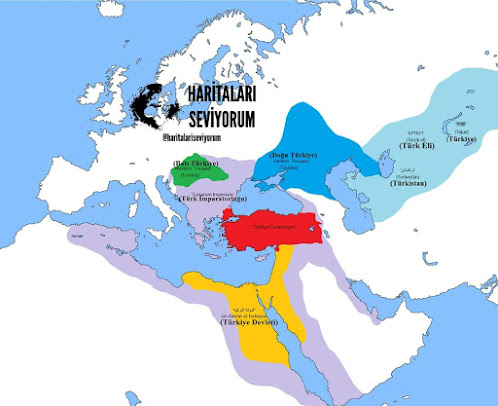
In terms of language, the Turkish language is spoken in 48 countries. The Turks, who internalized the geographies from Manchuria to Hungary together with the Steppe Belt, included the Mesopotamia-Anatolian publication in their coverage together with the Agricultural Belt. When all these data are evaluated together, what emerges is not a Turkish World devoted to a limited geography, but a Turkish Belt that surrounds the world.

The great steppe has been the biggest school of the nations it has hosted. The burning sun, freezing cold, deadly hurricanes, impassable mountains, impenetrable deserts have developed a will of steel in steppe people. Motun, Tonyukuk, Cengiz, Temür… These are the children of the steppe school. Source: Ali Akar. https://twitter.com/ali_akar/status/1267895190376808448

Western historians attribute the dominance of the Turks over the steppe to their ability to ride horses, draw bows, and shoot arrows. However, behind this domination was the accumulation of knowledge (mind), ukuş (understanding), bilig (knowledge) for thousands of years. From these came the power of the bow, arrow, and spear. Source: Ali Akar https://twitter.com/ali_akar/status/1267162827028140045

It is sad to forget the inscriptions (Yenisey, Orkhon, Altay) written on stone in the areas from Manchuria to Mongolia and Hungary, as if they were written on ice, starting from 1500 years ago along the steppe belt. To expand the delayed entry of the printing press, which was developed 500 years ago in the West, to our country is the ignorance of not knowing that the printing press actually existed in the Uyghurs and that the Turks started their printing business in the 800s and gave the first examples on this subject, which is an even sadder feeling.

The Steppe Belt and the Fertile Crescent

5G: The Largest Networks of 12,000 Years…

5G: Steppe (Step) and Agriculture Belt synthesis

On the map, ORDOS is the intersection of the starting point of the yellow steppe belt south of Beijing , where the Yellow River bends.

  • Yellow Belt: Steppe highway.
  • Red frame: Uyghur/East Turkestan
  • Green Belt: Agricultural Belt/ Fertile Crescent

It is obvious what kind of mobility we have provided from Beijing (Beijing) to Budapest.

From the Ordos plains in the Yellow River to the Danube plains, grazing their horses on the steppe plains, the Turks traveled along the yellow belt, from Far Asia to Eastern Europe, and later settled in East Turkestan (Uyghur) and Transoxiana and settled in Iran, Iraq. They reached Anatolia via Syria.

Another fact that the 1071 discourse ignores is that it ignores the Turks who settled and settled in Eastern Europe and the Balkans from the yellow belt, referring only to 1071, and referring to them as the Turkish-speaking Byzantine soldiers in the Romanian Diogenes army.

Bulgars, Uzs, Ogurs, Avars, Cimmerians, Cumans are the essential elements of the human material of nearly twenty states in Eastern Europe and the Balkans.

Main Stations:

  • Uyghur Turkestan
  • Transoxiana /Bukhara, Samarkand/
  • Khorasan
  • Iran
  • Anatolia
  • Damascus
  • Baghdad
  • Cairo
  • Rumelia

Our Geography and Basins , from the Blue Danube tribes in Bavaria to the plains of the Yellow River in the downstream of Manchuria

The first ancient concepts of our civilization began to form in the Yenisei Basin in the Altai (Siberia, Russia) around 3000 BC, from there to the Orkhon Basin (Mongolia) and then 1000 BC. The 2000-year-old culture and civilization accumulated in the 1950s moved to the Ordos region in the Yellow River Basin (China), and after forming the idea of ​​the Chu State, the first Chinese State, the first Turkish State, the Hun State, was established in the early 200s BC by Oguz Kagan.

On the way to the Turkestan oases (Turfan, Kaşgar, Yarkent, Kuça, Hotan), the civilization formation that will come to light began with the works of Kaşgarlı Mahmud and Yusuf Has Hacip in the 1000s AD.

The journey to the West continued with Transoxiana – Great Horasan – Caspian Basins this time; There was a golden age between the years 700 -1100, when the great thinkers of Turkish culture grew up; Ancient concepts have been enriched with Islam.

Before the last Rumeli stop on our Ancient Journey, we reached the region surrounded by the Five Seas and reached Anatolia, Mesopotamia and the Nile lengths, and the Cihan State drawn by Oğuz Kağan.

“ Let the sun be a flag, the sky is a tent”

mission; It was carried out centered in Rumelia, and dominance was established in the continents of Europe, Asia and Africa.

Old world/Middle of the world

The Mediterranean region; The region surrounding the Mediterranean.

  • 10 BC / 3rd by BC – 5th century / Nile-Amudarya region
  • 5 BC – 5th century AD /Fertile Crescent
  • AD 700 – 1200/Darül Islam

Western hegemony; It is based on the middle of the East, the Middle East. Our civilization is based on the middle of the world. This middle is the Mediterranean. It is the middle of the old world; Mediterranean, Mediterranea.

Our civilization is of the Old World; It was formed in the Yellow River – Orkhon – Amudarya – Nile – Mediterranean regions.

  • East Asia (Karakorum, Karabalsagun, Orhun, Ötüken),
  • Central Asia (Turfan, Kucha, Kashgar)
  • South Asia (New Delhi, Punjab, Lahore, Agra),
  • Transoxiana (Samarkand, Bukhara, Khiva),
  • Khorasan (Tus, Nishapur),
  • Nile (Cairo, Alexandria)
  • Mediterranean (Thessaloniki, Algeria);

Our Islamic Civilization grew in the Mediterranean basin and expanded from Spain to beyond the borders of China.

In the middle of the region between Transoxiana and Andalusia, the Nile river is located. The distance between Transoxiana and China is the same as the distance between Transoxiana and Andalusia. It seems that; The borders of our sovereignty areas, which are lined by seas on all four sides, are the Pacific Ocean in the East, and the Indian Ocean in the South; It is surrounded by the Black Sea in the north and the Mediterranean in the west.

Oğuz Kağan’s legacy of “more seas, more rivers” has come true. Hungary is also called Hungarya, Bulgaria is also Bulgaria; One of the names of both communities, their connection with Turkishness is evident. In fact, the EU is a project related to the suppression of Turkishness that hung up to Vienna and shook Rome as well. They marketed the entire Balkans to themselves. Eastern Rome had already assimilated the Turks in the Balkans by Christianizing the Cumans, Pechenegs, Bulgars and Avars.

Talking about the cafes of Paris, London, and Barcelona, ​​the foreign Turks’ imagination and reasoning describe the existence of Isfahan, Lahore, Karachi, Damascus, Kashgar, Xian, Kazan, Skopje. Not even a crumb of fame, Adis Ababa, Seville, Andalusia’s coffeehouses, coffee houses and teahouses exist, nor even the crumbs of their thinkers.

Let’s quickly put the references of the East on our agenda together; Let’s talk about Harezmi, Konevi, İbnül Arabi, Hamidullah, Fazlurrahman, Mohammed İkbal, Kaşgarlı Mahmud, Ferdovsi, Gaspıralıs, Niyazi-i Misri and their thoughts, starting with Oğuz Kagan.

The Hong Kong subway logo is inspired by the characters of the Chinese alphabet thousands of years ago. http://goodlogo.com/download/mtr_hong_kong_logo_vector_3620

Why can’t we share the same thought for the logo of the Istanbul metro, because there is neither the art of calligraphy nor the art of marbling, the heirloom of ancestors, in that logo, both of which have their roots in the depths of Asia. The lack of effort in the intellectual structure and the cultural shallowness have condemned us to an ongoing drought, and the ways out of this seem to be related to the cultural centers of our past and how we can feed on the cultural resources produced by these centers.

Intellectual shallowness actually concealed a deep cultural depth.


Mesopotamian World: Göbeklitepe Infographic, Turkey

by Emine Sonnur Ozcan

https://www.academia.edu/14613659/G%C3%B6bekli_Tepe_Infographic


Sadri Alışık – Hello Istanbul Poem (From His Own Voice)


Poem by Artist Sadri Alışık

ENGLISH TRANSLATION

This is my first time into the world,

By destroying the reign of Great Fatih.

A day between the swaddling and the shroud,

Istanbul, My phrase of Istanbul.


Hello Kızkulesi,

Hello Eyüp Sultan,

Hello Kanlıca, Şehremini…


An Istanbul is blowing from my childhood,

Sour boza, cobblestones flaky.

Are those azan recited from Yusha or from Hırka-i Şerif?

Our neighbors are the captains, a remnant of the maltese stony afternoons.


Still in those white rhinos?

They buried a history in Üsküdar in Karacaahmet,

It’s like women in chadors are forgotten in coral slippers.

Duyûn-u Umumiye retired phaetons,

It’s still an autumn in Acıbadem,

They have been courtiers since Friday greetings.


Hello Beylerbeyi, hello Sultan Selim,

Hello my dear friend, Istanbul, hello…


What seasons have worn out on the streets of ocher,

Fine beaded barber shops where I get beardless haircuts.

Grand Bazaar Coppersmiths, under bridges in dark blue May,

And in the Bosphorus, the Company-i Hayriye smokes.

Where are you, that Istanbul, where are you…


When I listen to the moonlight in the sound of spinning wheels,

The lilac gardens of Aunt Mediha,

My grandfather’s Kuvay-ı Milliye stories.

You know, my wooden wheeled cars.

You know, my quiet childhood forgotten at the feasts.


Yet another Istanbul was once, with its caged scents,

Wet in lavender-flowered afternoons in white headscarves.

The long bazaar with its folding chairs,

Copper trays carried Istanbul.

A hidrellez promenade from Sultaniyegah,

He sang songs of quiet devotion.

On the Golden Horn ferries, the promises are cut off.


Hey baby hey…

They used to pull Istanbul from the sea in the Burunbahçe fish, without getting wet…

How many holiday handkerchiefs had passed from my hand to the dowry chests.

I used to take all the sleep of Istanbul to my bosom.

In my dreams those sins still wake up

Committed in the streets that I could never pass.


Hello Sultanahmet, hello Basilica…

Hello, my dear friend, My Istanbul,

Hello, hello sir, hello…


TURKISH

Bu benim dünyaya ilk gelişim,

Yıkarak saltanatını koca Fatih′in.

Kundakla kefen arasında bir gün,

İstanbul, İstanbul deyişim.

Merhaba Kızkulesi,

Merhaba Eyüp Sultan,

Kanlıca, Şehremini merhaba…

Bir İstanbul esiyor çocukluğumdan,

Ekşi bozalı, Arnavut kaldırımları lâpâ lâpâ.

Yuşâ’dan mı okunur o ezanlar, Hırka-i Şerif′ten mi?

Komşularımız kaptanlar, malta taşlı ikindilerden kalan.

Hâlâ o beyaz gergeflerde mi?

Bir tarihi gömmüşler Karacaahmet’inde Üsküdar’ın,

Sanki çarşaflı kadınlar mercan terliklerinde unutulan.

Duyûn-u Umumiye emeklisi faytonlar,

Hâlâ bir sonbahar Acıbadem′de,

Cuma selamlıklarından beri saraylılar.

Merhaba Beylerbeyi,

Merhaba Sultan Selim,

Merhaba iki gözüm İstanbul′um,

Merhaba…

Aşı boyası sokaklarında ne mevsimler eskimiş,

Sakalsız saçlar kestirdiğim ince boncuklu berber dükkanları.

Kapalıçarşı Bakırcılar, lâcivert mayıslarda köprü altları,

Ve Boğaziçi’nde Şirket-i Hayriye duman duman.

Nerdesin o İstanbul, nerdesin…

Hani çıkrık seslerinde mehtapları dinlediğim,

Mediha teyzelerin leylâk bahçeleri,

Büyükbabamın Kuvay-ı Milliye hikâyeleri.

Hani tahta tekerlekli arabalarım.

Hani bayram yerlerinde unutulan asude çocukluğum.

Gene bir başka İstanbul′du bir zamanlar kafesli ıtırlarıyla,

Beyaz başörtülerin lâvanta çiçekli öğleden sonralarında ıslanan.

Açılır kapanır iskemlelerinde uzun çarşının,

İstanbul’u taşırdı bakır siniler.

Sultaniyegâhtan bir hıdrellez mesiresi,

Sessiz sadâkat şarkıları söylerdi.

Haliç vapurlarında söz kesilmiş tazeler.

Hey yavrum hey…

Burunbahçe dalyanında İstanbul′u çekerlerdi denizden, Hiç ıslatmadan…

Kaç bayram mendili geçmişti elimden çeyiz sandıklarının.

Bütün uykularını koynuma alıp uyurdum İstanbul’un.

Rüyalarımda hâlâ o günahlar uyanır,

Hiç geçemediğim sokaklarında işlenen.

Merhaba Sultanahmet, Yerebatan merhaba…

Merhaba iki gözüm İstanbul′um merhaba,

Merhaba efendim, merhaba…