Home Blog Page 265

Turkey’s Biological Wealth

by Faik Tunay

Today, the degree of biological richness has also been a scale in determining the importance of countries. This diversity, which is vital for all living things, continues to disappear rapidly.
28.6.2021

Unfortunately, this existence of our country is also under threat. Anatolia has been a shelter for all living things for thousands of years. Being the place where three plant geographical regions and three main climates meet are the biggest sources of Anatolia’s wealth. The incredible biological richness of Anatolia, which also takes the name of Asia Minor, is still at an interesting level despite being destroyed for centuries. The most obvious indicator of this is that a new plant species is being discovered on average every ten days in Turkey.

Although Turkey covers 0.6% of the world’s land, it hosts 2.6% of all plant species in the world. However, Turkey is the only country where three phytogeographic regions meet. Euro-Siberia (EUR-SIB), Mediterranean (MED), and Iran-Turan (IR-TUR) References: Flora of Turkey and the East Aegean Islands by Professor PHDavis from Edinburgh University. This difference creates various sub-climatic zones and very special habitats in our country. For example, while there is a Siberian-like climate on Mount Ararat (5165 meters), which is Turkey’s highest mountain with an average altitude of 1100 meters, Mediterranean climate features are observed in the Iğdır plains at its base, where even cotton can be grown. There are many different plants all over Turkey.For example, the Piyan plant, which grows around Akşehir and Eber lakes, has three to four fertile ovaries in each flower. Piyan is one of the two known species among 18000 species of the legume family. This genetic feature can create various possibilities depending on the developing technology. For example, if it can be transferred to beans, lentils and chickpeas from the same family, it leads to a significant increase in yield.

While Turkey imported about 240 thousand tons of lentils in 2019, it imported 372 thousand tons in only the first 8 months of 2020, but even this data shows that the effective use of the piano can provide a significant increase in productivity. Every part of Turkey is very rich in terms of plant diversity. The north of Mesopotamia, where the Tigris and Euphrates rivers were irrigated and where the first regular agriculture was made in history, Southeastern Anatolia is among the important gene centers of the world in terms of food crops, especially cereals and legumes. The problem caused by an important disease in the most productive wheat type of the USA was solved by transferring genes from the natural wheat of Southeastern Anatolia. The application, which provides both disease-resistant and high-yielding wheat, also provided significant savings in agricultural pesticides. References: Damania AB 2008 History,Achievements and Current Status of Genetic Resources Conservation There are many studies confirming that wheat farming first started in the Karacadağ region of Southeastern Anatolia. All the world’s wheat varieties have descended from three ancestors in a long evolutionary process. All of these species and twenty species that do not directly participate in the evolution process of wheat occur naturally in Anatolia. Despite all these, Turkey is a country that simultaneously exports and imports wheat. Looking at the last 15 years, it is seen that some years imports and some years exports are high.All of these species and twenty species that do not directly participate in the evolution process of wheat occur naturally in Anatolia. Despite all these, Turkey is a country that simultaneously exports and imports wheat. Looking at the last 15 years, it is seen that some years imports and some years exports are high.All of these species and twenty species that do not directly participate in the evolution process of wheat occur naturally in Anatolia. Despite all these, Turkey is a country that simultaneously exports and imports wheat. Looking at the last 15 years, it is seen that some years imports and some years exports are high.

Another important potential exists for organic farming. There are still regions in Turkey that have not met with pesticides and chemical fertilizers. The consumption of pesticides per hectare is less than one third compared to the EU, and it does not exceed half of chemical fertilizers. Although Turkey has very suitable conditions for organic production and a high export potential, its share in the world organic food market is unfortunately very low. If we make a broad definition, organic agriculture; It includes human and environment-friendly production systems aimed at re-establishing the natural balance lost as a result of faulty practices in the ecological system.It is a production method that recommends benefiting from parasites and predators and adopts the principle of increasing the quality of the product, not increasing the quantity in production. According to the famous work of De Materia Medica by the physician P. Dioscorides, who lived in Kozan in the first century, Anatolia is also a very important center in terms of medicinal and herbaceous plants. If organic agriculture and medicinal plants are handled correctly, it can provide serious advantages to Turkey. Turkey has 10000 plant species, while the whole European continent has 13000 plant species. More than 3000 endemic plant species are as common in Europe. In addition to the number of species that countries have in terms of biological diversity, the number of endemic (limited only to that country) species is also of great importance. Turkey is one of the world’s remarkable countries in terms of endemic plants. About one out of every three flowering plant species is endemic.The number of endemic species is higher than the number of endemic species in all European countries.

However, the fauna of Turkey is close to the European continent with more than 60000 animal species, and according to scientists, many species are still waiting to be discovered. During the bird watching tour organized in 2005, 276 bird species were identified in three weeks. University of Utah lecturer ornithologist Assoc. Dr. According to Çağan Şekercioğlu, this number, which is a country record, shows that Turkey is rich in birds among non-tropical countries. Another striking example applies to bees. Turkey hosts at least five honeybee breeds in parallel with its plant diversity and different climatic regions. Buckfast hybrid, one of the most productive bees in the world, was produced in England by using the male line of the bee race of Central Anatolia. Anatolia, which has exceptional economic value and is extremely suitable for hybrid production,It is home to many bee breeds.

In order to secure our future, agriculture and livestock policies need to be reviewed very urgently and protecting our country’s biodiversity should be our priority. Based on scientific studies, it is also important to benefit and evaluate any species in a sustainable way without endangering its extinction. The priority for the extinction of our genetic resources or the endangerment of their descendants is to correctly identify the threat factor or factors. Unless the cause is revealed correctly, the desired result cannot be achieved with the measures to be taken.

* Faik TUNAY, 24th Term Istanbul Deputy, Businessperson

Agriculture in Turkey (Spanish) by Ex MP Faik Tunay


Agriculture in Turkey by Ex MP Faik Tunay


The three resurgent “empires” were Russia, China and Turkey.

EU foreign affairs chief: Europe faces threat from three ‘re-emerging empires’
Speaking in Parliament on Tuesday, Josep Borrell said the three resurgent “empires” were Russia, China and Turkey.

By Martin Banks

Martin Banks is a senior reporter at the Parliament Magazine

15 Sep 2020

Borrell told Parliament’s plenary that “Europe faces a situation where empires are coming back – there are at least three of them.”

The former MEP said Russia, China and Turkey – “big in the past” – were now “coming back with an approach on their immediate neighbourhood and also globally.”

His comments came during a debate with MEPs on the “dangerous” escalation and the role of Turkey regarding offshore natural resources in the Eastern Mediterranean.

Turkish President Recep Tayyip Erdoğan’s regional ambitions and push for control of gas resources in Eastern Mediterranean have put Turkey on a collision course with the European Union.

Tensions flared last month after Turkey sent a seismic research vessel to map out possible oil and gas drilling prospects in waters claimed by Greece, Cyprus and Turkey.

“We do not want a confrontation with Turkey. Turkey is an important and key partner for the EU and an accession candidate, but it is clear that this has now been put into question” Josep Borrell, EU High Representative

NATO members Turkey and Greece have overlapping claims to continental shelves and rights to potential energy resources in the eastern Mediterranean. Ankara now faces potential sanctions from the EU, which says it fully supports Member States Greece and Cyprus.

Dangerous military incidents involving Turkey, Greece and France have raised the risk of conflict. EU Member States have been split on how best to manage relations with Ankara, with France seeking a tougher stance while Germany urges caution.

But the more Turkey continues its current course of action the likelier it is that the EU will shift towards imposing economic sanctions.

Borrell joined some Member States, including Germany, in saying he wants to defuse the stand-off through dialogue.

https://www.theparliamentmagazine.eu/news/article/eu-foreign-affairs-chief-europe-faces-threat-from-three-reemerging-empires

Interview with Gene D. Matlock on Turks

October 26, 2021

Could the ancient Turks be the ancestors of all humans? From the Maya and Aztecs to the Indians, from the Russians to the Indians, from the Arabs to the English, Italian and Northern Europeans, would you believe if they were told that they all have Turkish origins? Well, what about Hz. Abraham, St. Moses, St. Jesus, St. Were Muhammad and Buddha also Turkish? Did all religions derive from the Tengri religion of the Ancient Turks?

These are confusing yet intriguing questions that are difficult to answer. However, one researcher answers ‘yes’ to all of these questions. And he presents the proofs of the correctness of his claim in his book ‘O People of the World, You Are All Turks’. The interesting thing is that the owner of this thesis is not Turkish, but an American: Gene D. Matlock.Gene D. Matlock in his book titled ‘O People of the World, How the Secrets of a Lost Civilization Can Change the World’, published in Turkish by Hermes Publishing in July, Gene D. Matlock states that the first people started with the Turks and then dispersed to the world, that the first spoken language was Turkish, that science, philosophy and religion were still He says he was born from Turks.

Matlock, who has lived in Mexico for 65 years and has been researching both the origins of Christianity and the origins of Native Americans in Mexico for many years, combines the clues he obtained in the light of religious books, mythologies, culture, traditions, and especially linguistics, and the evidence he presents is quite surprising. . We met with 81-year-old Matlock in Istanbul, where he came to give a conference, and we talked about his striking claim.Matlock says that the first people started with the Turks and then spread to the world, the first spoken language was Turkish, and science, philosophy and religion were born again from the Turks. Matlock, who has lived in Mexico for 65 years and has been researching both the origins of Christianity and the origins of Native Americans in Mexico for many years, combines the clues he obtained in the light of religious books, mythologies, culture, traditions, and especially linguistics, and the evidence he presents is quite surprising. . We met with 81-year-old Matlock in Istanbul, where he came to give a conference, and we talked about his striking claim.Matlock says that the first people started with the Turks and then spread to the world, the first spoken language was Turkish, and science, philosophy and religion were born again from the Turks. Matlock, who has lived in Mexico for 65 years and has been researching both the origins of Christianity and the origins of Native Americans in Mexico for many years, combines the clues he obtained in the light of religious books, mythologies, culture, traditions and especially linguistics.

We met with 81-year-old Matlock in Istanbul, where he came to give a conference, and we talked about his striking claim.Matlock, who has lived in Mexico for 65 years and has been researching both the origins of Christianity and the origins of Native Americans in Mexico for many years, combines the clues he obtained in the light of religious books, mythologies, culture, traditions, and especially linguistics, and the evidence he presents is quite surprising. . We met with 81-year-old Matlock in Istanbul, where he came to give a conference, and we talked about his striking claim.Matlock, who has lived in Mexico for 65 years and has been researching both the origins of Christianity and the origins of Native Americans in Mexico for many years, combines the clues he obtained in the light of religious books, mythologies, culture, traditions and especially linguistics. . We met with 81-year-old Matlock in Istanbul, where he came to give a conference, and we talked about his striking claim.

– You say that all the people in the world are descended from Turks. What prompted you to do research on this subject?

Years ago, I was very upset by the mistreatment of the Palestinians by the Israelis, and I started researching the history of the holy land that these people could not share and the origins of the religions there. I was writing this research at the same time. As the research progressed, everything took me first to India and then to the north of India as it went deeper. Whatever I threw my hand at, in the end, Turks were the source of everything, and Turkey and Central Asia as geography. Because, when I examined it carefully, I saw that Israel was not mentioned in the Old Testament (39 books that make up the first part of the Bible, including the Torah and the Psalms) and the Bible. The things mentioned in the holy books were actually compatible with Turkey. The legend of Noah’s Ark, the Great Flood… they all had their origins in Turkey and the Turks. This was showing me:The place where humanity started was Turkey. We humans have been wrongly conditioned to see Sumer, Greece, Egypt, and China as the ancestors of all civilization.

HUMANITY STARTED FROM TURKEY

– So, how come the Turks are the ancestors of all humanity?

A few thousand years ago, there was a highly civilized people living in abundance in an Arctic paradise… All religions in the world say that there are five original races of humanity, no matter what nation they belong to. These five races were called Kurus, Krishti or Krishtaya. The place where they live is called Eden in Judaism and Christianity. Hindus call it Uttura Kuru. Ancient Greek historians and mythology refer to it as Hyperborea. Tibetan Buddhists call it Khedar Hand (land of God Shiva) and Shambhala. It is also called Sivariya and Siberia, meaning the land of God Shiva. The paradise garden where the new first humans lived is the Siberian steppes. The first man here, Adem (in English spelling Adam), is used in the Turkish language to mean ‘human being’.As a matter of fact, the pure race (aryan) here, who has high intelligence and civilization, is Turkish. The fact that Turks refer to themselves as Kipchaks, Kurus or Aryans is proof of this. However, as it is mentioned in many different religions and mythologies, these people are cursed and experience a natural disaster. With a sudden deviation in the axis of the world, their place of residence is frozen and there has been great floods. The Kurus, whom we now call the Turks, had to flee south to Central Asia. This was the Great Flood. Noah and his descendants of humanity also came from this origin; that is, Turkish. The belief that Mount Ararat, on which Noah’s ark landed, is Mount Ararat in Turkey proves this. Thus, humanity of Turkish descent dispersed into Turkey and down to Mesopotamia and India. Therefore, the Sumerians, Hittites, Iraqis, Kurds, Indians,The Egyptians were all actually Turks. Descending from the Arctic, they spread to Northern Europe, Sweden, Finland, England, and the rest of the world. Today, everyone can trace the traces of their generation to the Turks.

– What can you show as proof of this?

You can see that everything from the language used in every corner of the world to the beliefs and names of gods comes from the same origin as a language. This shows that all religions and languages ​​originate from a single source: Turks! From England to Finland, you can come across words of Turkish origin, from human names to place names. There is a place called Kırkpınar in Finland! There are thousands of Turkish words in Urdu language. The Indian Bible, the Mahabharata, actually tells the history of the Turks. The name of Zeus, the great god of the Greeks, is also Turkish. The origin of words such as Jerusalem and Jesus is actually Turkish, and moreover, these mentioned places are not actually in Israel, but in Turkey; Jesus also lived in this land. On the other hand, recently the DNA of Celts (Irish, Galilean, Scots) has been examined and it has been proven that they came from Altai. vikings,The Phoenicians and the Etruscans, the indigenous people of Italy who lived here years before the Roman Empire and are considered the founders of Rome, are also Turks. It has been scientifically proven that the Estruscans’ DNA is 97 percent identical to that of the Turks.

– It is a frequently stated claim that the Indians in America are also Turkish.

Yes, Indians are Turks, they say it themselves. The similarity in their culture and traditions is obvious. Cherokees, who are from Melungeons, who say that they are of Turkish descent, especially in America, have very close relations with Turkey today.

– You are voicing these claims in many parts of the world. So, what kind of reactions do you get?

Everyone used to laugh at me, but now the situation is changing. Native Americans, Indians and Mexicans respond very positively to this thesis. Most agree. But the Americans or the British in the USA do not like it very much.

– What do you think would happen if the world accepted this?

Believing that we are all brothers will solve all the problems and unrest that humanity has. The world would be a better place.

The Turks discovered America, not the Spaniards.

‘Many place names in the Americas are actually of Turkish origin. The Teotihuacan ruins in Mexico are actually derived from the Turkish words Tea (god) + Tiwa (A Turkic tribe Tuvas also has a republic today) + Han (Turkish word meaning kingdom). The pyramids in the ruins of Karal in Peru are older than those in Egypt and are derived from the Turkish word for ‘king’ meaning ‘ruler’.

Many words of Turkish origin are still used in Mexico today. For example, mountains/hills are called hills in Mexico; There are cities named Atatepek and Capultepek. There is even a place called Havasu. When the Spaniards first asked the Aztecs which god they believed in when they first came to Mexico, they answered ‘Believe’. This is also the name of a goddess in Ancient Sumer. I mean, all the distance between the Sumerians and the Aztecs,Despite the ocean, he believes in the god of the same name. Moreover, Mexicans and Indians alike called Turks ‘Karaskus’ with the same word. It means that America was not discovered by the Spaniards, but by the Turks first.

After all, countless examples like these show that all civilizations in every corner of the world have passed through Central Asia and have carried the religion, language, culture and beliefs that are common everywhere from here to the whole world.’

Must We Write Ancient History

http://www.mondovista.com/rewrite.html

By Gene D. Matlock


Imperial Tradition in Africa

Prof. Dr. Süleyman KIZILTOPRAK / Historian

Dear Istanbulites!
In the time allotted to myself, I will talk about Africa, the colonial past in Africa, and try to dwell on its reflections on the present as much as possible. Challenges faced by Africa until 2012; We can say that it consists of the reflection of the problems whose roots are in the past to the present. When we look at the African continent, we see that its population exceeds 1 billion. Its area is more than 30 million square kilometers. It currently has 54 states and has around 30% of the votes in the UN General Assembly. Despite its very dense population, the average life expectancy in Africa is 45.8 years. Although there are more than 100 thousand dollar millionaires in Africa, tens of millions of people in the continent are faced with hunger, poverty and misery. The problems facing Africa are both its own problems and the problems of humanity.But it is also the reflection of the tangle of problems that we found roots in the last century. An African image has been projected onto us, especially through Hollywood.

What is Africa? It is a desert, it is black. It is an authentic geography covered with pristine forests where the rich and elite enjoy safaris, just as Roosevelt, one of the US presidents, hunted wild animals and posed with his feet on them. And European, or Western; describe people by the color of their skin. So African is black. When Europeans went to America, they named people according to their skin, regardless of whether they were a nation or a member of any civilization or culture, and called them Indians. XV first. Africa, which began to be captured through its coasts at the end of the century, did not allow the invasion of its interior parts for three centuries. From 1805 onwards, the African continent began to be recognised, learned and explored by Europeans. This is known in the literature as the discovery of the African continent.

As if the African did not know his own land, the waters of the Nile, the waters of the Zimbabwe River or the Niger River, as if the European from outside taught this to the African, a discourse was reflected in the literature. In fact, the intervention of all foreign powers in the African continent has something to do with the Industrial Revolution. Since its own markets were saturated with supply, new markets have been sought. Again, since their own factories met with the raw material needs, the raw material resources of the African continent have begun to be examined and researched. While this effort took the African continent back, it raised the European continent. While the human resources provided from Africa contributed to European civilization, European industry, and European nation states as cheap labor, it dried up Africa’s human resources,It has fragmented underground resources and broken their friendship with each other.

This is a brief summary of Africa’s 200-year history. When we look at the African continent before 1960, in the African continent represented by 54 independent states today, only 4 states are independent in one way or another. Egypt under British control, South Africa, which belongs to the Commonwealth of Nations but not independent, Ethiopia, which resisted Italian fascism, proved the dignity of Africa, the African people’s own freedom, independence and strength against foreign intervention, and Africa by gaining its freedom from America in 1847. Liberia, which was founded by African-Americans who were sent to or returned to the continent, is the independent state of Africa. The independence gained after 1960 is also a success achieved by these nations with great struggles and great human losses, as in the case of Algeria.

But unfortunately, many African countries have not been able to live their independence to the fullest. Because in 1960, I think, 16 African countries gained their independence, but the powers that said they have given their independence to Africa avoided operating a system that would allow Africans to maintain their own rule on their own, on the contrary, they left Africa with a mechanism that led to more conflict and chaos with its elites and rulers. This mechanism serves its own people, society.They have left a mechanism that drags them into chaos. This mechanism serves its own people, society.They have left a mechanism that drags them into chaos. This mechanism serves its own people, society.

It was operated by rulers who were alienated, who oppressed their own people like a colonial governor, who wanted to keep their own people together with taxes they could not pay and meaningless laws they could not abide by. Unfortunately, after 1960, Africa’s biggest problem is mismanagement, corruption, the enrichment of a handful of elites. A community trying to quell its hunger by providing only $1 a day, but on the other hand, with a ruling class who fled their country with tens of billions of dollars, somehow smuggled those money from their country, alienated from their own people, seeing their own people as inferior to a colonial governor, incompetent and incompetent bureaucracy and Africa came into contact with state structures that provided very scarce health and education opportunities. What happened to make Africa what it is today? Struggling with poverty and epidemics,How did the African people, exposed to poor health conditions, inadequate education, and brutal security policies in the name of safety, come to these days? Of course, there are three important points here: the first is slavery, the second is the colonial period and finally the post-colonial mismanagement.

Slavery in Africa has a feature that depletes the human resource of Africa. In the previous centuries, but in the XV. The African slave trade, which entered a new process in the century, XIX. Until it was banned at the end of the century, 50-60 million Africans were moved to Europe and the Americas by separating them from their land, place, home and family and exploited. The removal of such a serious human resource, a young, dynamic and productive population from Africa, to other lands, starting at a time when the African population was only 40 million,It left deep wounds in the minds of both those who left and those who stayed.

Unfortunately, local leaders, tribal leaders and tribal chiefs of Africa also mediated this slave trade. Unfortunately, African intermediaries were important actors in this slave trade, selling dozens of people from their own tribe or neighboring tribe, sometimes just for a rifle, sometimes for just $10. When did the slave trade end? By the time of the industrial revolution, the slave trade was obsolete when factories in Europe needed labor power instead of slave power. Now, a new role was given to enslave the African in his own country, to transport his own resources, to prevent him from using his own resources and to transfer them to other countries, namely the central countries.

I mean, dear listeners; The slave trade was abolished, not banned, by emphasizing purely human values. of Europe,or because the need for labor in the industry of Western countries arose, they wanted to seize world markets or African markets, and because they wanted to make them a consumer society, this practice was abolished.

How did colonialism begin? As I said, within the framework of the need for new markets and raw materials, the idea of ​​discovering Africa’s resources and making them known arose. They sold this information to statesmen or merchants. As a result of these, we see that the missionaries took action after the explorers. Missionaries began to go to African people to introduce some Catholicism, some Protestantism and Anglicanism. In the beginning, white men failed to spread Christianity in Africa. They then used black people again to persuade the African. They first started from Sierra-Leone, then South Africa was an important center;The black people they raised from here managed to spread this religion, which was on the verge of decline in Europe, in Africa, by interacting with other black people. I will mention some very striking numbers. While 100 years ago, the ratio of Christians to the general population in Africa was only 7%, today it has reached 50%.

Again, the proportion of Africans within Christianity, which was 5% 100 years ago, has reached 45% today.

If we take the entire Christian population of the world at 2.2 billion, 25% of this population is European today, but 100 years ago 70% was European.

These are very striking figures that show that Africa’s not only material values, but also spiritual values ​​have changed hands. Here, of course, the Christian clergy work in tandem with traders, explorers, and European soldiers. We can say that people are free to choose their own religion freely. But if this is imposed on a society, if their means are taken from them and they are left unable to farm, if they are condemned to produce only one crop, and if they have a priest who comes with a Bible to placate them,this is of course an important clue in telling the drama of these people.

On the other hand, the colonialist Western powers gave the lead to the spread of the elements of Islam that spoiled the society, not the side that held it together. For example, Ahmadiyya, Qadianism, Ismailism, and Baha’i’s spread in African countries by using very serious funds was paved the way. And this stands out as an element that disrupts, disperses and disintegrates these societies, both on the basis of thought and in terms of social peace. 30

31 There are railways only 50 km from their borders, but these railways are of no use to these countries. Well, what is it for? It serves for the transfer of raw material resources to the port. It does not help these countries to transport, trade with each other, or protect their countries. It has only one importance: to easily transport iron, phosphate or any other mineral to the port. These artificial borders in Africa have made African people fight with each other. There are 6 states that stretch along the Nile River, the Nile River passes through their own lands, and they have a right to it. However, once this number was 2.

Therefore, there are disagreements and problems between them. Again in Africa, the Niger River has not been ruled by such fragmented and different powers throughout history. A person on the other side of the same river, who goes to visit a member of his family, suddenly finds himself either in the mines or in court after being branded a traitor, on the grounds that he crossed into another country without permission. Unfortunately, these border problems in African countries actually cause serious humanitarian problems. Thus, the African can neither use his own resources nor live in peace. He becomes hostile to himself, his tribe, society, state and continent.

There is a community that has been deceived by the promises made by the colonial countries in the wars of independence in Africa. In World War I and World War II, France made 100 thousand Africans and England 400,000 Africans fight for their own purposes. Western powers forced African countries to produce a single product. They were forced to produce cotton in Egypt and Sudan, tea in Kenya, cocoa in Ghana. They produced these products and sold them to Western merchants at a very cheap price. In fact, Ghanaians will not face hunger if they plant enough potatoes on their own land, along with cocoa. Europe gave seeds to Malawi called ebter seeds. Malawi did not use these seeds. If Malawi had used these single-crop seeds, it would have faced hunger today like Somalia and other African regions.

Unfortunately, the international order established after World War II is not moral or just; It was established with an anarchic and very chaotic structure that is very contrary to human rights. This is not for the benefit of humanity. For whose benefit? For the benefit of the founding countries! To the benefit of the current 5 permanent member states! To whose detriment? To the detriment of all humanity. The African has to sell the product he produces, not according to the free market economy prevailing in the world, but subject to the restrictions of the World Trade Organization. A product produced by a whole nation is not enough for the weapons that its rulers arbitrarily use against their own people when the time comes, and sometimes for show. Products coming from abroad to Africa are not medicines or health supplies. The most important product in the foreign trade of Africans is weapons. not for their own needs,They are weapons that are intended to be used not to use against invaders from outside, but to intimidate their own people.

Africa has such striking numbers, dear listeners; Sudan, which has an area of ​​2 million 400 thousand square kilometers today, was divided into two. Neither the Sudanese government nor South Sudan know why it was divided. A split took place that was completely unsuccessful and produced more problems instead of reducing them. Unfortunately, this did not come to the fore in Turkey and people did not understand it. Neither the African nor the Sudanese understood, nor the Egyptian. In 1956, when Sudan and Egypt were definitively divided in two, all of Egypt was standing. Today Egypt stands to overthrow Mubarak; In fact, on the other hand, another state is being established in the waters of the Nile, another power is being placed, while the Egyptians are in the squares to solve their own internal problems. As if neither the Egyptian nor the Sudanese knew exactly what was going on.

However, the life of Egypt depends on the Nile. Egypt has a population of close to 85 million; all this population lives around the Nile River. These people need the Nile in agriculture, transportation, cleaning and consuming water, in everything you can think of. But they don’t know what’s going on. Today, 1/3 of Sudan’s land has been given to 8 million people. What will be the future of the Christian population still living in Khartoum, which country’s passport they will carry, it is not clear. A so-called Christian state was established in the south. A state that did not talk about the future of its own people or people with the same culture was established. Because they are concerned about which international company they will give the oil that comes out of South Sudan. There are more than 40 tribes and they all want to be ministers. Each tribe wants 3 ministries and there is talk of a government of 120 people.The tribes are fighting each other in the South for these political and economic interests. Again, the proportion of Christians in South Sudan is very artificial and uncertain. The referendum held there is not very healthy either. In the statistics of the 1930s, the proportion of Christians in South Sudan was around 20%. Still there today 31-32%

There is more than 25% Muslim population. But the Southern Christian, Northern Muslim discourse expressed to the world does not actually reflect the truth. South and North are a very mixed and complicated community. What will be the future of the churches in Khartoum and the Christians in Khartoum? These problems are not resolved. The US promised to remove Sudan from the list of terrorist states when the referendum was held. Two separate states were established, South Sudan raised its flag, but the world still imposes an embargo on Sudan. Sudan still cannot sell any goods to the world, it is still refusing from the banking system. If Sudan were in peace and agriculture could be done with modern techniques, it has enough agricultural opportunities for a population of 1.5 billion. With modern techniques, decent seeds and a productive and fertile population, Sudan’s lands are enough to feed 1.5 billion people if only agriculture is done.If only livestock were raised in Sudan, there would be no problem of hunger in Africa. But today, basic problems such as poverty and hunger await solutions in Sudan and Darfur.

I will give an example from Somalia. If any country is divided into four, it is not surprising to experience the highest level of economic distress and security problems there. In such a situation, it is not possible to control security problems and maintain peace. After the Ottoman Empire withdrew from East Africa, Somalia began to be a victim of the policies of England, which occupied Egypt, towards the region. Some of the Somali lands were occupied by Britain, some by Italy, and some by France. Finally, during the Cold War, Ethiopia guaranteed to retain some of the Somali territory. What can be expected in a country that has experienced all these negativities other than anarchy, terror, hunger, misery, ignorance and destruction? Before humanity changed climatic conditions,It should be discussed why countries that have been weakened by disintegration are helpless in such situations. As much as the colonial countries are responsible for this state of Somalia, their friends and neighbors are also responsible. Somalia has a population of 10 million. If Saudi Arabia could only meet the need for sacrifices from Somalia during the pilgrimage season, livestock in Somalia would be revived. Animal husbandry is one of the important livelihoods for the salvation of this country. These people speak Arabic, these people are Sunni Muslims, why are many Muslim Arabs and their states incapable of solving problems?Animal husbandry in Somalia will be revived. Animal husbandry is one of the important livelihoods for the salvation of this country. These people speak Arabic, these people are Sunni Muslims, why are many Muslim Arabs and their states incapable of solving problems?Animal husbandry in Somalia will be revived. Animal husbandry is one of the important livelihoods for the salvation of this country. These people speak Arabic, these people are Sunni Muslims, why are many Muslim Arabs and their states incapable of solving problems?

Dear listeners! Africa’s problem is 1-Humanity problem, 2-Muslim problem, 3-Arabism problem. Africa is not fully owned by humanity, neither the Islamic world nor the Arab world. During the Cold War, Africa had a chance; Russia was protecting these people in one way or another. When the Cold War ended, these people were left in a position without any power behind them, even for balance in the world. This people, who could not become a nation, could not form a higher identity, and remained at the level of a tribe, takes refuge in them because they have the only tribe and family to rely on and take shelter. In such an environment, interests that we can define as more primitive interests come to the fore, and these people slaughter each other and become instruments for committing crimes that amount to genocide in a cruel and senseless way.

Africa’s resources are so self-sufficient that let’s take oil, for example. Only the oil produced in Angola and Gabon is capable of meeting the needs of all of Africa. But Africa cannot use its own oil for its own needs. All these negativities return to Africa as blood, tears, hunger, misery, epidemics such as AIDS and a short lifespan. Today, the average life expectancy in England is 80 years, and 45 years in Africa. Only 13 out of every 100,000 newborns in the UK die.

Do you know how much this rate is in Africa? 10 for every 1,000 children Dear listeners! Africa has very deep problems today. It is possible to solve these deep problems. The African image was shaped around Roosevelt’s hunting in Africa, hunting wild animals and taking pictures with them; so Africa is wild,the natives have not reached the maturity to govern themselves, it is the white man’s duty to enlighten, develop and modernize this people. In Tarzan films, Africa is shown as a strange, wild, primitive community.

However, Africa has very rich soils, in some places it is possible to produce 2-3 times a year, water resources feed all of Africa, and if they are distributed fairly and regularly, they can feed a few Africans. But only if Africa shows its own strength, its own freedom, and the will to solve its own problems on its own. As a pleasing development, I should mention that non-governmental organizations in Turkey are interested in Africa. They carry out successful social aid activities in sister African countries such as Sudan, Uganda, South Africa, Ethiopia, Eritrea, Djibouti, Kenya and especially Somalia. This interest in Africa, which has historical, geographical and cultural ties, should continue to increase. The fact that these non-governmental organizations operate in these places in a transparent and independent way will benefit all humanity.The facilitating regulations and guiding activities of state institutions such as TIKA are very successful. However, considering the needs, it is clear that there is still more work to be done. Apart from social aid activities, Turkey has the capacity to contribute more in areas such as infrastructure, education, tourism and health needed by the brotherly African peoples.

Dear listeners! This is the reality of Africa! This is what Africa expects of humanity! It has the ability to stand on its own feet. As long as he thinks about his own problems in a sane way and external forces allow it! 2ndApart from social aid activities, Turkey has the capacity to contribute more in areas such as infrastructure, education, tourism and health needed by the brotherly African peoples.
https://uhim.org/Uploads/GenelDosya/bu-devletlerin-yargilanmasini-istiyorum-9015-d.pdf

With the aim of revealing the genocide and massacres perpetrated by the United States, China, England, Russia and France, Permanent Members of the UN Security Council, the International Monitoring Center for Rights Violations (UHİM) held the “I Want These States to be Tried” at Taksim Metro Cultural Center !’ On Saturday, April 07, 2012, Prof. Dr. Süleyman Kızıltoprak attended his conference titled ‘ Imperial Tradition in Africa ‘.

https://www.uhim.org/konferans-prof-dr-suleyman-kiziltoprak.html

@suleymankzltprk


Articles on Africa by Turkish Scholar Prof Dr Süleyman Kızıltoprak

Imperial Tradition in Africa

https://booksonturkey.com/imperial-tradition-in-africa/

Africa: Libya Major Abdulvahid Through the Eyes of an Ottoman Major During the Time of Abdul Hamid II
by Süleyman Kızıltoprak – Sefaattin Deniz
https://booksonturkey.com/libya-major-abdulvahid-through-the-eyes-of-an-ottoman-major-during-the-time-of-abdul-hamid-ii/

What Did the Ottomans Do in Africa?
by Prof. Dr. Süleyman Kızıltoprak 01.12.2014
https://booksonturkey.com/what-did-the-ottomans-do-in-africa/

Ottoman seal struck in Africa
NEWS INTERVIEW prof. Dr. Süleyman Kızıltoprak
https://booksonturkey.com/ottoman-seal-struck-in-africa/

Key to North Africa Ottoman Period in Algeria
https://booksonturkey.com/key-to-north-africa-ottoman-period-in-algeria/

Africa has not yet written its own story
https://booksonturkey.com/africa-has-not-yet-written-its-own-story/

The geo-strategic importance of Libya and the background of Turkey-Libya relations
https://booksonturkey.com/the-geo-strategic-importance-of-libya-and-the-background-of-turkey-libya-relations/

Barbaros prevented the second Andalusian genocide
https://booksonturkey.com/barbaros-prevented-the-second-andalusian-genocide/

Macron wakes the sleeping lion
https://booksonturkey.com/macron-wakes-the-sleeping-lion/

Africa: Libya Major Abdulvahid Through the Eyes of an Ottoman Major During the Time of Abdul Hamid II

by Süleyman Kızıltoprak  – Sefaattin Deniz
Abdulvahid Efendi, Sultan II. He is an Ottoman officer sent by Abdulhamid to today’s Libyan lands. While the Ottoman Empire was struggling with major economic crises, political turmoil and nationalist revolts at home, it was fighting a relentless struggle against Russian attacks and colonial powers such as the British and French abroad.
Italy, which was able to complete its national unity in 1870, a date that can be considered quite late, also set its eyes on the lands of Libya, which is a very close place. On the other hand, after the occupation of Tunisia by the French in 1881 and the occupation of Egypt by the British in 1882, the province of Tripoli became an even more important place for the Ottoman Empire. ottomans,Thanks to the state officials working in the region, it continued to collect information about the Tripoli state, which still exists as a part of the state, and tried to maintain its presence in these lands, which are quite far from the center, with the reports coming from here.
One of the names providing information flow to the center in Libya is Major Abdulvahid Efendi, who served in the region at different intervals. The information poured out from the pen of Abdulvahid, who was on official duty around Tripoli and Benghazi for more than ten years, is extremely important in terms of strategies for the region. He compiled the information he collected between 1870-1881 into a report and prepared the map himself, together with the sultan of the time, Sultan II. He presented it to Abdulhamid Han.
During the time Major Abdulvahid served in Libya, the Ottoman Empire was going through hard times. He focused entirely on his own task as if there were no problems, and revealed in all details what can be done to defend Libya against possible invasions. This Ottoman officer, who fulfilled his duty here, took his unique place in history. His report not only sheds light on Libya’s recent past, but also provides valuable data on the origins of the problems the Libyan people are experiencing today. May the soul of the reporter Major Abdulvahid rest in peace!
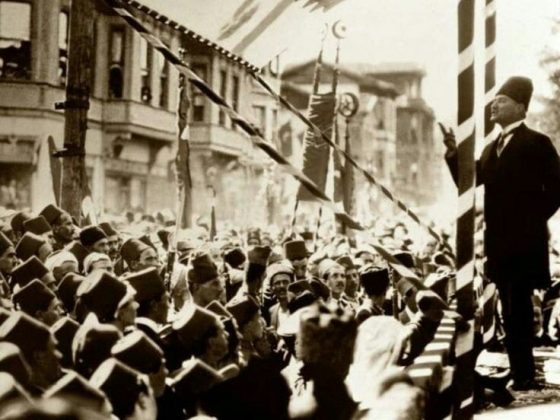
Africa: The geo-strategic importance of Libya and the background of Turkey-Libya relations

by Prof Dr Süleyman Kızıltoprak
15-01-2020
Turkey’s presence in Libya means ensuring the survival of the GNA, whose legitimacy is recognized by the UN, and at the same time protecting the unity and integrity of the Libyan people against imperial powers, and guaranteeing their independence and internal peace.

SÜLEYMAN KIZILTOPRAK: The geo-strategic importance of Libya and the background of Turkey-Libya relations

Ahmed Cevdet Pasha strongly stated that “A politician who does not know history is like a captain of a ship who does not know a compass”, and that statesmen will find correct solutions to the problems they face by looking at them from a historical perspective. Let’s try to present a historical perspective here today.

After Phoenician, Carthage, Greek, Roman and Byzantine domination, Hz. During the reign of Omar, the army under the command of Amr bin As moved towards Tripoli  and Tunisia after Egypt in 642  . In 647, victory was won in Tripoli with Uqbe bin Nafi. The conquest of North Africa was completed in 707 by Hassan bin Nu’man and Musa bin Nusayr. Tariq bin Ziyad conquered Spain in 711 and brought Islam to Europe from the southwest.

In order to ensure internal peace and security in North Africa, Harun Reşid appointed İbrahim bin Ağleb, the son of one of his emirs, as governor of Libya  in 800. and he established the Ağlebiler (800-909) dynasty, which would rule Tunisia under the Abbasid caliph, with his own hands. After the domination of the Fatimid State (909-1049) and the Almohad State (1160-1178), the Slave commander Şerefeddin Karakuş under the command of Salahaddin Ayyubid, with the expeditions he started in 1174, the policy of reintegrating North African cities such as Tripoli, Kayrevan and Tunisia into Egypt. acted within the framework. In 1185 he captured the city of Tripoli. The most important result of the campaigns of Karakuş and his friends and their domination until 1212 is that the Oghuzs in their troops participating in the North African expedition made their presence permanent. The Oghuzes continued their existence as military units called “guz” and “gazaz” in the state of the Almohads. The Gazaz tribe living in Yefrin today probably dates from those days. After the Almohads,Except for the interregnum period, the Hafsids dominated Libya for a long time (1228-1323 and 1369-1510).

Hafsids and Ottomans

Acting with the crusader ideology, the Spaniards, after putting an end to the Islamic presence in Andalusia step by step, turned towards North Africa with all their strength. In 1510, the Castilian army occupied Tripoli, which was dominated by the Hafsids, and put its people to the sword. Those who saved their lives evacuated Tripoli and fled into the country or were exiled.

 The most basic question to be asked is, “What is Turkey doing in Libya?” It’s not a question. Instead, “What are imperialist countries like the USA, Russia, France, Italy doing in Libya?” question should be asked.

Suleiman the Magnificent, who ascended the throne in 1520, provided the military aid requested by the delegation from Tacura in 1519, during the reign of his father, Sultan Selim. He sent a military fleet under the command of Murad Ağa. Murad Ağa established a strong resistance center in Tajura. Three years after Tripoli was given to the Maltese knights by Emperor Charles V in 1530, Kaptanıderyâ Barbaros Hayreddin Pasha re-conquered the city. However, this conquest did not last long with the Spanish counterattacks and the struggle for dominance in the city continued. At the end of this struggle, which lasted for 32 years, Tripoli joined the Ottoman lands on 15 August 1551 with the forces of Kaptanıderyâ Sinan Pasha, Turgut Reis and Murad Ağa.

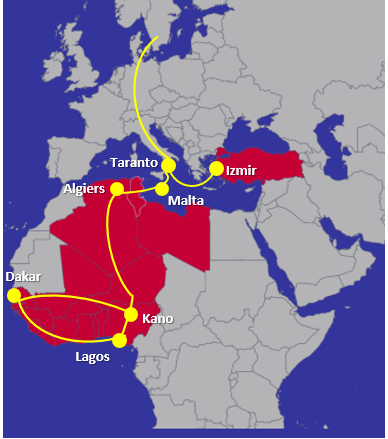
After the conquest, Murad Agha became the governor of Tripoli (1551-1553). After his death, Turgut Reis (1553-1565) came to the governor’s office and united the coastal part of the country and the desert region socially, politically and economically. Tripoli gained peace and prosperity during his reign. In the geography called “Libya” today, the Ottoman state had separate administrative centers under the names of Tripoli, Benghazi and Fizan. The quarries of Algeria, Tunisia and Tripoli were collectively called the “Occidental Hearths”. Although these quarries did not constitute a significant source of production and income for the central state, they served as an outpost in the Mediterranean for the defense of the Ottoman state and the Islamic world.

While the Ottoman state included young men of Christian origin in the Balkans to its central military organization, with the method of devshirme, it sent young men from Anatolia as soldiers to the Western Hearths in order to defend its lands in North Africa. Thus, the Ottoman Empire tried to develop the military capacity of the region, which had limited human resources in terms of military profession. By allowing these professional soldiers serving in Libya, Tunisia and Algeria to marry local girls, a generation of “Kuloğlu” emerged, whose numbers are now in the millions. “Kuloğulları” means soldiers of Anatolian origin, whose fathers are soldiers and their mothers are local people. In addition to the approximately 1000-2000 soldiers who are enlisted in the hearth every year,The number of Kuloğulları also increased arithmetically and they were employed in various civil service positions in the state and as a separate source of military force in the defense of the country.

Ahmed Şerîf went to Ankara on 15 November 1920 and met Mustafa Kemal at a dinner on 25 November. The Speaker of the Grand National Assembly of Turkey and the Commander-in-Chief presented Mustafa Kemal with a sword inlaid with jewels and a belt adorned with verses and hadiths. He sided with Atatürk during the War of Independence. He chaired the Great Islamic Conference convened in Sivas on Friday, February 18, 1921, by mobilizing all his might to support the National Struggle, saying “The Islamic world cannot get rid of the colony without Turkey’s independence” and “For the independence of Libya, we must first gain Turkey’s independence”. he did. Ahmed Sharif es-Senusi, with the assignment of Mustafa Kemal, carried out activities in order to unite the Arab tribes in Iraq against England.

As we entered the seventeenth century, the people who were appointed as Tripoli governor by sending from Istanbul had difficulties in maintaining their positions against the changing balances in the world and the Mediterranean. With the increase in world trade in terms of capacity and value and the deterioration of existing balances, the obligation to ensure the security of Mediterranean trade brought new risks. The Ocaklılar and Kuloğulları, who emerged as a new social, economic and military power behind them, took the lead against those sitting in the office of governor. Because the beylerbeyi knew that he would go to another job after serving for three years, that is, for a temporary period, he preferred to leave the main responsibility to “Uncle Ocaklı” and stay in a representative position instead of taking long-term actions.

Karamanlı Ahmed Bey, who became his uncle in 1711, enabled the sultan to take a decision that put an end to the practice of being a governor in this representative position. Ahmed Bey was given a privilege similar to the “regent of the sultan”, allowing him to establish a Karamanli dynasty in Tripoli. Until the end of the eighteenth century, naval raiding, which contributed partially to the Western Hearths of the Ottoman state, lost its importance in the face of modern armed merchant ships. In fact, the Governor Yusuf Pasha was in a difficult situation to compensate the damages suffered by the pirate raids of the ships, whose safety was guaranteed by the Tripoli governor in return for a certain price. Yusuf Pasha’s failure to take a position against Napoleon, who attacked Egypt, was also criticized in Istanbul.

In 1827, on top of the administrative crisis in Libya, the Ottoman navy was burned in Navarin by the joint navy of the European states. When developments such as the Greek revolt in the Eastern Mediterranean, the French occupation of Algeria in 1830 and the rebellion of Mehmet Ali Pasha were added to these, the necessary intervention in Tripoli was delayed. As a matter of fact, with the Tanzimat Fermanı declared in 1839, the province was connected to the center. The imperialist ambitions of France towards Tunisia and Libya as well as Algeria were known. Therefore, warm relations were established with the Gat, Tuareg (Tevârık), Ezgar and Hoggar tribes on the route to Fezzan and Central Africa. Steps were taken to ensure the safety of Sudan-Senegal, Sudan-Morocco caravan trade routes. However, when Egypt and then Sudan were occupied by the British in 1882,The stability and security environment established by the Ottomans took a heavy blow. Thus, the province suffered a significant loss of income and was waiting for the help from the center.

Tripoli sent three deputies to the Ottoman Assembly, which was established in 1877. In 1908, II. When the Constitutional Monarchy was declared, a total of eight deputies, one from Hums, two from Benghazi, three from Tripoli, one from Fezzan and one from Jabeligarb, represented Libya in the Parliament.

II. Abdulhamid’s Libya policy

Efforts were made to prepare the people against any invasion by establishing Hamidiye regiments, consisting of the children of tribal leaders and Kuloğulları in Libya. In order to repel attacks from the coast, weapons depots were set up at strategic defense points along the long coastline from Tunisia to the Egyptian border. On the other hand, in Tripoli, Fizan and Benghazi, sect sheikhs and tribal leaders, who were opinion leaders, were given medals and medals, and titles emphasizing loyalty to the Ottoman state were created. In this context, Sheikh Zafir Efendi, the leader of the Medeniyye sect, a branch of the Shazeliyye sect, which had an impact on the tribes in the region, II. He came to Istanbul at the invitation of Abdülhamid and received the title of his special adviser. During the reign of Sultan Abdulaziz, the support given to the Senusi zawiyas was increased and continued.Because, the Senusiyya sect was influential in the economic, political and social life of the region with its lodges on the trade route known as “Bilad al-Sudan trade”, which stretches from the Mediterranean to the sub-Saharan via Benghazi and Chad, and from there to Sudan at one end and Senegal and Morocco at the other end. . As a matter of fact, the members of the Senusiyya showed a very stable and strong resistance against the French and Italian imperialist expansion.

Ataturk and Libya

The sanjak of Fezzan was a place where the Ottoman state exiled the Young Turks. However, in the face of the colonial attacks of the Italians, medical and cadet Young Turks who were exiled in Fezzan at that time were employed in various areas of the province. Thus, they started to serve the Libyans in the positions of doctors, teachers and administrative officers in the province. Their presence, mingling with the people in Libya, strengthened rather than weakened the loyalty of local communities to the Ottoman caliph. So much so that in 1908 II. When the Constitutional Monarchy was declared, the Libyan people did not participate in the great joyful demonstrations of the Young Turks in Tripoli, and there were even those who reacted. Thereupon, the notables of the Union and Progress, the constitutional administration, the rule of law, equality,He sent Mustafa Kemal to Libya to explain what concepts such as justice and freedom meant. Mustafa Kemal, who was active in Libya to oppose the colonial Italians on an intellectual level, planted the seeds of freedom here. Mustafa Kemal, who resisted with only 5,500 soldiers against the Italians, who attempted to invade Libya with a hundred thousand soldiers in 1911, invited the people to join the resistance in order to increase the number of local soldiers as much as possible. Tripoli Commander Staff Colonel Neş’et Bey, Staff Major Ali Fethi (Okyar) Bey, Captain Nuri (Conker) Bey, Benghazi Commander Enver (Paşa) Bey, Kolağası Mustafa Kemal (Atatürk) Bey, Süleyman Askerî Bey and Kuşçubaşı Eşref Bey. With the successful work of the names, the Italians were almost imprisoned in the coastal parts and could not enter the inner parts of Libya.Mustafa Kemal, who was active in Libya to oppose the colonial Italians on an intellectual level, planted the seeds of freedom here. Mustafa Kemal, who resisted with only 5,500 soldiers against the Italians, who attempted to invade Libya with a hundred thousand soldiers in 1911, invited the people to join the resistance in order to increase the number of local soldiers as much as possible. Tripoli Commander Staff Colonel Neş’et Bey, Staff Major Ali Fethi (Okyar) Bey, Captain Nuri (Conker) Bey, Benghazi Commander Enver (Paşa) Bey, Kolağası Mustafa Kemal (Atatürk) Bey, Süleyman Askerî Bey and Kuşçubaşı Eşref Bey. With the successful work of the names, the Italians were almost imprisoned in the coastal parts and could not enter the inner parts of Libya.Mustafa Kemal, who was active in Libya to oppose the colonial Italians on an intellectual level, planted the seeds of freedom here. Mustafa Kemal, who resisted with only 5,500 soldiers against the Italians, who attempted to invade Libya with a hundred thousand soldiers in 1911, invited the people to join the resistance in order to increase the number of local soldiers as much as possible. Tripoli Commander Staff Colonel Neş’et Bey, Staff Major Ali Fethi (Okyar) Bey, Captain Nuri (Conker) Bey, Benghazi Commander Enver (Paşa) Bey, Kolağası Mustafa Kemal (Atatürk) Bey, Süleyman Askerî Bey and Kuşçubaşı Eşref Bey. With the successful work of the names, the Italians were almost imprisoned in the coastal parts and could not enter the inner parts of Libya.Mustafa Kemal, who resisted with only 5,500 soldiers against the Italians, who attempted to invade Libya with a hundred thousand soldiers in 1911, invited the people to join the resistance in order to increase the number of local soldiers as much as possible. Tripoli Commander Staff Colonel Neş’et Bey, Staff Major Ali Fethi (Okyar) Bey, Captain Nuri (Conker) Bey, Benghazi Commander Enver (Pasha) Bey, Kolağası Mustafa Kemal (Atatürk) Bey, Süleyman Askerî Bey and Kuşçubaşı Eşref Bey. With the successful work of the names, the Italians were almost imprisoned in the coastal parts and could not enter the inner parts of Libya.Mustafa Kemal, who resisted with only 5,500 soldiers against the Italians who attempted to invade Libya with around one hundred thousand soldiers in 1911, invited the people to join the resistance in order to increase the number of local soldiers as much as possible. Tripoli Commander Staff Colonel Neş’et Bey, Staff Major Ali Fethi (Okyar) Bey, Captain Nuri (Conker) Bey, Benghazi Commander Enver (Pasha) Bey, Kolağası Mustafa Kemal (Atatürk) Bey, Süleyman Askerî Bey and Kuşçubaşı Eşref Bey. With the successful work of the names, the Italians were almost imprisoned in the coastal parts and could not enter the inner parts of Libya.With the successful efforts of important names such as Staff Major Ali Fethi (Okyar) Bey, Captain Nuri (Conker) Bey, Benghazi Commander Enver (Paşa) Bey, Kolağası Mustafa Kemal (Atatürk) Bey, Süleyman Askerî Bey and Kuşçubaşı Eşref Bey, the Italians were almost imprisoned in the coastal areas. and they were unable to enter the interior of Libya.With the successful efforts of important names such as Staff Major Ali Fethi (Okyar) Bey, Captain Nuri (Conker) Bey, Benghazi Commander Enver (Paşa) Bey, Kolağası Mustafa Kemal (Atatürk) Bey, Süleyman Askerî Bey and Kuşçubaşı Eşref Bey, the Italians were almost imprisoned in the coastal areas. and they were unable to enter the interior of Libya.

The start of the Balkan Wars forced the Ottoman state to find an urgent solution for the situation in Libya. The Treaty of Ushi was signed on October 18, 1912. While the Italians’ dominance in Libya was recognized, an official with the title of “Nâibü’s-sultan” was appointed to represent the Muslims. When the First World War began, in the context of policies preventing Italy from joining the Anglo-Russian-French alliance, the Ottoman state took care not to openly violate the provisions of the Ushi Treaty, which were never fully implemented. Ahmed Şerîf es-Senûsî (1873-1933), who fought fiercely against the Italians, had to go to Istanbul on 30 August 1918 with a submarine, upon the agreement of Seyyid Idris from the Senusi family with the British and Italians. VI. During the enthronement ceremony held for Mehmed (Vahdettin) in Eyüp Sultan Mosque, the sword served as a siege.This mission is the clearest proof of how high the prestige shown to Ahmed Sharif in Istanbul is.

Ahmed Şerîf went to Ankara on 15 November 1920 and met Mustafa Kemal at a dinner on 25 November. The Speaker of the Grand National Assembly of Turkey and the Commander-in-Chief presented Mustafa Kemal with a sword inlaid with jewels and a belt adorned with verses and hadiths. He sided with Atatürk during the War of Independence. He chaired the Great Islamic Conference convened in Sivas on Friday, February 18, 1921, by mobilizing all his might to support the National Struggle, saying “The Islamic world cannot get rid of the colony without Turkey’s independence” and “For the independence of Libya, we must first gain Turkey’s independence”. he did. Ahmed Sharif es-Senusi, with the assignment of Mustafa Kemal, carried out activities in order to unite the Arab tribes in Iraq against England.

Libya independent from Italian colonialism

The Italian occupation period in Libya lasted from 1911 to 1943. When Italian-German troops were defeated and left Libya in 1943, Tripoli and Benghazi were occupied by British troops and Fezzan by French troops. Libya-Turkey relations resumed at the stage of the UN’s decision on the future of Libya. He made a temporary state structure in the city of Berka. Sheikh İdris es-Senusi applied to Turkey on behalf of Libya and requested experts to be appointed at a high level. In this context, many high-ranking officials, especially Sadullah Koloğlu, who presided over the Libyan government, left Turkey. King Idris es-Senusi, who declared the state of Libya on December 24, 1951, was the king of the poorest country in the world at that time. Libya gave military bases to these countries through agreements with Britain in 1953 and the United States in 1954.In return, he made a financial contribution to the country’s budget with the rent and compensation he received from these countries. The fate of the country changed when rich oil deposits were discovered in Libya in the early 1960s. It became a candidate to become one of the richest countries from the status of the poorest country in the world. After that, a revolution took place in Libya in 1969. Although relations with Turkey were frozen for a while, the leader of the revolution Gaddafi renewed bilateral friendly relations by supporting Turkey’s Cyprus Peace Operation.Revolutionary leader Gaddafi renewed bilateral friendly relations by supporting Turkey’s Cyprus Peace Operation.Revolutionary leader Gaddafi renewed bilateral friendly relations by supporting Turkey’s Cyprus Peace Operation.

Why is Libya important for Turkey?

As a result, besides Turkey’s existing historical and cultural ties with Libya, its geographically neighborly relations are also of significant importance. Knowing its historical responsibilities does not mean that a country should make bilateral agreements to protect its rights in sea waters or challenge other powers to fight. Declaring his will to protect his rights and interests at all costs and showing loyalty to his bilateral relations expresses the power and deterrence of that state. Turkey’s current relations with Libya are based on a 500-year-old background. In this huge historical past, Kanuni II. There are memories dating back to Abdülhamid, from Mustafa Kemal to the government of Bülent Ecevit-Necmettin Erbakan. In addition, Murad Ağa, who fortified Libya’s current religious, political and cultural identity,The tombs of great commanders and admirals such as Turgut Reis and the architectural works they founded continue their existence there with all their splendor. These artifacts, which the Spanish and Maltese knights could not wash, even resisted the bombs in the Second World War. Today, Turgut Reis’s tomb stands as a joint monument of the Turkish-Libyan friendship history, despite the attacks of the fanatics who define the tombs as a “centre of polytheism” instead of seeing them as historical heritage.Turgut Reis’s tomb stands as a joint monument of Turkish-Libyan friendship history.Turgut Reis’s tomb stands as a joint monument of Turkish-Libyan friendship history.

On the other hand, the Libyan government gave military support to the Turkish soldiers who came to the rescue of the Turkish Cypriots in 1974, despite the reaction of the Western powers. After the loss of a piece of land where Muslim Turks lived for the first time, which resulted in the 1774 Küçük Kaynarca Agreement, Libya had a share in the first victory, though indirectly, in the first victory of the Turkish military with a military campaign to an area outside its borders where Muslim Turks lived. The fact that Mustafa Kemal Pasha prepared the people of Libya for resistance in 1911 before starting the War of Independence in Anatolia and organizing the nation against the imperialist invaders is a situation that deserves special attention. After this experience at the age of 30, Mustafa Kemal became the Anafartalar Hero at the age of 34 and started the War of Independence from Samsun at the age of 38.Although he was injured in his eye in Libya, where he ran to the rescue at the cost of his life, he did not give up. When Mustafa Kemal started a struggle against the people of Anatolia against those who tried to occupy the center of the homeland by revealing all their existence, his friend Ahmet Şerîf es-Senûsi, who came from Libya, was with him. Based on these experiences, Turkey-Libya friendship will again be decisive in establishing peace in the region.

In the light of all this information, we can say that Turkey’s indifference to what is going on in Libya and the Eastern Mediterranean will directly affect Ankara’s geopolitical and geostrategic position, regardless of which government is in power. One of the factors affecting the collapse of the Ottoman state was that although it gradually lost its maritime sovereignty in the Mediterranean, it could not develop a solution against it. The fact that Turkey is in Libya today means that the “project of being squeezed into the Gulf of Iskenderun” has been aborted. So much so that if Turkey cannot maintain its presence in the Mediterranean, even the unauthorized navigation of Turkish ships and planes in the Eastern Mediterranean will be endangered. In this context, the most basic question to be asked is, “What is Turkey doing in Libya?” It’s not a question. Instead, “USA, Russia,What are imperialist countries like France and Italy doing in Libya?” question should be asked. In addition, the presence of the UAE and Saudi Arabia in Libya, which act together with the imperialist countries but do not take even the slightest step to cure the Arab and Islamic world, should also be questioned.

The Libyan government gave military support to the Turkish soldiers who came to the rescue of the Turkish Cypriots in 1974, despite the reaction of the Western powers. After the loss of a piece of land where Muslim Turks lived for the first time, which resulted in the Treaty of Küçük Kaynarca in 1774, Libya had a share, albeit indirectly, in the first victory of the Turkish soldiers with a military campaign to an area outside its borders where Muslim Turks lived.

Undoubtedly, Turkey’s presence in Libya means ensuring the survival of the Libyan Government of National Accord (GNA), whose legitimacy is recognized by the UN, and at the same time protecting the unity and integrity of the Libyan people against imperial powers, and guaranteeing their independence and internal peace. As it is known, a state has geopolitical and geocultural borders as well as political borders. In this context, it is not an exaggeration to state that Turkey’s geopolitical and geostrategic borders start from Libya in order to protect its presence and interests in the Mediterranean. It is an obvious fact that one of Turkey’s most important steps towards becoming a regional and global power depends on having a strong naval power capacity as it was during the reign of Suleiman the Magnificent. 6 of the largest fleets in the USA.Considering that the fleet is stationed in Sicily to control the Mediterranean, and Russia’s fortification of the Tartus bases in Latakia, Turkey, as a country with the largest coastline in the Eastern Mediterranean, has its arms in the Eastern Mediterranean and Libya. cannot be expected to follow. Turkey’s initiatives are very important and historically important in order to protect the country’s interests and regional peace.

[Prof. Dr. Süleyman Kızıltoprak is a faculty member at Mimar Sinan Fine Arts University]

@suleymankzltprk