Home Blog Page 118

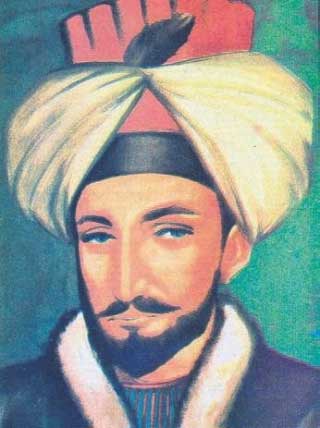
Katip Çelebi: Akla dayanan ilimlerin gerekli olduğu konusunu ele almaktadır.

Esirgeyen ve Yarlıgayan Tanrının Adıyla

Aklı halk için kılavuz kılan ve doğru olmayan ile doğru olanı ayırmak yolunda onunla şeriatı güçlendiren Allah’a hamdolsun. Bu ikisinin –akıl ile şeriatın– arasını kesip bulan nakil[1] ve kâmil akıl ile gönderilmiş olan Muhammed’e, onun soyuna ve arkadaşlarına, bilgin kişilerin toplantılarında konular dönüp dolaştığı, konuşulduğu sürece salat ve selam olsun.

Bundan sonra konuya gelelim: Yaratılışın başlangıcından beri bilgin kişiler arasında akıl ve naklin[2] ikiz olduğu, akla dayanan ile nakle dayananın iki rahvan at olduğu herkesçe kabul edilmiştir. Bu ikisi, kişiyi kesin ve su götürmez bilgilerin yücelerine çıkarmak için yol ve kılavuz, basamak ve merdiven olduğundan dolayı, araştırma ve görüşleri ortaya koyma yollarında akıl ve nakil [kaynakları] halkın dayanağı olduğu gibi, bütün işlerde de bu ikisine başvurulmaktadır.

Kimi kişiler kendilerini vesveseye düşüren şeytanın azdırıp yoldan çıkarması yüzünden, tanık gösterme yolunu bırakıp, bilgisizliğinden ve ahmaklığından ötürü zanlara ve içindeki kuşkulara kapılarak tanığın karşısına çıkmak diler; bundan dolayı da birkaç meselede kavgaya ve boş taassup [bağnazlık] hastalığına tutulur. Geçmişte olan taassup savaşları gibi bu akılsızların boş uğraşmalarının da zamanımızda vuruşup kırışmaya yol açmasına az kalmıştı. Bunun için kavgalı meselelerde tanık yolunu göstermek üzere birkaç satır karalayarak adına Mizânü’l-Hakk fî İhtiyâri’l-Ehakk [En Doğruyu Seçmek İçin Hak Terazisi] denildi; ta ki herkes bu kavganın, bu birbiriyle düşmanca uyuşmazlığın konusu nedir ve bundan nasıl bir sonuç alınır, bilsinler de ahmaklık yollarından dönüp kuru kavgadan vazgeçsinler.

İşte bu küçük kitap bir giriş ile nice konulara ayrılarak düzenlenmiştir.

GİRİŞ

Akla dayanan ilimlerin gerekli olduğu konusunu ele almaktadır.

Doğruyu bulmak isteyen bilsin ki, insanoğlunun ardında koştuğu ilim var olsa gerek, yok olan mutlak olarak bilinmez. Zihin oraya yönelmez. Eğer bu bilim maddeyi gerektirmiyorsa bu soydan işlerle ilgili konulara ilahi ilim derler, bunun dalı budağı çoktur; bu konuyu ele alan da ya hakîmdir, ya mütekellimdir.[3]

Var olan nesne, zihinde maddeyi gerektirmeyip de dışarıda maddeyi gerektiriyorsa, bununla ilgili konulara da riyazi ilim[4] derler; bunun kökleri dört bölümdür: sayı, hey’et, hendese ve musiki fenleri; bunların her birinin de nice dalı budağı vardır.

Var olan nesne hem dışarıda, hem zihinde mutlak maddeyi gerektiriyorsa, o soydan nesnelerle ilgili konulara da tabii ilim[5] derler; bu ilmin dalı budağı çoktur.

Bunların hepsi nazari hikmetin bülümleridir. Bir bölümü de amel ile ilgili olduğundan ona da ameli hikmet ve ahlak ilmi derler.[6]

İşte akla dayanan bütün ilimler ile nazari ve ameli olan ilimler bu yukarıdaki bölümlerin dışında değildir. Bunlar da fikir ve nazar yolu[7] ile söz konusu edilir. Fikirde yanlıştan korunmak için istidlal ve nazar kitapları yazılmış, adına da mizan ilmi[8] ve mantık ilmi denmiştir. Bunlar ilimlerin ölçüsü ve ayarıdır.

Büyük bilgin Seyyid Şerîf  Cürcâni’nin dediğine göre; bir bilgin, ilmini bu tartı ve bu ayar ile ayarlamazsa, onun bilgisine güvenilmez ve yer verilmez. Bundan dolayı kimi bilgisizlerin bu iki ilmin dince yasak olduğunu söylemeleri bilgisizlikten ve ahmaklıktandır. Yoksa gerçeği arayan bilginlerin çoğu bunun gerektiği düşüncesindedirler. Mantık ilmi doğrudan bir amaç değildir, amaçlara ulaşmak için bir yol ve alettir.

Yaratılışın başlangıcından beri bütün kavimlerin ve ümmetlerin arasında zaruri, gerçek ve bir delile dayanan ilimler yer tutmuştur. Bu söylenenler varlıkların gerçeğini, ne olduğunu araştıran ilimlerdir. Gökten inmiş kitaplar ve şeriat ilimlerinin konuları, adı geçen bu ilimlerin konuları ve meseleleriyle birçok noktada birleşip uyuşmuşlar ve belli bir sayıda maddede de ayrılmışlardır. Bundan dolayı Hıristiyan milletler felsefiyatı[9] reddettiler; ama Müslümanlar Tehâfüt[10] ile karşılık yazıp kesin olarak reddetmediler. Bu alanda yetkisi olanlar bu maddeleri bilirler.

Ama şeriat ilimleri de –ki bu zamanda murat İslam ilimlerinden ayrı değildir– ya doğrudan doğruya elde edilmesi istenen bir ilimdir ya da bunu elde etmeye vasıta olan bir ilimdir. Başka ilimleri elde etmeye vasıta olan bu ilimlere alet ilimleri, edebi ilimler ve Arapça ilimleri derler;[11] çünkü bunlar öğrenilmesi doğrudan amaç olan ilimler değildir. Edeb-i ders doğrudan doğruya ve edeb-i nefs[12] ise dolaylı olarak ona bağlıdır ve Arapça lafızları da konu olarak alır. Bunun bölümleri mevzuat kitaplarında[13] yazılı olduğu üzere oniki olarak tanınmaktadır.

Amacı doğrudan doğruya kendisi olan ilimler de konularıyla birbirinden ayırt edilir. Konusu Tanrı ise tefsir ilmidir ve Kuran ilmidir,[14] kollarıyla birlikte. Peygamberin sözü ise hadis ilmidir,[15] kollarıyla. İkisinden ve onlara bağlı olan konulardan çıkarılıp salt inançla ilgiliyse kelam ilmidir.[16] Niyahet müteahhirîn[17] hikmet konularını da bu ilme karıştırdılar. Büyük bilgin Sa’deddin Teftâzânî, Şerh-i Makasid’de “çok dar boğazdan onun yardımıyla çıkacak yol buldukları için” demiştir.

Eğer sırf inanç olmayıp amel ile de ilgiliyse kökleri, dalları ve onlara bağlı daha başka heveslendirme ve korkutma ilimleridir. Önceden söylendiği üzere akıl ilimleri[18] ve hikmet ilimleri bu ilimleri arasına sokulmuştur; o ilimleri anlamayanlar bu ilimleri de tam olarak anlayamaz.

***

Bundan sonra halk arasında yayılan inkâr konusuna gelelim. İslamlığın başlangıcında Peygamberin arkadaşları, Hazreti Peygamberden –Tanrı’nın salat ve selamı üzerinde olsun– aldıkları ve rivayet eyledikleri kitap ve sünnetle yapışıp İslamlığın kaidelerini gereği gibi yerleştirip berkitmeden başka ilimlerle uğraşmaya cevaz vermediler; belki de bunu yasaklamak yolunda çok sert davrandılar.

Bu yasağın bir sebebi de şudur: İslamlık Hicaz toprağında çıktı; Arabistan Yarımadası’nda oturanların her zaman üzerinde durdukları şiir ilmi, atasözleri ve Eyyam-ı Arap’tı.[19] İlim usullerinin bu alanda kullanılmadığını İbn Haldûn Mukaddime’de bütün ayrıntılarıyla anlatmıştır, isteyen onu okusun.

Hatta Hazreti Ömer –Tanrı kendisinden razı olsun– Mısır ve İskenderiye’yi aldığında orada bulunan nice bin cilt kitabın hepsini oda yandırdı. Çünkü öyle olmasa halk Allah’ın kitabını ve Tanrı elçisinin sünnetini korumaktan alıp, bu yakılan kitaplarla uğraşırlardı; İslamlığın temelleri bu derece yerleşip pekişmezdi.

İslamlığın ilk başlangıç yıllarında onlar bu işi gördüler. Peygamberden sonra gelen Dört Halife zamanında ve onların ardından gelen ikinci, üçüncü devirde Peygamberin zamanına yetişmeyip de onun sahabelerine uyanlar ve müçtehitler[20] ravilerin rivayet ettiklerini kitap halinde toplayıp usul ve fürû kaidesine[21] göre şeriatın ortaya koyduğu delillerden ilahi ahkâmı[22] bulup çıkararak yazıp çizdiler.

İslam ilimleri işlenip kitap haline konduktan, herhangi bir yolla bunların bozulması önlenip yazıya geçirildikten sonra; İslam uluları gördüler ki eskilerin yasaklanması bu amaçlaydı, sakınca ortadan kaldırıldı ve iş bitti.

Müslümanlar için varlıkların gerçeğini bilmek önemlidir, diye Emeviler ve Abbasoğulları devirlerinde evâil kitaplarını[23] çevirip Arapçaya döndürdüler. Yaradılışları sağlam, akılları başlarında olan ve doğru düşünen kimseler bunları her devirde okuyarak elde edip öğrenmekten geri kalmadılar. Kitap yazmak ve gerçeği araştırmak alanında, hikmet ve şeriatın arasını bulup birleştiren ve gerçeği araştıranların eserleri her çağda ün kazandı, itibar gördü ve geçerli oldu.

İslam bilginlerinden ve hakikati araştıranlardan İmam Gazzâlî, İmam Fahreddin Râzî, büyük bilgin Adududdin Îcî ve onların izinden gidenlerden Kadı Beyzâvî, ulu bilgin Şîrâzî, Kutbeddin Râzî, yine büyük bilgin Sa’deddin Teftâzâni, Seyyid Şerîf Cürcânî –ulu Tanrı hepsine rahmet etsin– ve onların yolundan gidenlerden büyük bilgin Celâleddin Devvânî ile öğrencileri gerçeği bulma ve inceleme konağına ulaşıp tek bir konuda kalmadılar.

Lakin nice boş kafalı kimseler İslamlığın başlangıcında bir maslahat için ortaya konan rivayetleri görüp cansız taş gibi –akıllarını kullanmadan– salt taklit ile donup kaldılar. Aslının sorup düşünmeden red ve inkâr eylediler. Felsefe ilimleri diye kötüleyip, yeri göğü bilmez cahil iken bilgin geçindiler. “Göklerin ve yerin hükümranlığına, Allah’ın yarattığı her şeye ve ecellerinin yaklaşmış olabileceğine bakmadılar mı?” [A’RAF 7: 185] tehdidi kulaklarına girmedi. Yere ve göklere bakmayı öküz gibi göz ile bakmak sandılar.

***

Ulu Osmanlı devletinin ilk çağlarından Sultan Süleyman Han zamanına gelince dek hikmet ile şeriat ilimlerini uzlaştıran gerçek araştırıcılar ün salmışlardı. Ebülfeth [Fatih] Sultan Mehmed Han, Medaris-Semani’yi[24] yaptırıp kanuna göre iş görülüp okutulsun diye vakfiyesinde yazmış, Haşiye-i Tecrîd[25] ve Şerh-i Mevâkıf derslerinin okutulmasını bildirmişti. Sonra gelenler bu dersler felsefiyattır diye kaldırıp Hidâye ve Ekmel[26] derslerini okutmayı akla uygun gördüler. Yalnız bunlarla yetinmek akla uygun olmadığı için felsefiyat kaldı, ne Hidâye kaldı, ne Ekmel.

Bununla Osmanlı ülkesinde ilim pazarına kesat gelip bunları okutacak olanların kökü kurumaya yüz tuttu. Kıyıda köşede, Doğu Anadolu’da yer yer kanuna göre ders gören öğrencilerin daha başlangıçta olanları bile İstanbul’a gelip büyük tafra satar oldular. Onları gören kimi kabiliyetli insanlar zamanımızda hikmet öğrenmek istediler.

Fakir [ben] de yoklama ve ders okutma sırasında istidadı olan öğrencileri, Sokrat’ın Eflatun’u heveslendirdiği gibi, varlıkların gerçeğini araştıran ilmi öğrenmeleri için heveslendirdim; bu risalede de öğüt ve hepsine nasihat olsun diye şu birkaç maddeyi ele alıp söyledim. Ta ki mutlak ilim[27] adına olanı elden geldiğince öğrenmeye çalışsınlar, elbette bir yerde lazım olur, zararı olmaz. Kötüleyip inkâr eylemeyeler; çünkü bir şeyi inkâr, o nesneden uzak ve yoksul kalmaya yol açar.

Birinci Madde: Hendese bilen müftü ile hendese bilmeyen müftünün fetvasıdır.[28]

Bir kimse boyu, eni ve derinliği dört zirâ[29] bir kuyu kazmak için birini sekiz akçeye tuttu. O da boyu, eni ve derinliği iki zirâ olan bir kuyu kazdı; karşılığında dört akçe istedi. Fetva ettirdiler, hendese bilmez müftü dört akçe hakkıdır, dedi. Hendese bilen müftü hakkı bir akçe diye fetva verdi; doğrusu da budur, çünkü iki zirâ kuyu, dört zirâ kuyunun sekizde biridir, ücretin de sekizde bir olması gerekir.

İkinci Madde: Hendese bilen kadı ile hendese bilmeyen kadının hükmüdür.

Bir kimse boyu ve eni yüz zirâ olmak üzere bir tarlayı başkasına satıp teslim edeceği zaman boyu ve eni ellişer zirâ iki tarla verdi. Aralarında uyuşmazlık çıkıp bir kadıya vardılar ki hendese bilmezdi; hakkı budur diye hükmeyledi. Sonra hendese bilen bir kadı bulup dinlettiler, yarım hakkıdır dedi; doğrusu da budur. Bunların aslını bilmek isteyen riyaziyat (matematik) görmeye heves eyleye.

Üçüncü Madde: Bilgin Beyzâvî “Ay için de birtakım menziller (yörüngeler) tayin ettik. Nihayet o, eğri hurma dalı gibi (hilal) olur da geri döner” [YÂSÎN 36:39] ayetinin tefsirinde ayın yirmi sekiz menzilini söyledikten sonra “Ay her gece bu menzillerden birine uğrar, şaşırmaz, o menzili ne aşar ne de o menzilin arkasında kalır”[30] demiştir. Eğer ayın her menzile inmesi hep aynı vakitte olsaydı bu söz doğru olurdu, lakin öyle değildir. Kimi gecenin ortalarında bir menzilden bir menzile geçer, kimi bir gecede iki menzile yürür ve her menzil için aşağı yukarı on üç derece belki bir sınır vardır. Ayın yürüyüşü kimi on bir derece, kimi on beş derece olur. Niçin böyle olduğunun aslının bilmek isteyen nücum ve felekiyat[31] fenlerini göre.

Ve bir madde de İskender’in “iki dağ arasında” yürüyüşünde [KEHF 18:93] vardığı yerin Ermeniyye ve Azerbayca dağları olduğu söylenmiş ve bunlar bilinen Tebriz yakınındadırlar diye yazılmıştır. Bu da gerçeğe uygun değildir. Doğrusunu bilmek isteyen coğrafya fennini okuyup incelesin.

Dördüncü Madde: Budur ki riyaziyat [matematik] dersleriyle uğraştığım sırada hatıra gelen üç meseleyi fıkıh meseleleri[32] biçimine koyarak şehülislam Bahâi Efendi’den fetva istemiştim. Ses çıkmadığı için bunları açıklayan bir risale yazdıktan sonra, gördüm ki üç sorunun birine meğer cevap yazmışlar. Kendi el yazısıyla fetva emini[33] Şeyhzâde Efendi’den çıkan bu karşılık, yanlışın yanlışı olduğu için risalenin sonunda gibi verilerek, “Bu yanlış karşılığın düzeltilmesi” diye bir ek yazılmıştır; isteyen yazdığım risaleyi görüp[34] bilsin.

Sorulardan biri budur ki: Güneşin batından doğması hey’et[35] kaidesine uygulanır mı? Biri de, altı ay gündüz altı ay gece olan yerlerde beş vakit namaz nice kılınır ve oruç nice tutulur? Biri de Mekke-i Mükerreme’den başka yerde dört yön kıble olur mu?

Öyle ise istidatlı kimselerin mâkulat[36] ve riyaziyat öğrenmeye çalışması gerek; ta ki nazar yolunda zan ve şüphe sahibi, çok vehimli ve çok şüpheli olmasın.

Tembih: Bundan sonra bilinir ki bir toplulukta, bir konuda kavga ve uyuşmazlık çıkıp yerleştikten sonra o kavgayı ve uyuşmazlığı bütünüyle ortadan kaldırmak mümkün ve kolay değildir. Eğer eli kılıçlı, güçlü bir kişi çıkıp da bir tarafı güç kullanarak bastırıp susturmak istese de olmaz, sürülür gider.

***

İmdi bu risaleyi yazmaktan beklenen, istidatlı olanlara tecrübe, istidlal ve cedel alanında bir gösteriştir. Yoksa ayaktakımı hayvan gibidir, onların bahs ü cedeline[37] ne itibar.

Bu da bilinir ki Âdem zamanından beri halk bölük bölüktür. Her bir bölüğün bir türlü gidişi ve bir türlü tutumu vardır, ki bu öteki bölüğe aykırı görünür. “Dinlerini parçalayan ve bölük bölük olanlardan (olmayın. Bunlardan) her fıkra, kendilerinde olan ile böbürlenmektedir” [RÛM 30:32] denildiği gibi hepsi kendi yolunu beğenip, onu ötekinin yolundan üstün tutar.

Nihayet kimi akıllıdır, bu uyuşmazlığın hikmeti üzerine durup düşünerek altında nice işler bulur. Kimsenin gidişine ve tutumuna karışıp sataşmaz. Kendi dini bakımından eğer şeriatın beğenmediği bir iş ise bunu içinden inkâr ile yetinir.

Kimisi de ahmaktır, uyuşmazlığın nereden çıktığını bilmez; bütün insanlar bir gidişte bir tutumda olsun diye olmayacak bir şey kurar. din işinde gereği yokken kavga ve uyuşmazlık yasak olduğu halde, işe karışmak ve sataşmak kaydına düşer, yerleşmiş ve kökleşmiş işleri kaldırmaya çalışır, mümkün olmaz. boşuna zahmet çeker.

İmdi gerekir ki basiret[38] sahipleri, insanlığın ondan ayrılmaz yönleri olan temeddünün[39] ve toplu halde yaşamanın gerektirdiklerini bilerek, halkın bölük bölük bölündüğünü ve her birinin özelliklerinin ne olduğunu bilmeli, öğrenmelidirler. Bu şehir halkının sınıflarını, her sınıfın törelerini ve göreneklerini bilip anladıktan sonra, bütün yeryüzünde yaşayanların da sınıfları ve halleri üzerinde toplu bir bilgi edinmeye çalışmalıdırlar. Bunu da bilip öğrendikten sonra hikmet-i temeddünün[40] sırrı gittikçe açılır, ortaya çıkar. Giderek bilinir ki bu soydan kavgacı ve iddiacı kişiler örümcek ağına düşen sinek gibi güçsüz ve dermansızdır.

Kaynak: Çelebi, Kâtip; Mîzânü’l-Hakk Fî İhtiyâri’l-Ehakk, Kabalcı Yayınevi, sayfa 15-24

[1] Nakil: Başta Kuran olmak üzere, hadisler ve dinin esaslarını bildiren ana kaynaklar.

[2] Akıl ve Nakil: Bilimin iki ana kaynağı. Akıl bilinmeyeni arayıp bulmak için müşahede, muhakeme ve deneme yolundan yürür. Naklin bu yoldaki dayanağıysa, akıldan da yararlanmak şartıyla Allah’ın indirdiği kitap ile Peygamberin hadisleridir.

[3] İlahi ilim: Konusu mutlak varlık olan ilim; Tanrı’yı bilme ilmi.

Mütekellim: Konusu Allah’ın kendisi, sıfatları, başlangıcı ve sonu bakımından kâinat olan ilimle uğraşan kişi.

[4] Riyazi ilim: Matematiksel ilim. Aslında geometri (hendese), hesap, astronomi (hey’et) ve optik gibi geometrik muhakemeye dayanan bazı ilimler için kullanılan ad.

[5] Tabii ilim: Konusu doğanın sorunları ve olayları olan ilim.

[6] Nazari hikmet: Metafizik, matematik ve fiziği içine alan ilimler.

Ameli hikmet: Pratik felsefe. Konusu insanların hareketleri ve davranışları olan ilim.

Ahlak ilmi: Öğretme amacıyla ortaya konmuş olan ahlak kuramı. Ertemleri ve onları elde etmenin yollarını, kötülükleri ve onlardan kaçınmanın yollarını öğreten ilim.

[7] Nazar yolu: Gözlem, muhakeme ve deneme yolu.

[8] İstidlal ve nazar kitapları: Birtakım delillere dayanarak, gözlem ve muhakeme ederek, denemeler yaparak bir sonuç çıkarmayı anlatan kitaplar.

Mizan ilmi: Felsefenin bir kolu; konusu genellikle düşünme şekillerini içerir. Özel olarak delillere dayanarak sonuç çıkarma yollarından ve bilimsel yöntemlerinden bahseder.

[9] Felsefiyat: Din kitaplarının öğrettikleriyle yetinmeyip, Allah ve kâinata dair bazı soruların karşılığını bulmak için aklın ortaya koyduğu düşünceler, muhakeme ve görüşler.

[10] Tehâfüt: İmam Gazzâli’nin eserine (Tehâfütü’l-Felâsife: Filozofların Tutarsızlığı) ad olarak verdiği bu kelimenin, kullanıldığı yere bakıldığında özel anlamı “tutarlı bir düşünceye dayanmadan kurdukları fikir yapıları yüzünden, filozofların ve onların fikirlerinin birbiri ardına yıkılıp düşmesi” demektir. Bkz. Dr. Mübahat Türkler, Üç Tehâfüt Bakımından Felsefe ve Din Münasebetleri, Ankara, 1956.

[11] Alet ilimleri: Daha yüksek bilgileri edinmeye yarayan belagat, gramer, maani, mantık gibi ilimlere verilen ad.

Edebi ilimler: Arapça ilimleri diye anılan edebi ilimler, Arap dilinde söyleyip yazmakta yanlış yapmayı önlemek için bilinmesi gerekli ilimlerdir.

[12] Edeb-i ders: Edebi kültür için bir kişinin öğrenmesi gereken bilgiler; bunlar Zemahşerî’nin Kıstas adlı eserinde sıralandığına göre on iki ilimdir: Lûgat, sarf, nahiv, iştikak, maani, beyan, aruz, hat, şiir tenkidi, nesir, muhazarat ve belagat ilmine bağlı olan bedii.

Edeb-i nefs: İnsanın halkla düşüp kalkmasında ve onlarla münasebetleri sırasında güzel ahlakı ve beğenilen özellikleri benimseyip kendinde toplaması.

[13] Mevzuat kitapları: Türlü ilimlerin konularını ve birbirleriyle ilişkilerini gösteren kitaplar.

[14] Tefsir ilmi: Kuran-ı Kerim’in kolay anlaşılmayan, güç yerlerini açıklama ilmi.

Kuran ilmi: Kuran-ı Kerim’de ayet ve surelerin tarihi, hangi sebeplerle ve nerede indiği, okunuşu ve düzgün söylenişi gibi sorunlarla uğraşan ilim.

[15] Hadis ilmi: Bir mesele üzerinde Peygamberimizin ne düşündüğünü, nasıl hareket ettiğini bildiren sözlerinin araştırılmasını konu eden ilim.

[16] Kelam ilmi: Dini inançların kanıtlanıp şüphelerin kaldırılması gücünü bize veren ilim. Konusu var olması açısından varlıktır ve şeriat kuralları üzerine kurulmuştur; Allah’ın şeriatında akıl neyi gerektiriyorsa, varlığın da onun üzerine kurulduğunu kanıtlamakla uğraşır.

[17] Müteahhirîn: Ebû Müslim, Ebû Hanife, İmam Yusuf, İmam Muhammed gibi mütekaddimîn (öncekiler) diye anılan büyük din ve mezhep bilginlerinden sonra gelenler.

[18] Akıl ilimleri: Pozitif ilimler, konuları akıl yoluyla araştırılıp incelenen ilimler.

[19] Eyyam-ı Arap: İslamiyetin öncesinde ve ilk devirlerinde kabileler arasındaki ünlü savaşlar.

[20] Sahabe: Peygamberimizin sağlığına yetişip onunla beraber bulunmuş, arkadaşlık etmiş kişi.

Müçtehit: Kişisel bir kanaate ulaşmak için olağanüstü gayret sarf eden kişi; özel anlamda Kuran ve sünnette açıkça belirtilmemiş bir sorun üzerinde bu ikisini kıyas yoluyla bir kanaate varan kişi demektir.

[21] Usul ve fürû: Bir ilmin temelleri ve ondan çıkan dalları. Bir ilmin dayandığı temel ve bütünü kavrayan kurala usûl, bu temeller üstüne kurulan bilimlere fürû denir. Fıkıh terminolojisinde usul bütünü içeren hükümler, fürû da bunlara bağlı olan hükümlerdir. Şeriat hükümlerinin neler olduğunun bilinmesi, verilen hükümlerin şeriatça geçerli olması için fıkıh usulünün ilkeleri şunlardır: Kuran, sünnet, kıya ve icmâ. Usul fıkhının bu asıllarına ait kurallar ile bunların ulgulanmasına dair yöntem ilmi demektir. Fürû da “tatbiki fıkıh”a ait kurallar ve konmuş hükümlerin sistemli bir şekilde sıralanıp kitap haline getirilmesidir.

[22] İlahi ahkâm: Allah’a mahsus hükümler, Allah’ın buyrukları, onun irade ettikleri.

[23] Evâil kitapları: Klasik Yunan eserleri.

[24] Medaris-i Semaniye: Sekiz Medreseler. İstanbul’da, Fatih Camii’nin iki tarafına Fatih Sultan Mehmed tarafından kurulmuş ve yüksek öğretim veren sekiz medrese. Bu medreselerin dördü Karadeniz, dördü de Akdeniz tarafındaydı ve her birinin ayrı adı vardı.

[25] Haşiye-i Tecrîd: Nâsırüddin Tûsî’nin Tecrîdü’l Kelâm adlı eserine, konuların önemi yüzünden onu kabul veya reddeden birçok şerh yazılmıştır. Burada ünlü bilgin Cürcânî’nin yazdığı şehr söz konusu olmalı.

[26] Burada Ekmelüddin Muhammed bin Mahmud el-Babertî’nin Hidâye adlı esere yazdığı el-İnâye adlı şerhten –ki Osmanlı medreselerinde el üstünde tutulurdu– bahsediliyor.

[27] Mutlak ilim: Hiçbir amaca bağlı olmayarak sırf ilim adına olan ilim.

[28] Hendese: Geometri, çizgiler ve hacimlerin mekânda nitelikleri ve ilişkilerini araştıran ilim.

Müftü: Bir şehir veya kasabanın din işlerinin başında bulunan kişi; din işlerinde hakem yerinde olup bunlara dair fetva veren kişi.

[29] Zirâ: Eskiden Er-Ravza Adası üzerinde Nil’in sularını ölçenlerin kullandıkları bir uzunluk ölçüsü. Çeşitli İslam ülkelerinde farklı amaçlarla kullanılıp başka başka adlar taşır.

[30] Metinde Arapça

[31] Nücum: Yılrızların hareketlerini, yörüngeleri üzerinde dönmelerini, birbirlerine yakınlık veya uzaklıklarını ve başkaca durumlarını araştıran ilim.

Felekiyat: Göklere ait olan ilim, konusu gökler ve yıldızlar olan ilim; astronomi.

[32] Fıkıh meseleleri: Fıkıh açısından nasıl hüküm verileceğine dair karşılık isteyen sorular.

[33] Fetva Emini: Şeyhülislamlık dairesinde, fetvahanenin başında bulunan kişi. Fetva emini şeyhülislama sorulan şeriat meselelerinin fetvalarını hazırlamak, dilekçeyle sorulan sorulara karşılık vermek ve şer’iye mahkemelerinden verilen ilamları incelemek işlerini görürdü.

[34] Bu risalenin adı İlhâmü’l-Mukaddes min Feyzi’l-Akdes’tir.

[35] Hey’et: Astronomi. Gök cisimlerinin durumlarını ve hareketlerini, fizik ve kimya bakımından yapılarını inceleyen ilim.

[36] Mâkulat: Akıl yoluyla bilinip anlaşılan konular; Kuran ve hadislere dayanarak bilinen menkulât’tan ayrı olup akıl ve muhakeme yoluyla elde edilen bilgiler.

[37] Bahs ü cedel: Münakaşa ve münazara sanatı. Felsefi meseleler üzerinde muhakeme ve münakaşa, olumlu veya olumsuz muhakemenin yöneldiği konu.

[38] Basiret: Firaset, idrak, kavrama. Sonunu düşünme, sonunu hesaplama. Bir işin içini dışını önceden gereği gibi görüp kavrama.

[39] Temeddün: Medeni halde yaşamak; şehirler kurarak bunlarda toplu halde yaşamak.

[40] Hikmet-i temeddün: Medenileşmenin ve insanların toplu halde yaşamalarının sebebi.

By Bilge Tonyukuk Enstitüsü zaman: Eylül 26, 2017
Demirel’den Sonrası ise Avrasya değil ama BOP

Felsefe Kitapları

Yunan
Batı
Roma
Hind
Çin

Dış Dünya’ya neden ilgimiz yok?

Bir ülkenin kendi dışındaki dünyayı incelemesi sınıflaması kategorize etmesi dış dünya ile olan yakınlığın ve faydanın temin edilmesi açısından önemli bir faaliyettir. ABD’den Samuel Huntington, Fransa’dan Fernand Braudel, İsviçre’den Elmar Holenstein, Yunanistan’dan Dimitri Kitsikis, İran’dan Firdevsi akla gelen ilk örneklerdir.

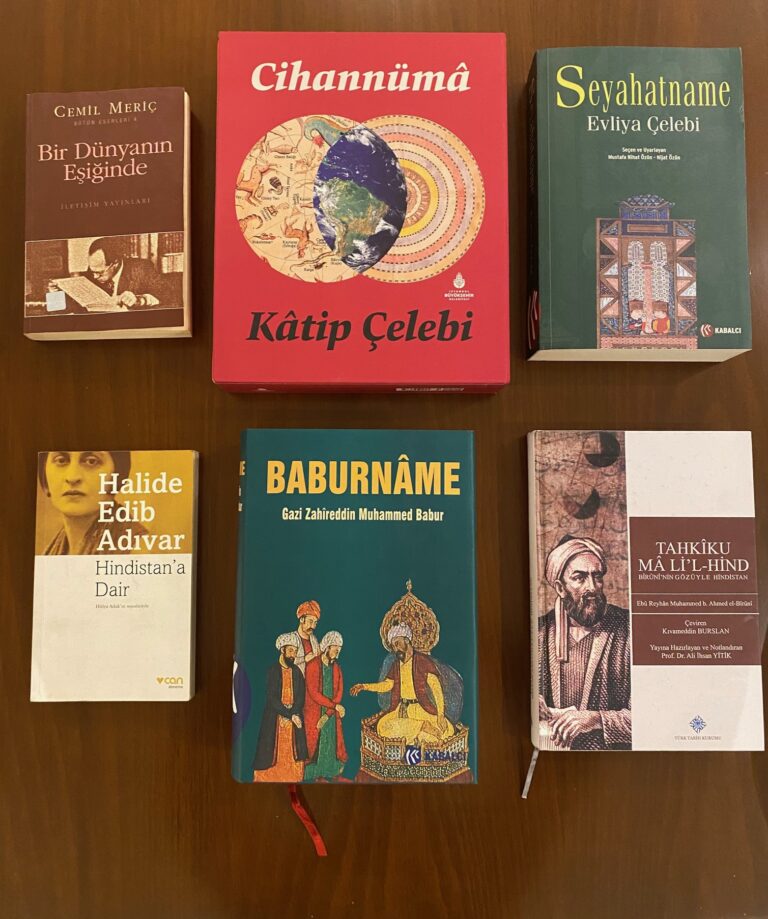
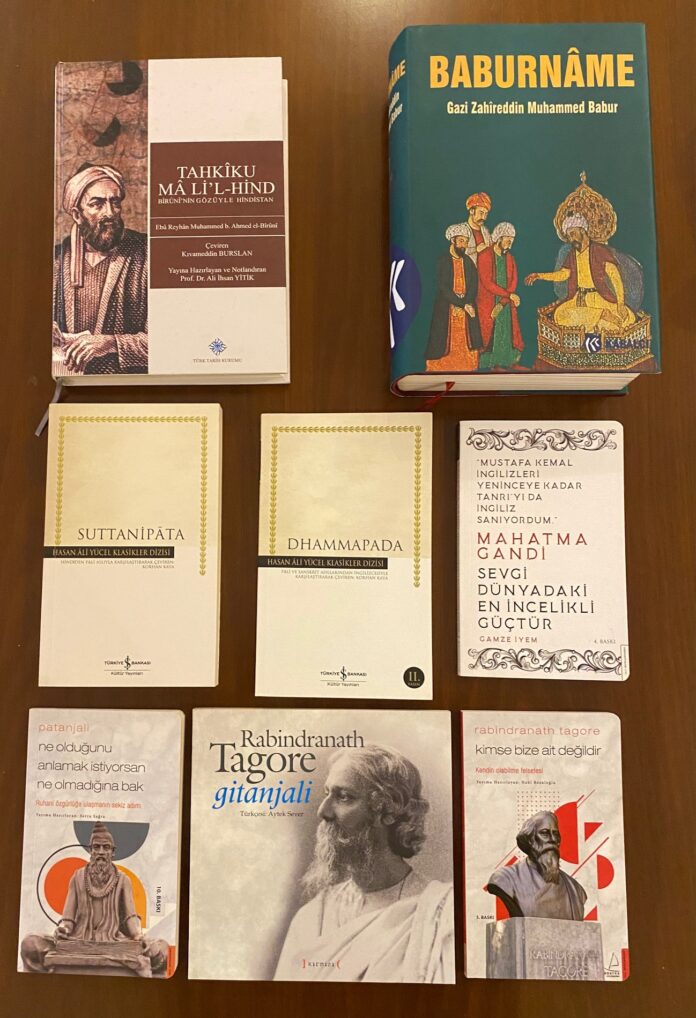
Orta Doğu, büyük Orta Doğu kavramları da Batılı yazarların bu kategorizasyon incelemeleri neticesinde ortaya çıkarılmıştır. Dünya ülkeleri bu şekilde değişik kavramlar altında tasnif edilmektedir. Türklerin, geçmişte bu konuda yaptığı en detaylı inceleme el Birûni’nin, Hindistan seyahati neticesinde ülkenin detaylı incelemesi ile ortaya çıkmıştır. Osmanlı döneminde ise Katip Çelebi dünya haritası anlamını taşıyan Cihannüma eserini yazmıştır. Evliya Çelebi Seyahatnamesini, Babür Şah ise Babürname eserini yazarak yaşadığı coğrafyaların bilgilerini hatırat şeklinde nakletmiştir. Turan kavramı da İranlı şair Firdevsi’ye aittir. Fransız yazar François Gipouloux, Yeni Akdeniz kavramını üretmiştir.

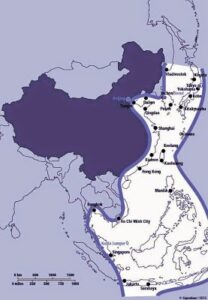
Yeni Akdeniz limanları

Dünyanın en gezgin bir ulusu olan ve teşkil ettikleri diaspora Çinliler ve Hintlilerden sonra dünyada üçüncü sırada gelen Türkler, acaba neden dış dünyayı, coğrafyaları sınıflandırmakta kategorize etmekte yazılı eserlere dönüştürmekte bu denli ilgisizler.

Bu konuda bir kavramsallaştırma çabası ve çalışması da görmüyoruz. Türklerin gezdikleri yerler de kendilerine ait olan kültürler değildir sadece egzotik yerlerdir yüzeysel bir ilgi ile gidilmekte, alışveriş yapılmakta ve dönülmektedir. Gezenler için Asya çok uzaktadır ama Amerika çok yakındır. Hindistan olsun Afrika olsun salgın hastalıklarla doludur mikroplarla doludur, “aman canım gidilir mi.”

Kâtib Çelebi Cihannümâ’yı telif sebebini Arapça, Farsça ve Türkçe yazılmış coğrafya kitaplarının yetersiz olması, buna karşılık Batı’da bu ilme büyük önem verilmesi şeklinde açıklar. Bu gaye ile coğrafya alanında çeşitli kitaplardan faydalanarak İslâm coğrafyacılarının eksiklerini telâfi etmeyi ve coğrafya ilminin kendi zamanındaki durumunu ortaya koymayı düşünür. Coğrafya alanında Doğu anlayışından Batı anlayışına geçişte önemli bir yere sahip olan Cihannümâ’nın gerek aslı ve matbu nüshası, gerekse Batı dillerine çevirileri birçok Batılı seyyaha, özellikle XIX. yüzyılın ilk yarısında coğrafî yerlerin tesbit ve tanınmasında önemli derecede yardımcı olduğu gibi Osmanlı Devleti’nde aydın kitlenin görüş açısını da büyük ölçüde genişletmiş ve bu sahada başka eserlerin yazılmasına yol açmıştır. Bu sebeple eser, Batı ile geniş kültür birliğini hedefleyen çalışmaların bir sembolü olmuştur.

Osmanlı Coğrafyacılığı için Kaynaklar


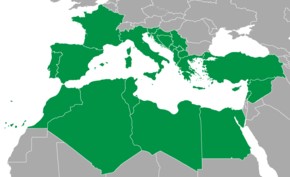
“Greater Mediterranean” Union (GMU)
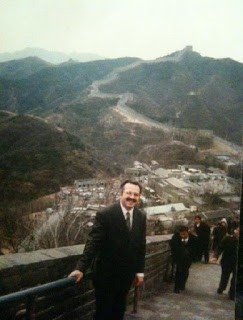
On the Great Wall of China, April 1997

Levent Ağaoğlu [1]


From the Great Wall of China to Rumelia

I sacrifice to my

noble ancestors

From the Mediterranean to

the Pacific!

A spark is enough for

my beloved nation.

             April 1997, Hong Kong

CONTENTS
  • Conceptual Renewal
  • Concepts of Imperial Strategyupdate
  • “Greater Middle East” Strategy Concept
  • Strategic Concept of “Greater Mediterranean” (Asian Mediterranean)
  • Atlanticism, Eurasianism, Mediterraneanism
  • Ports, rivers, caravan-transport routes of the Greater Mediterranean
  • Silk Road
  • “Turkestan was the heart of the world economy in history”
  • “Our most valuable underground resource is our saintly sages lying in Turkestan lands”
  • “A Mediterranean stretches all the way to the Chinese border”
  • Mediterranean World and Turkic Republics
  • Old Mediterranean – New Mediterranean
  • Turkish Poetry
  • Levend’nâme Great Mediterranean in Poems
  • Mediterranean and Turks
  • Can the Turks realise a union in the Mediterranean
  • Why the Mediterranean?
  • Greater Mediterranean Union
  • Mediterranean
  • Countries of the Greater Mediterranean Union
  • France’s Greater Mediterranean Union initiative
  • Mediterranean Writings
  • Conclusion

************************************************

Conceptual Renewal

1 While Asia-Pacific concept is valid why not Asia-Mediterranean becomes valid as well?

2 While Central Asia concept is valid why not Turk-Asia and Asia-Turk concepts become valid as well?

3 While Five Eyes concept is valid why not Turkish Eyes become valid as well?

4 While Greater Middle East concept is valid why not Greater Mediterranean concept becomes valid as well?

5 The World of Çelebis. Why not?

From scratch with new concepts…

CONCEPTS OF IMPERIAL STRATEGY

The term Eurasia is a concept invented by German strategists (1858). The

term “Middle East” is an imperial concept invented by the British (1850) and

the term “Greater Middle East” is an imperial concept invented by the

Americans (1943). These imperial powers, who have no historical background

and historical depths in the regions in question, sew a dress like a clamp in

which the people of the region cannot move. However, the concept of the

Mediterranean has been used since the 7th century. The imperial powers have

devalued a 1300-year-old concept and polluted a region that is not theirs with a

fabricated military terminology.

A concept and definition without philosophical and historical depth is not

objective, it is hollow. The concept of the Greater Middle East is designed as

an ideological concept based on religion and therefore divisive (sects, cults).

However, the concept of the Mediterranean means the Middle World and is a

unifying concept that increases interaction and co-operation. It reflects the

unifying philosophy of the Roman Empire.

GREAT MIDDLE EAST STRATEGY CONCEPT/PROJECT

The GMEP project, which the “divide and rule” strategists tried to dictate

especially after the Second World War, is a mandate administration. Turks are

neighbouring Russia to the north through Turkey, India to the south through

Turkestan and China to the east. Our preference for transatlantic allies instead

of neighbouring countries is forced and tragic.

It has been more than 30 years since we left the race of progress that we

started to catch up with the late Özal. After the 1974 Cyprus landings, just as

we were prevented by civil war rehearsals, the same rehearsals were put on

stage after Özal’s death (1993), and we were distanced from the European

target and eventually turned into a GMEP country in the Middle East. Among the

three eastern alternatives (Eastern Europe, Eastern Asia, Middle East), we

chose the Greater Middle East.

In June 2001, when I was returning to Turkey after a 4.5-year stay in Hong

Kong, the United States had abandoned the Greater China policy and

restarted the Greater Middle East policy with Bush Jr. We are a wing country

again. GMEP is a project of the Atlantic power.

In the second half of the 1960s, US journalist (!) C.L.Sulzberger published two

articles on the Turks.

First, the article “Russia, China and the Turks” in the New York Times of 26

November 1965. [2]


GREATER MEDITERRANEAN (ASIA MEDITERRANEAN) STRATEGIC CONCEPT/PROJECT


On 15 August 1968, Sulzberger published the article “The Great Turk” in

Cumhuriyet newspaper, praising the “Turks from the Adriatic to the China

Sea”. Sulzberger shows the direction that our founder indicated as the

Mediterranean Sea as the China Sea.

“It would be useful to reconsider the Asian qualities of the Turk. The ancient

Turks, who advanced with heavy and sure steps from Mongolia to Austria,

crushing the closed societies in their path and cracking horses under saddles,

always looked in the direction they were going, always to the West. Apart from

all these, the departed Turks left unforgettable memories for their compatriots

who remained in China and Russia. The days will come when Turkism will

regain its strength and its culture will spread. Of course, this will not happen

tomorrow. Just like the emergence of Chinese bogeymen which frightens the

long-term planners. But if these planners will continue to make calculations

on Asia for the next century, they should not forget the presence of the

Great Turk in Asia.” [3]

While both articles published by Sulzberger clearly show the US perspective on

the Turks in the Greater Middle East policy, on the other hand, by mentioning

the Turks in Russia and China and assuming that they may be a threat to the

US, Sulzberger seems to have demonstrated his far-sightedness, taking into

account the developments in the first quarter of the 21st century. Turkey, which

is being squeezed by the US from the west through Greece and from the south

through Syria, is now looking for ways out against this hostile behaviour of its

so-called ally.

GMU, the Greater Mediterranean Project, is a Turkish project from the Pacific

to the Mediterranean. It is important that the institutional and technical

infrastructure of GMU is prepared and the project becomes functional. In the

Greater Mediterranean geography of the Turks, there is no country where

their language, population and influence are not present.

Mediterranean Countries

The term “Greater Mediterranean” is a Turkish concept. Turks have thousands

of years of history and historical depth in the proposed region. In this respect, it

is essential to transform the Mediterranean, surrounded by three continents,

and the Turkestan region, surrounded by India, Pakistan, Afghanistan, China,

Russia, Azerbaijan and Iran, into a synergetic power through the Silk Road

and the Spice Road. As the great poet Nazim Hikmet expressed in his lines

“Galloping in from Far Asia,

Stretching like a mare’s head to the Mediterranean

This country is ours.

Asia in the context of Turkestan, Turkey as a mare’s head and the

Mediterranean, which are expressed in the verses, have a unity.

Leaving behind the 100th anniversary of the Republic, Turkey, as the

founding initiative of the Organisation of Turkic States, should bring up a

dynamic cooperation project that the countries of the Organisation can

develop with the Mediterranean countries and launch the Greater

Mediterranean Union (GMU) initiative, the antidote to the GMEP. In 2021,

although the Organisation of Turkic States was established, this organisation is

based on a limited geography of Turkey and Turkestan countries, the

integration and diversity of the Greater Mediterranean (Mediterranean

countries, Turkey, Turkestan and Khorasan) should be activated. What is

important is that Turkey’s Greater Mediterranean vision should be decided

and realised. There is no such vision yet.

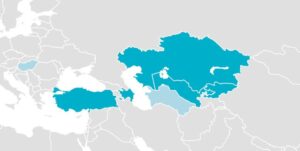
Countries of the Organisation of Turkic States

It should not be forgotten that 70% of the Silk Road route passes through

Turkestan countries.[4] Moreover, Turkey is the country with the longest coast

to the Mediterranean Sea. In history, the destinations of the Silk Road caravans

departing from Turkestan have always been Mediterranean ports.

Our duty is not to translate and use the “divide and rule” style strategic

concepts of the imperial powers such as Middle East, Greater Middle East

etc. into our language, but to place our concepts from our history at the centre

of our strategy by leaving these garbage concepts out of use. For example,

these seas surrounding us such as the Mediterranean Sea, the Black Sea, the

Red Sea and the Gokce Sea are all expressed in colours and have deep

meanings.

The Mediterranean is also a geopolitical and political concept. The Great

Mediterranean instead of the Greater Middle East. The continuation of “Your

first target is the Mediterranean!” strategic target. Of course, there is no political leader who can articulate this.

With the concept of the Greater Mediterranean, the Mediterranean expands

eastwards to the Great Wall of China. The Great Wall is like the Berlin Wall; a

world of prohibitions.

“Greater Mediterraneanism” against Atlanticism and American, Russian

and Chinese Eurasianism. Turkey, which is besieged by the USA with the

Greater Middle East Project (GMEP), especially from the West and South,

will be able to find its way out through the Greater Mediterranean Project.

ASIA-MEDITERRANEAN

The concept of Asia Pacific is associated with the Pacific Ocean on the eastern

coast of Asia and the continents of North America, South America and

Australia beyond. At the western end of Asia is the Mediterranean Sea,

which is also associated with the continents of Europe, Asia and Africa along

these coasts. International trade between China and America, which are

located on opposite coasts of the ocean, ranks first in world trade.

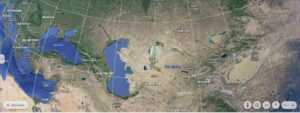
However, no concept has yet been produced about the connection of the Asian continent with the Mediterranean.

Here we can propose the concept of Asian Mediterranean. The geopolitics we call Asia Mediterranean is actually a much more strategic geography than Asia Pacific. The five seas, straits, canals and islands located here make the Mediterranean, which means the centre of the world, unique. Turkestan and Turkey, which are included in the concept of the Greater Mediterranean geopolitics, are all in transition zones; transition from China to Europe, transition from Asia to Europe, transition from Asia to Africa.

Trade between China and the US in the Asia Pacific region is the world’s

largest trade. In the same way, Mediterranean trade through Turkey and

Turkestan trade through Turkey have the capacity to grow to gigantic

dimensions. In particular, the natural resources of the Turkestan region and

the markets of the Mediterranean region reveal the opportunity to re-stage a

model similar to China’s exchanges with the countries of the Asia Pacific

region in the Mediterranean.

ATLANTICISM, EURASIANISM, MEDITERRANEANISM

While Atlanticism seems to be an Anglo-Saxon strategy, especially through

the GMEP project to control the Mediterranean Sea and NATO strategy to

control the Black Sea and the Arctic Ocean, Eurasianism seems to be a

German-Russian co-production. The German policy of opening to the east is

trying to expand on the axis of Russia and Turkey. Russia, on the other hand,

strongly defends its Eurasian strategy as it has territories in both Europe and

Asia and the largest surface area in the world.

The critical point here is that Atlanticists and Eurasianists have no coastal

links with the Mediterranean and Africa; both currents are completely extraregional forces.

As a result, when we analyse the strategy of the Mediterraneans, we can

see that only France has had a failed attempt that did not yield any results.

The only advantageous country here is Turkey. Turkey, which has the longest

coasts in the Mediterranean, has been present in Asia, Europe and Africa in

the past centuries. The Turkish population, especially in north Africa and the

Balkans in south-eastern Europe, has the necessary conditions for a regional

union based on the Turkish language and Turkish culture. By giving a

bipartite structure to the Greater Mediterranean Union, Turkey can implement

a model in both Turkestan and Mediterranean countries and initiate a

vibrant and dynamic regionalisation development.

In what way can we attempt a regional union with the countries in the

Atlantic where we have no coasts? However, our country, which has the

longest shores of the Mediterranean, can realise this potential with the

vitalisation of the Organisation of Turkic States and can bring the

landlocked Turkestan countries to the sea and give them a magnificent

vision extending to the Mediterranean through Turkey.

Firstly, the Atlanticists continuously blocked Turkey’s accession to the

European Union and then the US positioned Turkey in the Greater Middle East

Project. Since the beginning of the 21st century, Turkey is now a Greater

Middle East country and co-chair of the project. The legal infrastructure has

also been changed in this way. The presidential system is a GMEP

implementation. In case Turkey joins the European Union, the enormous

power that the union will gain is perceived as a threat by the USA. This is

because Turkey is located in a geopolitical position that can be strategically

effective on both the European and Asian continents. In this case, what

Turkey should do is to implement its own regionalisation project through a

Great Mediterranean Union that includes all three continents. Here,

instead of the divide and rule policy imposed by the USA through religion, the

regionalisation project should be implemented as soon as possible with an

interactive dynamic from east to west and from west to east in areas

extending from the “Mediterranean to the Great Wall of China” through

language.

TWO-PART “GREAT MEDITERRANEAN” CONCEPT DESIGN

Five of the 26 thinkers in the fresco of the School of Athens, designed under

the leadership of the Vatican, were born in Turkey.

  1. Homer
  2. Diogenes
  3. Anaxagoras
  4. Anaximander
  5. Heraclitus

In the fresco of the School of Athens [5] The unity of the Catholic Church,

which ideologically fragmented the Mediterranean, with the concept design of

the “Greater Mediterranean”, a “Lost Enlightenment” that extends to the

borders of the Great Wall of China when the Khorasan and Turkestan

geographies that fall within the sphere of influence of the Mediterranean are

added. [6] will start to resurface.

The “Great Mediterranean” is in two parts. 1 Classical, old Mediterranean. 2

Turkestan and Khorasan geographies. Turkey, which “stretches out like a

mare’s head to the Mediterranean”, and the integrity of the Great

Mediterranean formed by Turkestan and Khorasan geographies surrounded by

oases, is a platform of enlightenment together with its thinkers. These thinkers

take us on a journey along the shores of our Great Mediterranean Civilisation,

like all the waves that arise from the Mediterranean and gain momentum.

The Atlantic Mind [7] It dismembered the region in order to take it under its

sovereignty and used the terms used in military terminology such as Middle

East etc. to generalise the region it dismembered. The Greater Middle East

Project is a project that does not belong to us. Our future will be shaped by our

actions in the geography represented by the Great Mediterranean map.

Just as the Mediterranean Sea is surrounded by three continents (Asia,

Europe, Africa), Turkey is big in Europe, Asia, Africa and all three continents.

Turkey is the power in the north of Africa, in the south-east of Europe, in the

interior, west and centre of Asia. Rather than calling these regions by

geographical names such as the Balkans, the Caucasus and Central Asia, it is

of utmost importance that we use the political concept of Turkey.

The Mediterranean, marginalised as the Middle East, is the Middle World

when subjected to an objective and accurate reading. This is the etymological

meaning of Mediterrane. In the Middle World, all directions come together.

Inner Asia (Turkestan), which is located on the Silk Road route, is also a

Mediterranean-style organisation from history, together with its oases.

In the 21st century, the two Mediterranean regions, the Mediterranean Basin

(Mediterranea) and the Silk Road (Turkestan), are uniting around the concept

of the “Greater Mediterranean”. Mediterranean countries (including

Turkey), Turkestan countries and the countries of the historical Khorasan

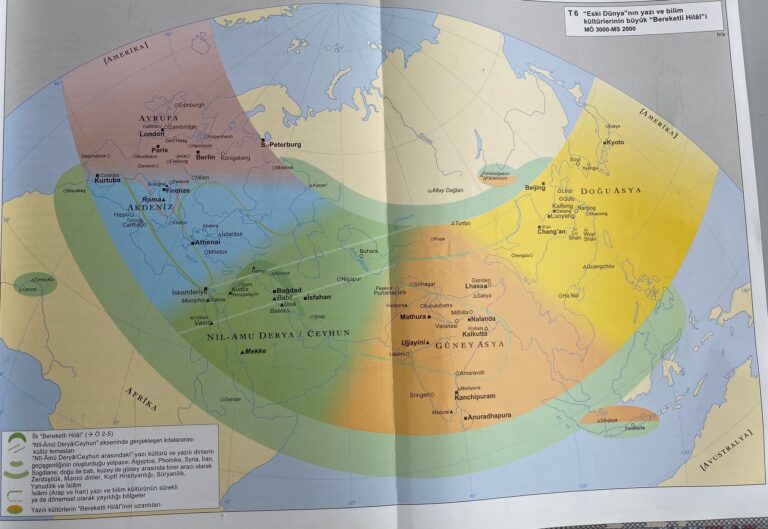
region together show a view of a Fertile Crescent.

Despite the Western Atlantic powers that created the concepts of Central Asia

and the Middle East in the 19th and 20th centuries in line with their own

interests, the ancient reality of thousands of years since ancient times is the

Mediterranean and the region called Central Asia is Turkestan.

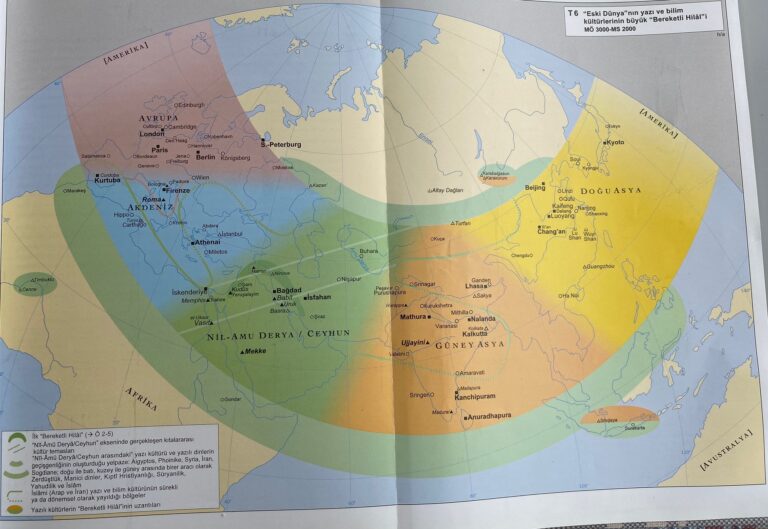
Fertile Crescent (Mediterranean, Turkey, Turkestan, Khorasan)

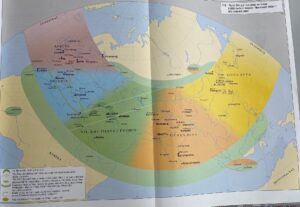
The “Fertile Crescent” of the scientific and writing cultures of the ancient world (3000 BC-AD 2000) Source: Elmar Holenstein, Atlas of Philosophy

PORTS, RIVERS, CARAVAN-TRANSPORT ROUTES OF THE GREATER MEDITERRANEAN

The Danube, the Adriatic coast, the Mediterranean, the Sea of Islands, the

Ionian Sea, the Ionian Sea, the Black Sea coast, the Nile, the Eastern

Mediterranean, the cities and harbours of the Levant and North Africa, the

Euphrates and Tigris rivers in Syria and Iraq, The coasts of the Caspian Sea,

the coasts of the Maveraunnehir (Seyhun, Ceyhun), the coasts of the Persian

Gulf, the oasis cities in East Turkistan, the cities and settlements on the banks

of the Yenisei, Orkhun, Selenga, Tola rivers are the areas where the Great

Mediterranean phenomenon is in question.

The shores of the Great Mediterranean, the centre of the world, are

surrounded by harbours overflowing with ideas and commodities; Istanbul,

Troy, Miletus, Pergamon, Halicarnassus, Athens, Thessaloniki, Izmir, Ephesus,

Rome, Barcelona, Beirut, Piraeus, Alexandria, Kyrenia, Magosa, Paphos,

Haifa, Tripoli, Casablanca, Tunisia, Algeria, Assos, Haifa, Jaffa, Jaffa, Alanya,

Alexandria, Latakia, Tartus are the cities where great thinkers were raised.

Homer, Diagones Laertius, Thales, Anaximander, Heraclitus, Anaxagoras,

Sheik Edebali, Nasrettin Hodja, Yunus Emre, Aşık Pasha living in Turkey,

Aristotle, Plato, Socrates, Parmenides, Protagoras, Pythagoras living in

Greece, Laozi, Abu Hanifa, Bilge Tonyukuk, Bilge Kagan, Farabi, Maturidi,

Kashgarli Mahmud living in Turkistan, Yusuf Has Hacip, Ahmed Yassawi and

wise thinkers such as Harezmi, Biruni, Ibn Sina, NizamülMülk, Ghazali, Hacı

Bektaşı Veli, Mevlana living in the Khorasan geography are the witnesses of

the Great Mediterranean concept that have left deep traces in this world, they

are the pioneering sparkles, treasures of light of the Great Mediterranean

Civilisation emerging from the Mediterranean Basin.

The Mediterranean Basin is an Atlas of Thought, the world’s most

comprehensive Encyclopaedia of Thinkers; it is the homeland of philosophy.

The firsts article of the encyclopaedia is one of the most crowded articles. The

first philosophy in Athens and Miletus, the first library in Alexandria and

Pergamon, the first Christianity in Antakya and Tarsus, the first sociology in

Tunisia, the first roots of the modern alphabet in Phoenicians, the civilisations

of Asia Minor, Ancient Egypt, Ancient Greece and Crete, and the Andalusian

Civilisation have all come to life on these shores.

The islands, peninsulas, rivers, mountains, inland seas, harbours, basins,
straits, gulfs and canals surrounding the Mediterranean Sea have led to the
emergence of the most influential ideas and thinkers in this most interactive
piece of geography.


THE SILK ROAD

All innovations (paper, printing press, gunpowder, compass) were carried to

Europe from Greater Asia via the Silk Road, and the Iron Silk Road, which will

be operational from 2035 onwards, will integrate the “Great Mediterranean”.

While Asia Minor Turkey was being woven with railways in the 1935s, a century

later, the 2035s will be the beginning of a new era, the Silk Road Age, in which

Greater Asia will connect the Oceans by railways.

The intellectual riches that started with Tonyukuk the Wise in the Yunzhong

Çuğay mountains along the 41st parallel at the starting point of the Silk

(Wisdom) Road and described as Mediterranean Civilisation with Yahya

Kemal Beyatlı in Rumelia via Yusuf Has Hacip (Turkistan), Yesevi Ahmet (Piri

Turkistan), Hacı Bektaşı Veli, Yunus Emre (Diyarı Rum) will be blended again

in the Mediterranean Pot.

The Silk Road, Turkestan, Maveraunnehir, Khorasan, Mesopotamia, Asia

Minor (Anatolia) and North Africa are the functional units of the “Great

Mediterranean Union”.

“THE HEART OF THE WORLD ECONOMY IN HISTORY WAS TURKESTAN”

“The heart of the world economy in history was Turkestan. Economic

historians formed this sentence in the 1970-80s. Their justification was this,

they said: “When is the history of the world economy?” Is this famous debate

500 years old? Is the history of the world economy 5000 years old or 50,000

years old? In the middle of that debate, some economists said: Archaeological

data, findings, etc. show us that there has been an integrated world

economy for at least 5000 years.

Where is this place, through which line, the line connecting China and

Europe, and where is the heart of this line, the heart of this line is

Turkestan.

Whenever there are strong states in Turkestan, there is a world
economy, whenever there is instability and conflict in Turkestan, the
world economy stops.

That’s why, for example, cities like F are the New York of the period,

that is, there are people of all nationalities. They came there to trade, they

exchanged with each other, very proud and very rich.” Prof Dr Mehmet Akif

Okur [8]

Turkestan is a geographically catalysing region. Turkestan synthesises all

aspects within itself, including India, China, Islam, which came to the region

from the west, Tengricism, Shamanism and Zoroastrianism. All these religions

reach a synthesis in Turkestan; “Our most valuable underground resource

is our saintly sages lying in the lands of Turkestan

  • Greater Asia and Turkestan are strategic geographical nomenclatures
  • instead of Eurasia and Central Asia, which are British-Russian coproductions.
  • Great Britain and Russia, hand in hand, transformed the term Turkestan into Central Asia with the Great Game.
  • Greater Asia again. Turkestan again.

A MEDITERRANEAN SEA STRETCHES TO THE CHINESE BORDER

“Tuula Romagnoli[9] He was one of the Italians I knew best and he talks

about a Mediterranean Sea. One end of this Mediterranean is here, the

other end is Iran and it goes all the way from Asia to the borders of China,

and we should not forget this. The culture and structure of this world

depends on this, there is no Third World-type colonialist legacy here, people

are open to the world in various languages and in various ways. We can never

say that the intellectuals here are mono-coloured and unipolar, neither their

conservatism nor their openness to the world. Just as ambassadors were

exchanged between Spain and Iran, in the 11th and 12th centuries,

ambassadors from the provinces around Barcelona travelled to Timur, and this

is also true for the Turkic world.” İlber Ortaylı [10]

MEDITERRANEAN WORLD AND TURKIC REPUBLICS

“The Mediterranean World is an indivisible part of the world, and there is

no doubt that Turkey has always been a central link within that part. No

matter how much you may want to give importance to Spanish in universities

or education, people apply to the Cervantes Institute in large numbers and

the demands continue to be met. Because people are looking for a relationship

with their surroundings in a country like Turkey. The ignorance and irrelevance

of the state and political parties in these matters is none of our business.

You cannot prevent immigrants from coming to this country from these

countries. Today, our working mothers find the best opportunities for their

children not in expensive kindergartens and primary schools, but in carers from

our eastern republics, who are not the type of carers we are used to. In every

university, especially in the newly established ones, I have to look for

mathematicians from Azerbaijan and Kazakhstan and literary scholars from

Central Asia. Our livestock breeding, horse breeding and agriculture, which

are in ruins, will survive only with people coming from here.

It is clear that Turkey does not have the capacity to receive all types of

migrants, there is no doubt that Turkey will be a country of migrants, we cannot

oppose this because we need it and we will be in constant contact with our

eastern Republics on these issues, this migration will not only be the migration

of farmers or animal keepers but also the migration of intellectuals and

engineers.

If we want to prevent our people from fleeing to the West, we need to create an

important cadre. This can only be done with the people who will come from

there. Since Mehmet the Conqueror, just as he summoned people from the

Samarkand observatories, we need to continue to do the same. I am sure that

this is the most important virtue that the Republic of Turkey has gained at the

end of the century, and I am also sure that once these things are done, the

political mentality in Turkey will also improve.

What you call realpolitik, slight twists and turns cannot be contrary to the

essence, the essence is always the unity of this world. And this, of course,

is not achieved through such political unity fatwas, but first and foremost by

ensuring that the masses live with each other and are intertwined with each

other.” İlber Ortaylı [11]

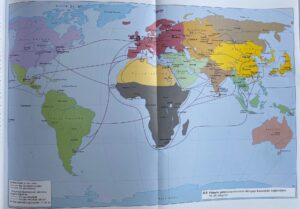
World-wide connections of philosophical traditions 16th-20th century

Source: Elmar Holenstein, Atlas of Philosophy

OLD MEDITERRANEAN – NEW MEDITERRANEAN

Public opinion leaders in our country always talk about the Balkans, the

Caucasus, the Middle East and the Turkic World. North Africa, Southern

Europe, Mediterranean, Eastern Europe, Northern (Russia-Ukraine),

Mesopotamia basins do not come to their minds. Altogether they are ten

basins. As long as we do not use the concept of basin, this disconnection, this

isolation will continue forever. Even though it is so on paper, even island states

are not condemned to loneliness, while peninsular countries, such as Turkey,

are stuck in loneliness.

It was my stay in Asia-Pacific for nearly five years that reinforced this idea

of basins in me. They associate the Asian continent with the Pacific,

but why is there no Asia-Mediterranean concept? The idea of basins has

brought China to today. China has started to implement the Canton

(Guangdong) model in exports, especially since 1978, and has gathered the

factories of the world to Canton. The clue here is that the factories producing

in the Canton region have concentrated their exports to these countries,

while sourcing their raw materials from the basin countries and regions. As a

result of this, an understanding of co-operation has developed in Asia-Pacific.

There are five basins in the Asia-Pacific region. East Asia, Southeast Asia,

North Asia, Greater China, Australasia.

The Asia Pacific basin is now the New Mediterranean.

Turkey is the country that can function as a dynamo in the classical

Mediterranean region in the style of the Canton model. However,

Turkey, unable to develop co-operation models, continues to spend decades

like a prodigal with artificial agendas and imposed GMEP agendas. On the other

hand, China, despite all the pressures imposed on it, continues on its way

without starving its 1.5 billion population by implementing basins and

cooperation models.

Although the Great Wall of China is physically located in the territory of the

People’s Republic of China, mentally there is a Great Wall of China in the

minds of each of the politicians, public administrators and opinion leaders in

Turkey and this mentality prevents co-operation on various occasions. The

zero zero policy with neighbours has brought Turkey to this point.

TURKISH POETRY

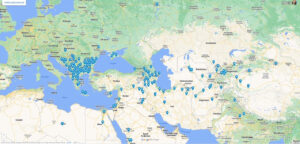
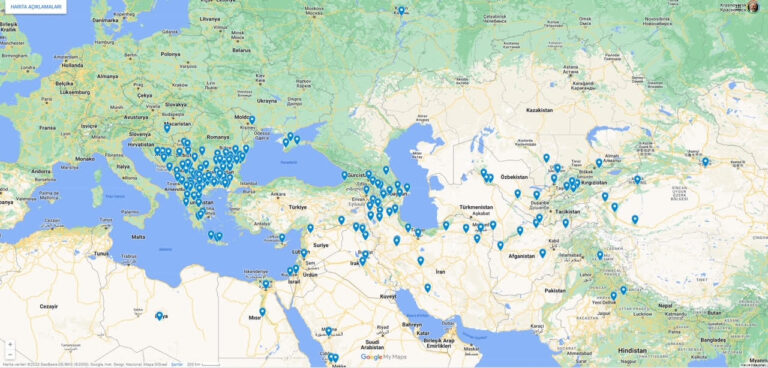
When we look at the map of Turkish poets outside Turkey, we see a map of

the Great Mediterranean. There are concentrations in the Balkans and

Caucasus regions. Within the definition of the Caucasus, there is also Iran

and further east, in the oases of East Turkistan, there are clusters of poets in

the easternmost city of Turfan. There is a sparse distribution in Asia.

There are concentrations in the Balkan Peninsula, which appears as a

settlement between the Mediterranean and the Black Sea, in the Crimea in

the north of the Black Sea, in the Caucasus, on the western shores of the

Caspian Sea and its hinterland, and again on the eastern Mediterranean

coast, starting from Cairo to the Turkish border.

Seasides have harboured more poets. It is essential to analyse Turkish poetry

in terms of the geographies where we have left our mark on the world. Poets

born in more than 200 cities and settlements in Europe, Asia and Africa have

written poems in Turkish.

THE GREAT SEA IN LEVEND’NÂME POEMS

Levend’nâme;

– In the Roads…

– In the Years..

. – In the Writings..

. – In the Hearts…

– In the Rows…

He brings together what we have accumulated with poetry.

Levend’âne searches after poetry in the integrity of the Great

Mediterranean formed by Turkey, which “stretches like a mare’s head to the

Mediterranean”, and Turkestan, which is surrounded by oases

LEVENDNĀME Poems take us on a journey along the shores of our Great

Mediterranean Civilisation.

We thought we would take a look at the continents, countries

and regions while following the wide geographies that we travelled but did

not disappear with poems; we came across a very rich list.

In contrast to the concept of Levantine, which refers to Eastern

Mediterraneanism, the concept of Levend’âne, which is associated with the

Greater Mediterranean concept, appeared to be inclusive of the

accumulations of around fifty countries and regions on four continents.

THE MEDITERRANEAN AND THE TURKS

The Mediterranean has been a historically, culturally and economically

important region for the Turks. Historically, the expansion and influence of

the Ottoman Empire largely extended to the Mediterranean. This region

played a critical role for the Ottoman maritime trade and strategic position.

Culturally, the different civilisations with which the Mediterranean interacted

have made various contributions to Turkish culture. Turkish settlements on

the shores of the Mediterranean have witnessed cultural exchange and

interaction throughout history.

Economically, the Mediterranean coast contributes to Turkey’s economy in

sectors such as agriculture, fisheries and tourism. At the same time, its

strategic location in terms of maritime trade and transport increases its

economic importance.

CAN TURKS REALISE UNITY IN THE MEDITERRANEAN

Turkey already has diplomatic, economic and cultural relations at various

levels with many countries in the Mediterranean region. However, Turkey’s

realisation of a full-fledged unity in the Mediterranean may be a complex

process depending on regional dynamics, political relations and the attitudes

of other countries.

For such a union, it is important to first define common interests and

objectives between the parties. In addition, existing political conflicts,

security concerns and other factors should also be taken into account.

Monitoring political developments and relations in the Mediterranean region

may help to better assess the possibility of Turkey taking such an initiative.

WHY THE MEDITERRANEAN?

In Turks, white represents the west as a direction and wisdom as a meaning.

The movement of Turks has always been in the western direction, the

meeting with Islam is also in the western direction. The meeting with Europe

is also in the west direction. The Turks travelled west, north and south from

the point where they were in Asia, but not east, because in the east was the

eternal enemy China.

The goal of a Greater Mediterranean Union is extremely meaningful in this

respect. The Organisation of Turkic States and Turkey together are moving

westwards towards the Mediterranean. However, Mediterranean countries will

also be moving eastwards towards Turkey and Turkestan. This is a

meaningful interaction. For example, the idea of the Greater Mediterranean

was planned by French President Sarkozy as a movement towards the

north, towards Europe, towards the UK, and unfortunately it was not

successful. Because there will be no movement of the UK together with

France. In this respect, it is very meaningful that the idea of the Great

Mediterranean Union is formed as a synthesis of the west and the east.

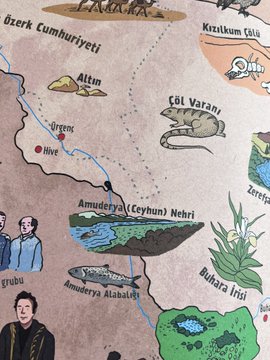
The greatest achievements of the human heritage have been realised in the

basin between the Nile River, a river flowing into the Mediterranean Sea, and

the Amuderya, the Ceyhun River of Turkestan. The cities of civilisation here

are countless; there were Roman, Sassanid, Seljuk, Khorasan and Ottoman

cities.

When Turks use the term Mediterranean in a historical context, they usually

refer to the Mediterranean coast, settlements and interactions in this region.

Due to the expansion of the Ottoman Empire and the government’s interest

in maritime trade, the Mediterranean was of strategic and economic

importance.

Furthermore, the southern coasts and coastal regions of Turkey are under the

influence of the Mediterranean climate, which means that they have a rich

potential for agriculture and tourism. These factors have been influential in

the Turks’ use of the term Mediterranean.

The Mediterranean Sea means “white sea” or “inland sea” in Turkish. This

term derives from the generally calm and clear appearance of the sea. The

Mediterranean is a vast region, including the coasts of southern Turkey, and

is of geographical, historical and cultural importance.

During the Ottoman period, Turks had established a strong influence and

dominance in the Mediterranean, especially in Anatolia, Egypt, Syria and

Arabia. With their strategic position in these lands, maritime trade and

military successes, the Ottomans had become an important power in the

Mediterranean region.

GREAT MEDITERRANEAN UNION

Turkestan is a geographically catalysing region. Turkestan, which synthesises

all aspects, includes both India and China, Islam, which came to the region

from the west, Tengricism, Shamanism and Zoroastrianism.

All these philosophies reach a synthesis, which I concluded with the following

sentence “Our most valuable underground resource is our saintly sages lying

in the lands of Turkestan

The Greater Middle East Project is a project that does not belong to us. I look

at this map from the perspective of Greater Turkey, not the Turkic world, but

Greater Turkey. Our future will be shaped by our actions in the geography

represented by this map.

Turkey is big in Europe, Asia, Africa and all three continents.

The power in the north of Africa, in the south-east of Europe, in the interior,

west and centre of Asia is always Greater Turkey. Rather than calling these

regions by geographical names such as the Balkans, the Caucasus and

Central Asia, it is extremely important that we meet them with the concept of

Greater Turkey, which is a political characterisation.

MEDITERRANEAN

Our founding leader Mustafa Kemal Atatürk left his strategies to us. He was

the theoriser and the implementer. The greatest strategy is the idea of a

republic based on parliament. The parliament, that is, the people. But in the

process, first the name of the Turkish Army was changed to the Armed Forces

with the 27 May Coup. Then, as of 2018, the Parliament was relegated to a

secondary position. The strategy entrusted to us by our founder is the

Mediterranean strategy. But in the evil balance of Yalta, we were pushed into

the camp of the Atlantic powers. We forgot the meaning of the

Mediterranean, which means the middle of the world, and we got stuck in the

Middle East swamp, which is the strategy of the Atlanticists. We are now a

Greater Middle East country.

The Atlanticists have a grand strategy that encompasses the whole world.

We, too, have a strategy centred on the Great Mediterranean and

encompassing the whole world, which is Atatürk’s greatest trust to us. After

the idea of the Republic, which is the greatest strategy, the Mediterranean

strategy is the main one.

Continuing to be a derivative of the world politics of the Atlantic powers,

rather than developing the politics and unity of the Great Mediterranean

Union in the Mediterranean, which is the centre of the world, will have

severe consequences for our country.

COUNTRIES OF THE GREATER MEDITERRANEAN UNION

EUROPE

  • Balkan 6 FTA (Free Trade Agreement)
  • Black Sea 1 FTA
  • Southern Europe 9 GB – EU (Customs Union – European Union)
  • Eastern Europe Tunaboyu. 1. OTS (Organisation of Turkish States)

AFRICA

  • North Africa 3 FTA

ASIA

  • Caucasus 1 FTA
  • Eastern Mediterranean 2 FTA
  • Turkestan 7 OTS

Great Mediterranean 30

………………………………….

FTA (Free Trade Agreement)

List of FTAs in force

o Albania

o United Arab Emirates

o United Kingdom

o Bosnia and Herzegovina

o EFTA

o Faroe Islands

o Morocco

o Palestine

o South Korea

o Georgia

o Israel

o Montenegro

o Kosovo

o Macedonia

o Malaysia

o Egypt

o Moldova

o Mauritius

o Serbia

o Singapore

o Chile

o Tunisia

o Venezuela

13 countries Mediterranean. Caucasus Black Sea

  • Balkan 6
  • North Africa 3
  • Caucasus 1
  • Eastern Mediterranean 2
  • Black Sea 1

GB – EU Southern Europe (9 countries)

  • Spain
  • France
  • Italy
  • Greece
  • Bulgaria
  • Croatia
  • Slovenia
  • Malta
  • Romania

Projection of the Greater Mediterranean Union

  • OTS 8
  • FTA 13
  • GB/EU 9

Total 30

EU 27 countries

FRANCE’S GREATER MEDITERRANEAN UNION INITIATIVE

The Great Mediterranean Union was once proposed by French President

Sarkozy, but it did not take off. I hope yours will work.

The Mediterranean Union is an initiative aimed at promoting co-operation

among the countries bordering the Mediterranean Sea. Efforts to establish

this union have varied over time. The main objectives include economic cooperation, cultural exchange, solidarity in security matters and regional

development.

Launched in 1995, the Barcelona Process laid the foundation for the

Mediterranean Union. This process aimed to develop partnership relations

between the European Union and the 12 Mediterranean countries. However,

the full operationalisation of the Union and the implementation of the projects

have faced various difficulties over time. The future of the Mediterranean

Union may change depending on the political and economic dynamics among

the member states.

The Mediterranean Union is an initiative aimed at promoting co-operation

among the countries bordering the Mediterranean Sea. Efforts to establish

this union have varied over time. The main objectives include economic cooperation, cultural exchange, solidarity in security matters and regional

development.

Launched in 1995, the Barcelona Process laid the foundation for the

Mediterranean Union. This process aimed to develop partnership relations

between the European Union and the 12 Mediterranean countries. However,

the full operationalisation of the Union and the implementation of the projects

have faced various difficulties over time. The future of the Mediterranean

Union may change depending on the political and economic dynamics among

the member states.

Nicolas Sarkozy’s Mediterranean Union initiative came to the fore during the

French presidency of the European Union in 2008. However, this initiative has

caused some criticism and controversy. The union proposed by Sarkozy

aimed to promote co-operation among the countries bordering the

Mediterranean. However, some countries, especially some Arab countries,

saw this initiative more as a French influence and criticised it.

Therefore, Sarkozy’s initiative was not fully successful and did not achieve the

planned objectives. However, efforts such as the Barcelona Process, which

laid the foundation for the Mediterranean Union, have continued in regional

cooperation and dialogue.

CONCLUSION:

Fatih started the conquest of the Mediterranean from the mountains of

Albania. When Mustafa Kemal Atatürk, the founder of the Republic of

Turkey, gave the order to attack the enemy on 26 August 1922, he used an

expression that transcends time.

“Your first objective is the Mediterranean. Forward!”

After his death and in the years following the Second World War, this goal

was revised by his followers as Atlantic. Now we have to turn again towards

the goal that Atatürk showed us.

Integration and integration efforts such as the EU, BSEC, D8, ECO are

attempts that have been defunct through stalling. The cornerstone of the

“Asian Millennium” we are in is the “Greater Mediterranean”. Our country

has taken the first concrete step in this regard by establishing the

Organisation of Turkic States. Now it is time to expand the cooperation

between Turkey and Turkestan countries towards the Mediterranean

countries.

The geographies of Turkey and Turkestan show a unity of unique value and

together with the route and traffic to the Mediterranean via the Silk Road,

they constitute a triple cooperation ground.

As a first step in the “Greater Mediterranean” vision, we can initiate

integration by associating Libya with the Organisation of Turkish States.

As a generation whose ancestors sailed in the Mediterranean waters, a new

and modern cooperation, reunification and integration task awaits us.

Since the Caspian Sea is on the north-south axis and the Mediterranean Sea is on

the west-east axis, the coefficient of expansion is higher. The Americans created

the concepts of Greater China and Greater Middle East.

We Turks, on the other hand, can unite the sub-basins (Balkans, North Africa,

Levant, Caspian, Turkestan, Indian Subcontinent) by producing the concept of the

Great Mediterranean.

MEDITERRANEAN WRITINGS [12]

References

  1. Poet-Thinker. 40 years export professional. He lived in Hong Kong

between 1997-2001; he always heard the footsteps of the upcoming

Great Asian Century. Ismail Gaspıralı’s ideal of “Unity in Language, Idea

and Work”, he is working on a series of books[1] ; he is writing down his

observations and experiences as an intellectual and entrepreneur. He

has adopted the motto of sleeping with ideas and getting up with poetry.

Contact: [email protected]

  1. https://hayatitek.com/rusya-cin-ve-turkler/
  2. https://1000kitap.com/gonderi/172859053?oku=1
  3. https://www.agaoglulevent.com/ipek-yolu-guzergahi/
  4. https://www.booksonturkey.com/buyuk-akdeniz-bilgeleri/
  5. https://leventagaoglu.blogspot.com/2019/04/kayp-aydnlanma-ortaasyann-altn-cag.html
  6. https://www.booksonturkey.com/pusulamiz-kuzey-atlantik-natosumu-renkli-denizlermi/
  7. Eurasia One Foundation – Prof. Dr. Mehmet Akif Okur Conference. 10

November 2018

  1. https://it.wikipedia.org/wiki/Tullia_Romagnoli_Carettoni

10.İlber Ortaylı: “The Turkish World is the Synthesis of East and West” |

Workshop on State Accumulation in Asia. 19 November 2023

11.İlber Ortaylı: “The Turkish World is the Synthesis of East and West” |

Workshop on State Accumulation in Asia. 19 November 2023

12.https://www.booksonturkey.com/akdeniz-yazilari/

Bereketli Türk Hilali

Akdeniz

  • İstanbul
  • Miletos

Nil-AmuDerya (Ceyhun)

  • Harran
  • İskenderiye
  • Kahire
  • Şam
  • Kudüs
  • Bağdad
  • Babil
  • Uruk
  • Basra
  • İsfahan
  • Şiraz
  • Nişapur
  • Buhara
  • Kazan
  • Altay Dağları
  • Karabalgasun

Güney Asya

  • Karakorum
  • Kuça
  • Turfan

Kaynak: Felsefe Atlası

Indo-Turkish Thesis

Turkic-Indian Languages

England made English dominant instead of the 800-year-old Turkish-derived Urdu (Ordu) and Dravitan languages, which were the dominant languages ​​of India. Thanks to Abdulhamid, they rented Cyprus and took control of the roads leading to India, completing the occupation of India and mastering their language. If the Mughal Empire had not collapsed in the late 19th century, 1.5 billion Indians would be speaking languages ​​of Turkish origin today.

Fallacy: Indo-European fiction

Fact: Turkish Belt-Indian Fabric/Turkestan-India bond. Indian discovered zero, Turkish Khwarezm applied it to mathematical operations; It was Europe that took all these and applied them, turning Zero into One. From where?. When the Arabic works written in the following two centuries are added to the first Turkish inscription (Bugut) written in Sogutian and Sanksrit as a result of Iranian and Indian influences; The Turkish Hinterland will be formed in the form of a triangle.

Turkish-Indian synthesis

We must create the Turkish-Indianland thesis. The language that will enable communication in the cultural and economic relations that are hoped to be developed between India and Turkey is not the language of the foreign English, which evokes colonialism and plunder on both sides and damages ties, but the Urdu language that allows the historical Turkish-Indian relationship to be expressed. The fact that Indians call this language Hindi as it is must be an indication of their adoption of it and their appreciation of the Turkish-Indian common heritage that this language evokes. Although it is only one of dozens of official languages ​​of India, our accuracy rate is quite high if we say that this language, which has such a wide domain of influence and where the Turkish-Indian heritage is embodied in its words, is the most preferred language for Turkish-Indian communication.

Number zero
Hindi words in inscriptions
Urdu language
Indian Lodges
Turkish states in the Indian continent
Sufism
Biruni
Khwarezmi
It seems that the main route of our Indo-Erland will be the Indian Ocean via the Five Seas.
INDIA. INDOLOGY. HINT’ERLAND. INDO-CHINA

INDO-EUROPEAN OR INDO-TURKISH?

Indo-Turkic mythology

Umay: Some researchers equate Uma, the wife of the Indian god Shiva, with Umay, mentioned in old Turkish texts. In Turkish, the equivalence of uma – umay can be considered based on examples such as borgu – borguy surna – surnay. Some researchers compare Humay in ancient Iranian texts. They equate Umay. This equality seems reasonable since h- cannot be expressed in the orthography of runic texts. However, in both views, it remains unknown from which language the word was transferred to which language. Among the ancient and present-day Turkish communities, the word Umay is seen in various meanings in Altai, Hakas, Şor, Sağay, Beltir, Bashkir and Yakut Turks. My request to my colleagues who are experts in Sanskrit is to enlighten me by making etymologies of phrases such as Umay, Tengri Umay, Umay iyesi, Uma Katun, etc. used by the Turks in Indian sources. Source: Hindi Elements in Göktürk Inscriptions Osman Fikri Sertkaya

INDIA TRAVEL NAME Indian Fabric & Turkish Belt

Written by evaluating the observations of my travels to India and the Indian literature together, the book India Travelogue – Indian Continent positions the trivets of India, Turkey and Turkestan in front of Indo-European classifications and Indochina geographies. The Great Asian century is also enlivened by the dynamism of the Turks and Indians, who share their thoughts and give meaning to life with freedom.

Just as the mental (thought) achievements of Europe were gathered from routes such as South Asia, Southwest Asia and North Africa, similar achievements of the Turks were made in Greater Khorasan, Asia Minor (including Northern India) by following the shepherd’s fires from Turkestan, where the table was kept at the table. It came to life in Anatolia) and then in Southeastern Europe (Rumelia). The Tigris, Euphrates, Seyhun, Ceyhun and Indus rivers of the region between the Nile and Yamuna rivers also sustained this life.

In short; Khorasan, India and Hittite are essential elements of our syntheses in Greater Asia and Asia Minor.

India is an ocean, but isn’t it Turkish? The term ocean, named after Talay, which we encounter for the first time in the Tonyukuk inscription, later manifested itself with the Buddhist priest and statesman Dalai Lama, revealing the richness of common life of the Indian and Turkish worlds in the vastness and depth of the oceans.

Published as the second book of the Turkish House series, the work is full of the problem of bringing liveliness to relations and exchanges by giving impetus to our extremely limited Indian library, despite such a rich historical accumulation and the legend of the Indian Continent, which became the homeland of four of the sixteen Turkish States.

In short; Indian fabric is not rare, those who seek will find it, India is not poor, it contains incredible riches. Let us navigate and travel in the Indian continent as our ancestors have done since Khwarazmî, Birûnî and Seydi Ali Reis.

Europe Asia

Sir, the yellow belt on the map is our Highway, which reaches from the Yellow River in China to the Danube River in Hungary, and on which we travel with horses because it is a steppe. This is how we went from the innermost part of Asia to the innermost part of Europe, and achieved the unity of Europe and Asia. Why should we now be the subcontractor of others’ BOP project and then of others’ Eurasia project? We will establish our own union ourselves, first of all, starting from Eastern Europe and the Balkans, and hopefully we will form the Asian-European union with the neighbors around us. That’s the thesis of the book. But the map says something else. Turkish-European., Turkish-Indian, Asian-European. We need to produce these theses.

Europe

The Turks, who put an end to the Roman Empire with Attila in the four centuries, destroyed the Istanbul-centered Roman Empire with Fatih the Conqueror, 1000 years later in the 1400s.

During the period before and after the capture of Istanbul, the Turks moved towards Europe via Çanakkale and established their capital in Edirne. During this period, Albania, Serbia, Bulgaria and Bulgaria, the Danube basin countries, came under Ottoman rule.

Moving away from the vision and mission of uniting the European and Asian continents, in which it is a part, and thus ensuring global peace, leading the project of a state 8400 km away has not brought any value to Turkey and will not bring any value to Turkey.

Today, Türkiye is now called a Middle Eastern country and has lost its image as a European country. This is also a loss of value and reputation in Asia.

It is strategic shallowness to lose the identity of the European and Asian continents, in which the political identities were primarily formed, and to engage in a regional project from the continental identity.

Indo-European language family

indian turkish

It is taught in only two universities in Turkey; Apart from the Urdu Language and Literature departments, which have a very limited impact and efficiency area, the functioning of the department proposed to be established will be as follows:

In this section, the Urdu Language (or another language to be determined, but most conveniently the Urdu Language), which is expected to enable cultural exchange between India and Turkey, will be taught intensively during the 1-year preparation phase. After students become proficient in reading sources, following the agenda and communicating in this language, they will receive education in literature, history and politics for 1 year. After this training, the student will choose an area in which he wants to specialize from these three main areas according to his own aptitude (aptitude, inclination) and continue his education in that direction.

If the same program is carried out in Turkish at a contracted university in India, students of both departments will be able to engage in scientific and cultural exchanges through semesterly or annual student exchanges, and mental bridges will be strengthened.

Thus, this 4-year or 5-year training program will provide our state with trained personnel who are ready to assume the role of ambassador in political, cultural and scientific fields.

A joint Indo-Turkish history research center should be established, with one foot in India and the other in Turkey, and researchers from Turkey and India should be assigned to both centers. In addition, Indian language and culture training should be given at the center in Turkey and Turkish language and culture training should be given at the center in India, and these courses should be open to applications from the public. In this way, the Turkish presence in India should be built on solid foundations and today’s initiatives should progress on a legitimate basis, supported by historical roots.

Awareness should be created among our young people about India and Turkey before they reach university age, and mutual cultural trips should be organized in this context. During these trips, young people should be informed about the mutual cultural flow as well as the potentials in these countries, and the awareness of putting these into practice in the future should be instilled. The mental world of our people, whose horizons are limited to Europe in the dominant education system, should be expanded to Asia. And these two countries should be promoted from their place on the world map to their place on the mind map for their people.

The West is an observatory 24/7, a radar that works endlessly. Fear is of no use to death. Today, a population equal to Turkey’s population lives in the Rumelian lands we left behind, which were taken away from us by the West.

I thought about this based on your comment. The West has taken away our cultural assets and archaeological artifacts and exhibits them in its museums. But it’s not just cultural assets on display. He took our soul away. Our soul was based on a philosophy of unity. Look, Land of Rum, Mevlana Celaleddin Rumi, Rumi, Rumelia, Kaiser, Erzurum, Rumelia Beylerbeyi are the concepts of Rome in our language. We must take our soul back. The greedy West cannot pursue a philosophy of unity. It’s our job. We must move towards unity, starting from Rumelia and Eastern Europe, the Eastern Mediterranean and the Indian continent.

The Indo-European thesis is fraudulent and a lie. But starting from the first Indianologist, the Uzbek Turk Biruni, we should put the Indo-Turkish thesis on the agenda and pursue the unity of the Eastern Roman, Mughal and Ottoman lands.


Türk Dünyası Kültür Atlası, Ahmet Yeşiltepe

Sibel Kandilli
@sibelkandilli

Yılın en önemli yayıncılık faaliyetlerinden biri

’tan geldi. Türk Dünyası Kültür Atlası, hem minikler hem de büyükler için dolu dolu bir atlas olmuş. Kutlarım. Türk kültürünün öğrenilmesi ve öğretilmesi için çok kıymetli bir çalışma.

Image

Image

Image

Image

Ayrıca Ahmet Bey’in atlasta çeşitli yerlere yerleştirilmesi ve eser sonunda bu yerlere dair bir bulmaca yer alması çok hoş bir detay.

Image

Image

Image

Image

Sibel Kandilli
@sibelkandilli
Ahmet Yeşiltepe
@ahmetyesiltepe
Çok teşekkürler… Çocuklarımızın ve gençlerimizin ufku genişlesin, sahip olduğumuz hazineyi keşfetsinler, yetişkinler de gururlansınlar istedik.
Sibel Kandilli
@sibelkandilli
Eser amacına ulaşmış, elinize sağlık.

“Great Mediterranean” Articles

Ataturk and the Great Mediterranean Union

Levent Agaoglu wrote (x)   Ataturk’s Testament “We would like the unity we want to establish to be very different from the unions (unions) that have passed…

Top 20 largest coastal cities in the Mediterranean and Black Sea

https://twitter.com/AlperUcok/status/1247163522544308225 By Bilge Tonyukuk Enstitüsü zaman: Nisan 06, 2020

Basin of Ideas: Mediterranean

The shores of the Mediterranean, the center of the world, are ringed by harbors that are always brimming with ideas; Istanbul, Troy, Miletus, Pergamon, Halicarnassus,…

Mediterranean Songs..Akdeniz Şarkıları

By Bilge Tonyukuk Enstitüsü zaman: Haziran 29, 2019
On the Great Wall of China, April 1997 Levent Ağaoğlu   From the Great Wall of China to Rumelia I sacrifice to my noble ancestors From the Mediterranean to the…

The Blue Homeland Doctrine and the Eastern Mediterranean 

  Does the doctrine cover all seas and nations, is it universal? Have the concept of Blue Homeland or similar concepts been expressed in…

Legacy of Rome, Eastern Mediterranean and Turkey

Map of Roman Empire Defense Bases 125 AD  The Roman Empire at the time of Hadrian in AD 125. Yellow dots are defense bases. 19 of a…

Extinct Languages of Turkey/Turks in Mediterranean Region

TURKEY (15 Extinct) Kaskean Palaic Hattic Hittite Mysian Phrygian Thracian Lemnian Lydian Carian Galatian Cappadocian Luwian Isaurian Mlahso TURKS (2 Extinct) Mamluk Kipchak Bulgar

Why the center of the world is Eastern Mediterranean?

https://www.youtube.com/watch?v=0lz93NTTXmQ https://upload.wikimedia.org/wikipedia/commons/b/bb/Roman_Empire_125.png Legionary Bases in Turkey. All bases are around Euphrates (Firat) river. 20 Satala (Turkey) 21 Melitone (Turkey) 22 Samosata (Turkey) 23 Zeugma (Turkey) 24.25 Raphana (Jordan) 26…

Cultural Heritage of Turks in Eastern Mediterranean

Cultural Heritage of Turks in Turkey Cultural Heritage of Turks in Cyprus Cultural Heritage of Turks in Jordan Cultural Heritage of Turks in…

What is the meaning of Blue Homeland Concept and effects on Eastern Mediterranean Cooperation?

https://m.youtube.com/watch?v=xn1oSDdl1K0 Podcast in Turkish language. Interview with Turkish Strategist Cihat Yaycı of Turk Degs on 04.01.2022 Levent Agaoglu Dear friends. Our guest, Cihat Yaycı, Turkish strategist gentleman, our retired…

What are the Eastern Mediterranean Energy Sources and Turkey’s Strategy by Strategist Cihat Yayci

Doğu Akdeniz’in Paylaşım Mücadelesi ve Türkiye Paperback – February 11, 2020           Click here to buy the book Sorular ve Cevaplar ile Münhasır Ekonomik…

Traveller’s Talks: Mediterranean World

https://www.youtube.com/watch?v=NtUR0XJs0b8&t=3s Mediterranean World (1): Afrasia and Eastern Mediterranean https://www.youtube.com/watch?v=XDF_xDwPQ3g&t=2s Mediterranean World (2): Mediterraneans https://www.youtube.com/watch?v=mF7yJq1k-GU&t=17s Mediterranean World (3): Mediterranean Triangle
Development is shifting from the Atlantic (Europe) to the Pacific (Asia). This development offers a great opportunity for Turkey. The economic dynamism between…

Akdeniz yazıları

Büyük Akdeniz Havzası/Birliği Yazıları

Büyük Akdeniz Havzası Bilgeleri Kimlerdir? Levent Ağaoğlu – 29/02/20240 Ortaçağlar’da (11.12.yüzyıllar) Ticaret Yolları Büyük Akdeniz Havzası Pagan dinlerinin, Budizmin, Maniheizmin, Zerdüşt dininin, Nasturiliğin, Tengrizm’in birbirleri ile etkileştiği, tek…

Büyük Akdeniz Havzası Bilgeleri Kimlerdir?

Ortaçağlar’da (11.12.yüzyıllar) Ticaret Yolları Büyük Akdeniz Havzası Pagan dinlerinin, Budizmin, Maniheizmin, Zerdüşt dininin, Nasturiliğin, Tengrizm’in birbirleri ile etkileştiği, tek tanrılı dinlerin doğduğu içerisinde Bereketli Hilal’in…

Büyük Akdeniz mefkûresi

Levend’nâme; • Yol’larda… • Yıl’larda… • Yazı’larda… • Yürek’lerde… • Yır’larda… biriktirdiklerimizi şiirle buluşturuyor. “Akdeniz’e bir kısrak başı gibi uzanan” Türkiye ve vahaların çevrelediği Türkistan’ın oluşturduğu Büyük Akdeniz bütünlüğündeki Levend’âne…

Atatürk ve Büyük Akdeniz Birliği

Levent Ağaoğlu yazdı (1)   İlim ilim bilmektir İlim kendin bilmektir Sen kendin bilmezsin Ya nice okumaktır   Yunus Emre (1240-1320)   İÇİNDEKİLER Birlik Hedefleri Balkan Paktı ve Sadabad Paktı Sonuç: Büyük…

MGTV ile Türk Dünyası: Büyük Akdeniz Birliği, Türk Medyası

LEVENT AĞAOĞLU’NDAN TÜRK DÜNYASINA BÜYÜK AKDENİZ BİRLİĞİ (BAB) ÇAĞRISI! https://www.youtube.com/live/id87xNqt-nU?si=ylCjF1SBiA1r5V23 TÜRK MEDYASININ TÜRK DÜNYASINDAN HABERİ VAR MI? https://www.youtube.com/watch?v=MBmTTHgGSwI&ab_channel=MGTVT%C3%BCrkD%C3%BCnyas%C4%B1n%C4%B1nSesi

“Büyük Akdeniz” Birliği (BAB)

Levent Ağaoğlu Şair-Düşünür. 40 yıllık ihracat profesyoneli. 1997-2001 yılları arasında Hong Kong’da yaşadı; yaklaşan Büyük Asya Yüzyılı’nın ayak seslerini duydu hep. İsmail Gaspıralı’nın “Dil’de, Fikir’de;…

“Büyük Akdeniz” Bilgeleri

“BÜYÜK AKDENİZ” BİLGELERİ   Düşünürlerin veya eserlerinin üzerine tıklandığında bilgilerine ulaşılmaktadır. Homeros, Türkiye Aristoteles, Yunanistan Platon, Yunanistan    Sokrates, Yunanistan Diagones Laertius, Türkiye Thales, Miletus, Türkiye…

Atatürk’te Akdeniz

FİKİR VE DÜŞÜNCELERİ Afyonkarahisar – Dumlupınar Meydan Muharebesi ve ondan sonra düşman ordusunu tamamen imha veya esir eden ve kılıçtan kurtulanları Akdeniz’e, Marmara’ya döken harekâtımızı…
Dünyanın Ortası Akdeniz’in kıyıları hep fikirlerle dolup taşan limanlar ile çepeçevredir; İstanbul, Troya, Miletos, Bergama, Halikarnassos, Atina, Selanik, İzmir, Efes, Roma, Barcelona, Beyrut, Pire, İskenderiye,…
Türkiye ve Akdeniz Havzası Türkiye ve Akdeniz Havzası Türkiye ve Akdeniz Havzası Türkiye ve Akdeniz Havzası Türklerin Akdeniz havzasından 500 yıl önceden başlayarak uyguladıkları stratejiler…

Süleyman Seyfi Öğün: Akdeniz

Süleyman Seyfi Öğün: Avrupa’nın hal ve gidişatı – Yeni Şafak https://www.yenisafak.com/…/suleymanseyfiogun/avrupanin-hal-ve-gidisati-2046026   6 gün önce – Avrupa’nın hal ve gidişatı yazısı ve tüm Süleyman Seyfi Öğün … Haçlı Savaşları…

Hedefimiz; “Yeni Akdeniz!”

Yeni Akdeniz neresi, biz bu soruyu kendimize sorduk mu hiç? Pasifik. İşte Kıbrıs işaret verir gibi yapar, o İpekyolu’dur. Batı bütün anlayışını mitolojiler üzerine…

“Yeni Akdeniz” Pazarları

“Yeni Akdeniz” Pazarları Asya-Pasifik bölgesinde Çin merkezli bir YENİ AKDENİZ oluşmaktadır. “Akdeniz dünyası” endüstriyel yenilikçi faaliyetlerin ve müteşebbislerin inisiyatifinin birleştiği bir potadır. ‘’Akdeniz dünyası’’ sermaye akışının, ticaretin…

Yeni Akdeniz’de yerimizi almalıyız

Turkish Time, Mayıs 2004 Levent Ağaoğlu bir ihracat profesyoneli. 1997 yılında, çalıştığı Şişe Cam firması onu Hong Kong’daki ofisine yönetici olarak atadı. Şişe Cam bünyesinde faaliyet…

“Akdeniz’den Pasifik’e”: Türkiye’nin Çin İle Ticareti Ve Bölgeler Arası İşbirliği Önerisi

Levent AĞAOĞLU  “Şarktan şimdi doğacak olan güneşe bakıyorum…Bugün, günün ağardığını nasıl görüyorsam, uzaktan bütün şark milletlerinin de uyanışlarını öyle görüyorum..Onların (Şark Milletleri’ nin) yeniden doğuşu,…
Türkiye ve Akdeniz Havzası Türkiye ve Akdeniz Havzası Türkiye ve Akdeniz Havzası Türkiye ve Akdeniz Havzası Türklerin Akdeniz havzasından 500 yıl önceden başlayarak uyguladıkları stratejiler…
T E S P İ T: Türkiye’nin kıtasal vizyonlara ve birlik girişimleri konusunda aklına ilk gelen kıtalar Avrupa ve Asya kıtaları olmasına rağmen yazar…
TESPİT: Avrasya-Akdeniz ( Avrupa. Asya ) Pusulamız. Avrupa Birliği’nin liderleri Almanya ve Fransa‘dır ve her iki ülkede de Avrupa’daki en genç, en kalabalık Türk toplulukları yaşamaktadır. Buradaki her…
Akdeniz aslında dünyânın en büyük ve kritik iç denizidir. Cebel-i Târık gibi dar bir su geçidi üzerinden Atlantik’e bağlanır. Sonradan insan eliyle açılan Süveyş,…
Doğu Akdeniz ülkelerindeki dokuz ülkede Türk kültür mirasını haritadaki eserlerle birlikte internet sisteme ekledim. Google’da Yunanlılarla ilgili bir şey yılı yazıldığı zaman anında uçuyor…

Mavi Vatan Doktrini ve Doğu Akdeniz

Doktrin tüm denizler ve ulusları kapsamakta mıdır, evrensel midir? Mavi Vatan kavramının kendisi veya benzeri kavramlar başka ülkelerde, dillerde dile getirilmiş midir, Mavi…

Roma’nın Mirası, Doğu Akdeniz ve Türkiye

MS 125 Roma İmparatorluğu Savunma Üsleri Haritası  Hadrianus zamanı MS 125 Roma İmparatorluğu. Sarı noktalar savunma üsleridir. Toplam 28 savunma üssünün 19 tanesi Osmanlı Coğrafyasında. Yeşil…