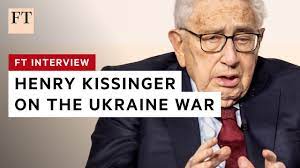
#HenryKissinger #Russia #Ukraine
12 May 2022
I’m here at the Kennedy Centre, where I’ve just spoken to Dr Henry Kissinger about the war in Ukraine, the prospects of it going nuclear, how that compares with the Cold War, which, of course, is his era.
How China is viewing the situation between Nato and Russia, and the prospect of a divided world between China and Russia on the one side, and the West on the other.
Are we in a new Cold War with China?
At the time that we opened to China, Russia was the principal enemy. But our relations with China were about as bad as they could be, because we had fought the Korean War against them.
Our view in opening to China was that it was unwise when you have two enemies, that you treat them exactly alike, and that you should at least provide an opportunity for whatever differences might appear between them, or for whatever the international situation might produce of different attitudes, do provide a possibility for that.
And so this is why, in a tortuous way, we approach China. What produced the opening was the tension that had developed autonomously between Russia and China, and which had an expression in border, important issues, which we were so convinced that the Chinese were the more ideologically committed that we first thought the incidents had been started by the Chinese.
But that was not true. That the Russians wanted to teach China a lesson. But Russia could not conceive that China and the United States could get together. And Mao, despite all his ideological hostility to us, Mao was ready to begin conversations. It’s not in principle. It is on the lines which it’s against vested interests is now established.
But it does not look to me as if this is an intrinsically permanent relationship. It is geographically, demographically
per cent of the Russian population lives in the European part. Much of the Asian part of Russia, much of, most of Siberia was acquired recently.
Its history is measured in the second half of the th century. I take it from your answer just now that it would be in America’s geopolitical interests to at least encourage more distance between Russia and China.
And you touched on this great Siberian, the great empty space north of very densely populated China. I think you could also have mentioned the Belt and Road
Initiative, coming right through Russia’s near abroad. There are neuralgias there, with Russia being a little brother, that are available to exploit.
Or is that wrong?
I think the geopolitical situation globally will undergo significant changes after the Ukraine war is over. And it is not natural for China and Russia to have identical interests on all foreseeable problems. I don’t think we can generate possible disagreement. But I think circumstances after the Ukraine war, Russia will have to reassess its relationship to Europe at a minimum, and its general attitude towards Nato.
And so will America, and especially Europe have to do, when the lessons of this period sink it. And so I think it is unwise to take an adversarial position to two adversaries in a way that drives them together. And once we take aboard this principle in our relationships with Europe and in our internal discussions, I think history will provide opportunities in which we can apply the differential approach.
It doesn’t mean that either of them will become intimate friends of the West. It only means that on specific issues, as they arise, we leave open the option, that may be a different approach.
We are prepared to explore differences in approach in terms of our own relationship, without discussing in the abstract what their relationship with each other would be, because that will be determined by their own interests and by their own domestic situation.
But in view of general strategy, in the period ahead of us, we should not lump Russia and China together as an integral element. So I mean, I take it, teasing out from your remarks, that the Biden administration’s framing of its grand geopolitical challenge as being democracy versus autocracy, I’m picking up an implicit hint that you think that’s the wrong framing.
I am not in agreement with stating an adversarial position as the basic element of the relationship. But of course, we have to be conscious of the differences of ideology and of interpretation that exist. But we should use this consciousness to apply it in our own analysis of the importance of issues as they arise, rather than making it the principal issue of confrontation.
Unless we are prepared to make regime changes, the principal goal of our foreign policy, which I think, given the evolution of technology and the enormous destructiveness of weapons that now exist, may be imposed on us by the hostility of others. But we should avoid generating it with our own attitudes. OK, let’s get into the specifics of today. You made your name, of course, in the ‘s studying nuclear theory and strategy. And then as National Security Advisor and Secretary of State in the US, you have probably more experience than any person alive of how to manage a standoff between two nuclear-armed superpowers.
You had a couple of Defcon or moments. I can’t remember which Defcon level they were. But one was when the Soviets wanted to send peacekeeping troops into the Sinai Desert. Let’s not get into that. But today’s nuclear language which is coming thick and fast from Putin, from people around Putin. Where do you put that in the context of all the dangers we went through, Cuban Missile Crisis, near accidents in, et cetera.
Where do you put today’s nuclear language in terms of the threat we might be facing today?
Knowing the technology, with the rapidity of its change, the subtlety of the invention can produce levels of catastrophe that were not even imaginable in the period that I’m talking, that I was talking about. And the strange aspect of the present situation is that the weapons are multiplying on both sides, and their sophistication is increasing literally with every year. And their range and automaticity, and almost any other noun you want to attach to them. But there’s almost no discussion that’s internationally about what would happen if the weapons actually became used. So my appeal, in general, in my discussions, on whatever side you are in these discussions, is to understand that we are now living in a totally new era, that we have gotten away as cultures up to now with neglecting that aspect.
But as its technology is spread around the world, as it does in here, diplomacy and war will need a different content. And that will be a challenge for the immediate future.
Now you’ve met, correct me if I’m wrong, but ballpark, you’ve met Vladimir Putin many times?
Yeah.
The Russian military nuclear doctrine is that they will respond with nuclear weapons or consider the use of nuclear weapons if they feel that the regime is under existential threat, that its existence. But of course, the word existential is in the eye of the beholder.
Where do you think Putin’s red line is in this situation?
I have met Putin as a student of international affairs about once a year for a period of maybe years, for purely academic and strategic discussions, to try to learn his thinking, and impart whatever thinking I had, as the conversation developed. I thought he was, his basic convictions were a kind of mystic faith in Russian history, as he conceived it, and that he felt offended in that sense, not by anything we did particularly at first, but simply by this huge gap that opened up in between Europe and the East when the security lines were moved from the Elbe towards some, at first, undefined future. And so he, as I understood it, was offended and threatened, and felt Russia was threatened by the absorption of this whole area into Nato.
This does not excuse, and I would not have predicted an attack of the magnitude of taking over a recognised country with which all kinds of non-military agreements existed.
And he miscalculated the situation he faced internationally. And he obviously miscalculated Russia’s capabilities to sustain such a major enterprise. And when the time for settlement comes, all parties will need to take that into consideration, that we are not going back to the previous relationship, but to a position for Russia that will be different as a result of this.
And not because we demand it. Because they have produced it. You say that Putin miscalculated, I mean, arguably massively miscalculated in his expectations of the military conquest of Ukraine, and the reception he would get from Ukrainians. Now, a lot of the nuclear theory and strategic theory you worked on assumes people have good information, and that they can act rationally on their good information.
Do you think he’s now recalibrating? Having miscalculated, do you think he’s getting good information? And if he isn’t, what further miscalculations should we be preparing for?
In all these crises, one has to try to understand what the inner red line is for the opposite number. And if we had met six months ago, well, I first, as I said, wouldn’t have thought that he would start a war of that scale in Europe or anywhere.
So the obvious question is, first of all, at how long will this escalation continue? And how much scope does he have for further escalation? Or has he reached the limit of its capabilities?
And he has to decide at what point escalating the war will strain a society to a point that will limit its fitness to conduct international policy as a great power in the future. I have no judgement when he will come to that point. The second level is when that point is reached, will he escalate by moving into categories or weapons that in years of their existence have never been used.
Weapons in which nuclear countries accepted defeat from non-nuclear countries, like both Russia and we in Afghanistan, without resorting to weapons, which in a purely technical sense could have ended the conflict.
So if that line is crossed, that would be an extraordinarily significant event, because we have not thought through globally what the next dividing lines would be. And we have to think of how to react were it to happen. But one thing we could not do, in my opinion, is just accept it, because that would open a new method of blackmail.
I mean, you’ve met Xi Jinping many times too, and his predecessors.
You know China well. What lessons is China drawing from this?
Any Chinese leader now, or all Chinese leaders would be reflecting how to avoid getting into the situation into which Putin got himself. And how to be in a position where in any crisis that might arise, they would not have a major part of the world turned against them. And the key decision America and China will have to make down the road, and not in any one month, is your first question.
Is the relationship so adversarial that there is no hope of composing even parts of it? And therefore, must every issue be dealt with in terms of relative position?
And therefore, it’s the best hope of restraint, the self-restraint of leaders on both sides. Thank you very much for joining us, and for making the effort to come down here today.
And I’m sure everyone else will join me in appreciation of your being here.
Black Sea: Dispatches and Recipes – Through Darkness and Light
$16.74 (as of 15/08/2026 02:11 GMT +03:00 - More infoProduct prices and availability are accurate as of the date/time indicated and are subject to change. Any price and availability information displayed on [relevant Amazon Site(s), as applicable] at the time of purchase will apply to the purchase of this product.)
Istanbul, City map 1:10.000, City Pocket map + The Big Five
$17.43 (as of 15/08/2026 02:11 GMT +03:00 - More infoProduct prices and availability are accurate as of the date/time indicated and are subject to change. Any price and availability information displayed on [relevant Amazon Site(s), as applicable] at the time of purchase will apply to the purchase of this product.)
Travel and leisure magazine istanbul: A Guide For First Time Travelers
$2.99 (as of 15/08/2026 02:11 GMT +03:00 - More infoProduct prices and availability are accurate as of the date/time indicated and are subject to change. Any price and availability information displayed on [relevant Amazon Site(s), as applicable] at the time of purchase will apply to the purchase of this product.)
Lonely Planet Turkiye: Plan the Trip of a Lifetime | Detailed Itineraries & Maps | Insider Tips | Covers Istanbul, Troy, Izmir and more (Travel Guide)
$14.49 (as of 15/08/2026 02:11 GMT +03:00 - More infoProduct prices and availability are accurate as of the date/time indicated and are subject to change. Any price and availability information displayed on [relevant Amazon Site(s), as applicable] at the time of purchase will apply to the purchase of this product.)
Crescent & Star: Turkey Between Two Worlds
$2.99 (as of 15/08/2026 02:11 GMT +03:00 - More infoProduct prices and availability are accurate as of the date/time indicated and are subject to change. Any price and availability information displayed on [relevant Amazon Site(s), as applicable] at the time of purchase will apply to the purchase of this product.)
Rick Steves Istanbul: With Ephesus & Cappadocia
$8.97 (as of 15/08/2026 02:11 GMT +03:00 - More infoProduct prices and availability are accurate as of the date/time indicated and are subject to change. Any price and availability information displayed on [relevant Amazon Site(s), as applicable] at the time of purchase will apply to the purchase of this product.)
Istanbul & Northwest Turkey Travel Reference Map WP
$10.95 (as of 15/08/2026 02:11 GMT +03:00 - More infoProduct prices and availability are accurate as of the date/time indicated and are subject to change. Any price and availability information displayed on [relevant Amazon Site(s), as applicable] at the time of purchase will apply to the purchase of this product.)
Istanbul Travel Guide 2026: The Complete Guide to Planning, Exploring, and Experiencing Istanbul, Turkey – Including Where to Stay, Top Attractions, Local ... Asia: City-by-City Travel Guides Book 3)
$9.99 (as of 15/08/2026 02:11 GMT +03:00 - More infoProduct prices and availability are accurate as of the date/time indicated and are subject to change. Any price and availability information displayed on [relevant Amazon Site(s), as applicable] at the time of purchase will apply to the purchase of this product.)
Istanbul Travel Guide 2026: A First-Timer’s Guide to the Streets, Food, History and Hidden Neighbourhoods of the City Where Europe Meets Asia
$7.99 (as of 15/08/2026 02:11 GMT +03:00 - More infoProduct prices and availability are accurate as of the date/time indicated and are subject to change. Any price and availability information displayed on [relevant Amazon Site(s), as applicable] at the time of purchase will apply to the purchase of this product.)
Insight Guides Turkiye: Travel Guide with eBook: 2026-2027 | Culture & Society | Must-See Sights | Stunning Photos | Expert Advice | Covers: Istanbul, Cappadocia, Ephesus and more
$20.06 (as of 15/08/2026 02:11 GMT +03:00 - More infoProduct prices and availability are accurate as of the date/time indicated and are subject to change. Any price and availability information displayed on [relevant Amazon Site(s), as applicable] at the time of purchase will apply to the purchase of this product.)
Rick Steves Istanbul: With Ephesus & Cappadocia
$8.97 (as of 15/08/2026 01:54 GMT +03:00 - More infoProduct prices and availability are accurate as of the date/time indicated and are subject to change. Any price and availability information displayed on [relevant Amazon Site(s), as applicable] at the time of purchase will apply to the purchase of this product.)
Lonely Planet Pocket Istanbul: Discover Twice the City in Half the Time | Top Sights | Maps & Walking Tours | Covers Sultanahmet & Sirkeci, Bazaar ... & Western Districts and more (Pocket Guide)
$12.48 (as of 15/08/2026 01:54 GMT +03:00 - More infoProduct prices and availability are accurate as of the date/time indicated and are subject to change. Any price and availability information displayed on [relevant Amazon Site(s), as applicable] at the time of purchase will apply to the purchase of this product.)
A Guide to Biblical Sites in Greece and Turkey
$11.08 (as of 15/08/2026 01:54 GMT +03:00 - More infoProduct prices and availability are accurate as of the date/time indicated and are subject to change. Any price and availability information displayed on [relevant Amazon Site(s), as applicable] at the time of purchase will apply to the purchase of this product.)
Istanbul: Memories and the City (Vintage International)
$13.28 (as of 15/08/2026 01:54 GMT +03:00 - More infoProduct prices and availability are accurate as of the date/time indicated and are subject to change. Any price and availability information displayed on [relevant Amazon Site(s), as applicable] at the time of purchase will apply to the purchase of this product.)
Rick Steves Mediterranean Cruise Ports (Rick Steves Travel Guide)
$19.10 (as of 15/08/2026 01:54 GMT +03:00 - More infoProduct prices and availability are accurate as of the date/time indicated and are subject to change. Any price and availability information displayed on [relevant Amazon Site(s), as applicable] at the time of purchase will apply to the purchase of this product.)
The Essential Travel Guide To Turkiye: Iconic Sights, Authentic Food and Smart Travel Tips From A Local (Istanbul, Cappadocia, Antalya and Beyond)
$2.99 (as of 15/08/2026 01:54 GMT +03:00 - More infoProduct prices and availability are accurate as of the date/time indicated and are subject to change. Any price and availability information displayed on [relevant Amazon Site(s), as applicable] at the time of purchase will apply to the purchase of this product.)
Lonely Planet The Mediterranean: Over 30 Mesmerising Cities & Islands | 15 Weekend Long Road Trip Itineraries | Tips on Where to Eat & What to See | Stunning Photography
$23.73 (as of 15/08/2026 01:54 GMT +03:00 - More infoProduct prices and availability are accurate as of the date/time indicated and are subject to change. Any price and availability information displayed on [relevant Amazon Site(s), as applicable] at the time of purchase will apply to the purchase of this product.)
The Amazing Mrs. Pollifax (Mrs. Pollifax Series Book 2)
$5.99 (as of 15/08/2026 01:54 GMT +03:00 - More infoProduct prices and availability are accurate as of the date/time indicated and are subject to change. Any price and availability information displayed on [relevant Amazon Site(s), as applicable] at the time of purchase will apply to the purchase of this product.)
High Albania
$0.99 (as of 15/08/2026 01:54 GMT +03:00 - More infoProduct prices and availability are accurate as of the date/time indicated and are subject to change. Any price and availability information displayed on [relevant Amazon Site(s), as applicable] at the time of purchase will apply to the purchase of this product.)