Home Blog Page 122

Türkçe

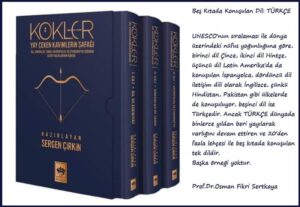
Sevgili dostlar merhaba. Bugün otuz Ağustos iki bin yirmi bir. Türklerin mutlu bir günü. Yöre Zafer Bayramları. Türk’ün kimliği üzerinde çok kısaca bir sohbet yapacağız sizlerle.

Türk’ün kimliği dilindedir, Türkçe’dir.

Ne kadar güzel söylemişiz değil mi? Türkçe. Bu kimlik? Dil üzerinden genişlemiştir ve çok daha geniş boyutlara ulaşacaktır.

Bizlere düşen Türk dilini, Türkçe’yi dünyada uluslararası bir dil haline getirmek misyonudur.

Bunu başardığımız müddetçe Türk kimliği dünyada yaygınlaşmış olacaktır.

Burada söz konusu olan kan üzerinden bir kimlik, akrabalık değildir. Dil üzerinden çok daha geniş insan kitlelerine ulaşabilecek, tüm kıtalarda sesini dil üzerinden duyurabilecek uluslararası bir kimliktir.

19. yüzyılda dünyanın en zengin iki dili Türkçe ve İngilizce idi. Sir James Redhouse, Mercan yokuşunda kurduğu kitabevi ile Türkçe-İngilizce sözlük hazırladı ve bunun neticesinde Türkçeyi liderlik tahtından indirdi.

O halde bizler de Türk dillerini karşılıklı kelime alışverişi ve etkileşimine dahil ederek tekrar liderlik tahtını geri almalıyız.

Fotoğraflar

fotoğraflar

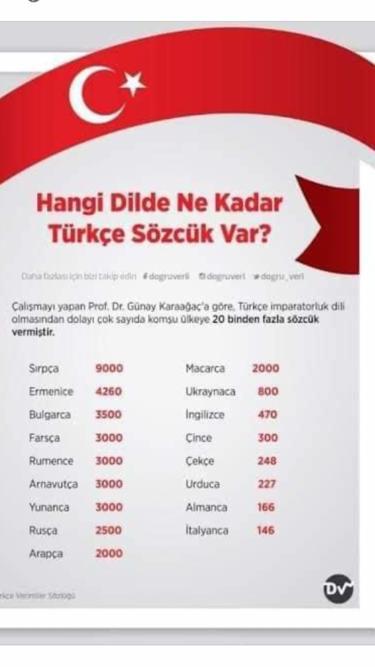
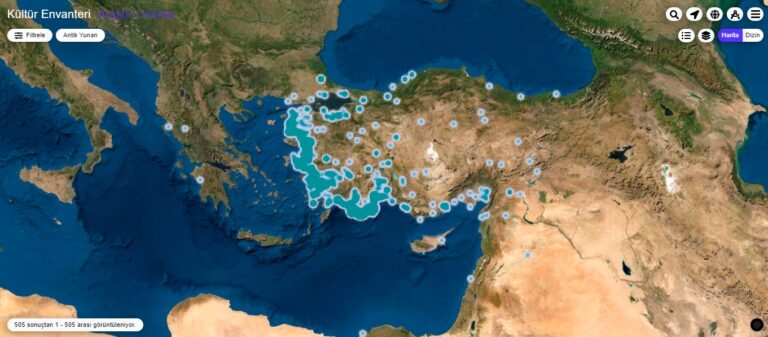
Türkçe’nin Etki Alanları

  1. Azerice
  2. Sırpça
  3. Ermenice
  4. Balkan Slav dilleri
  5. Urduca
  6. Türkistan dilleri
  7. Farsça
Güneydoğu Avrupa
Güney Asya
Orta Asya
Kafkasya

Türk

Çinliler için Tuarçi tabii ki onlar Türkleri böyle alt ayrımlara (Kazak Özbek Türkmen vb) tabi tutmuyorlar Türk diyorlar. Ben Türküm dediğimiz zaman da böyle pazu gösteriyorlar yani güç kuvvet anlamında bunu yapıyorlar. Fakat bu enterasan Çin’deki Tuarçi Türkiye fakat Rusya tarafına gelince onlar Stalin‘den bu yana bu ayrımı yapmışlar daha da ötesi Arnavutluk’ta misal Makedonya’da yörük var literatüre bakın, fakat Arnavutluk’ta Türk’ün adı yok o da Stalin uygulamasından gelen Enver Hoca’dan gelen bir gelenek.

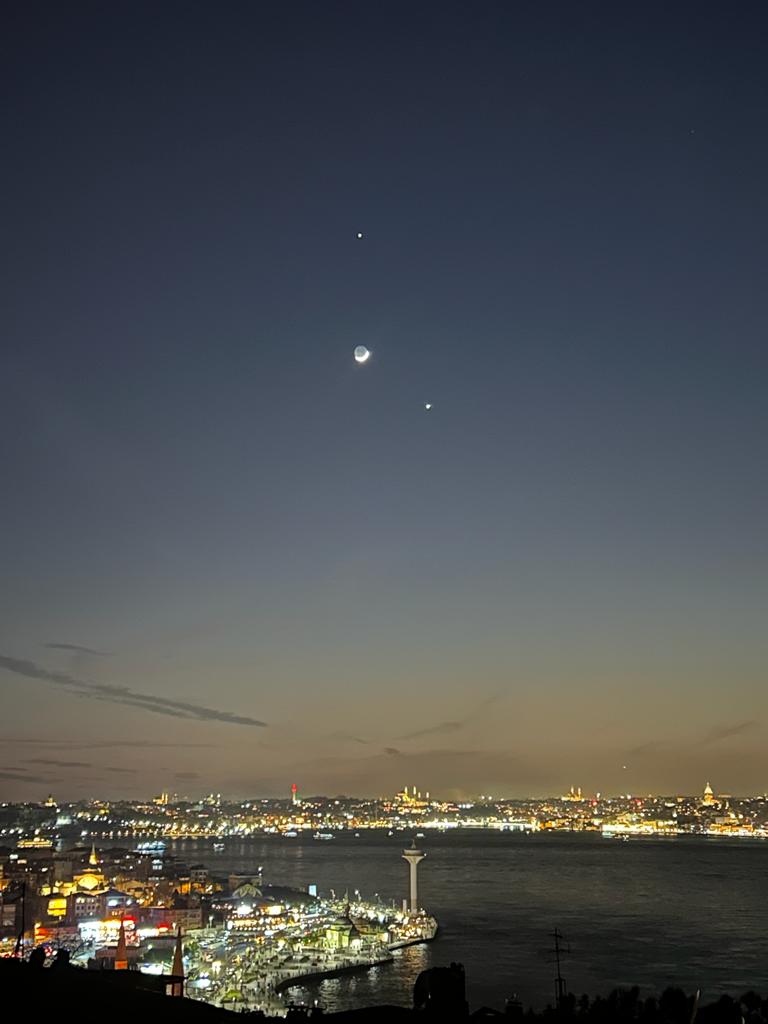
Jüpiter, Ay ve Venüs bir arada an itibari ile

Jüpiter, Ay ve Venüs bir arada an itibari ile

Nükhet Okutan Davletov ile Okuma Kulübü: “Türk Halkları Tarihine Giriş”


Türk Ordusu

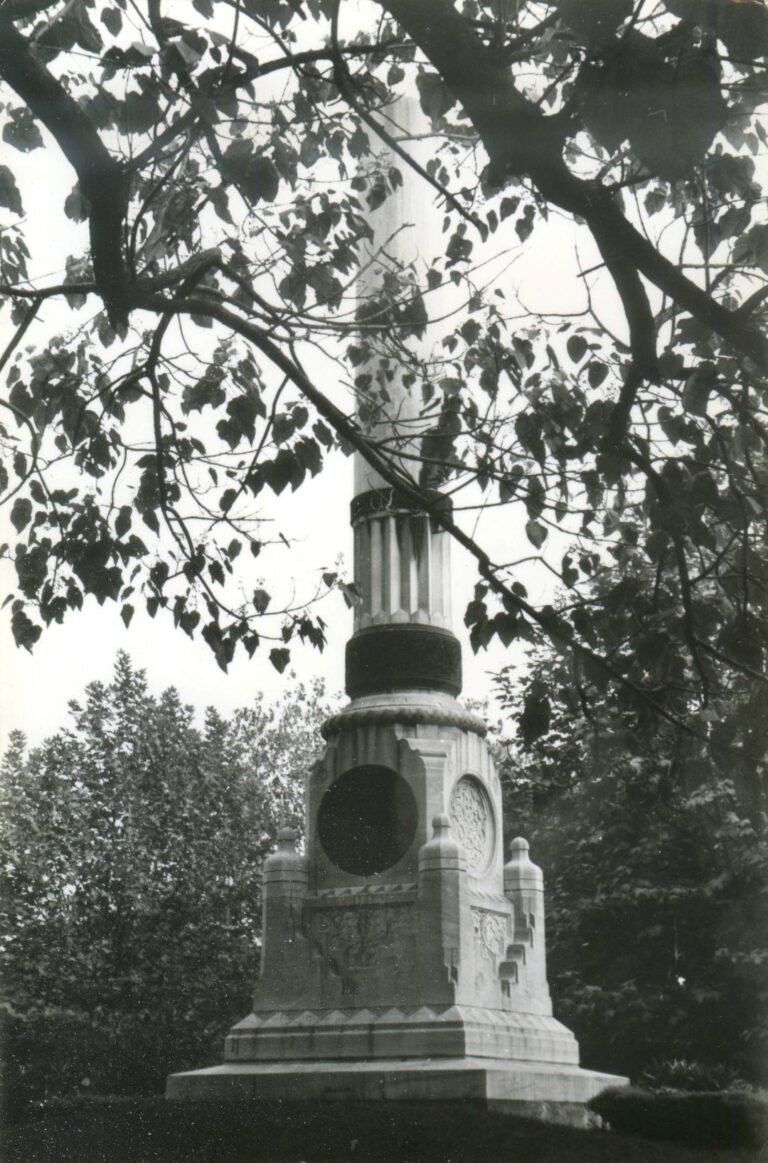
Fatih Hava Şehitleri Parkı Ekim 11, 1975

Bu ordu sultanın ordusu idi ve onun iradesini yerine getirir, yalnızca onu tanırdı. Bu ordu günde üç kez, “Padişahım çok yaşa!” diye bağırmak zorundaydı.

Yeni orduyu tamamen yeni prensipler ve temeller üzerine kurduk. Bu ordu, eski ordunun halkın davasına, vatan müdafaasına sadık kalmış kısımlarından ve emekçi köylü kitleleri arasından toplanan kişilerden oluşturulmuştur.

Biz bu orduyu kurarken, yalnızca bir tek amaç güttük.

Bu da, bu ordunun sultan ordusu değil, halk ordusu olması, ayrı ayrı şahısların değil, bütün halkın menfaatlerini savunmasıdır.

Mustafa Kemal Atatürk – 4 Ocak 1922

Tespit: Türk Ordusu. Ordu Türk halkının kendisidir binlerce yıldan bu yana bulunduğu geniş coğrafyalarda sürekli hareket halindedir. Savaş koşullarında olsun barış koşullarında olsun aynı zihniyetle yaşamaktadır. Türk halkının teşkilâtlanmış halidir Ordu.

Türk ordusu Asya, Avrupa, Afrika kıtalarının en iç bölümlerinden başlayarak binlerce yıl boyunca tecrübeler edinmiştir. Halihazırda 14 ülkede de varlığı bulunmaktadır. En nihayetinde de Türkleri 20. yüzyıl başında saltanatın alet olduğu esaretten de kurtaran yine Ordu’dur. Saltanat İngiliz gemisi ile ülkeden kaçarken Türk ordusu atlıları ile birlikte Akdeniz kıyılarına ulaşarak düşmanı ülkeden kovalamıştı.

Dünyanın jandarması ABD ise 21.yüzyıl başından itibaren Türk ordusuna bilumum oyunlar oynayarak mensuplarını hapislere attırmış gemilerini, kara gücünü ve hava gücünü kullanılamaz hale getirmeye çabalamıştı. Bu oyun halen devam ettirilmektedir.
Şubat 2023 de 10 ilde meydana gelen depremin gösterdiği bir gerçek ise ülke çapında örgütlü teşkilâtlanmış bir yapının bu tarz olaylar konusunda teşkilâtlanmış olan bir yapının yerinin sivil siyaset kurumları tarafından doldurulamamış olduğudur.
Ordu’nun belkemiği olan kara ordusu Türkiye genelinde dört ordu halinde teşkilâtlanmıştır. 81 vilayet yedi bölgenin sorumluk alanları dört o ordu tarafından bölüşülmüştür. Bu dikkat çekici bir merkezi yapılanmadır. Kendine özgü bir yapılanmadır. Ordularına altında kolordular Tugaylar Tümenler Alaylar Bölükler yer almaktadır.
Binlerce yılın deneyiminden gelen bu kendine özgü merkezi yapılanma olaylara müdahale konusunda kurmay zekası ile birlikte hızlıca ve anında hareket etmekte eyleme geçmektedir. Bu stratejik hareket kabiliyetinin kendimize özgü sosyolojimizden gelen bu hareket kabiliyetinin halkla bütünleşmiş bir yapının, batıdan, Avrupa’dan ve Amerika’dan gelen tepkiler neticesinde budanması, köreltilmesinin neticeleri doğal afetlerde görüldüğü üzere yıkıcı olmaktadır.
Türk ordusunun tarihine baktığımızda isimlendirme Çin’in iç Moğolistan topraklarında yer alan Ordos bölgesinden gelmektedir. Sarı nehrin bir çan eğrisi yaptığı bu geniş topraklarda 2000 yılı aşkın bir süre boyunca Türkler ve Çinliler savaşmışlardır. Türklerin ilk bağımsızlık hareketi de İlteriş kağan ve bilge Tonyukuk tarafından yine bu topraklarda kazanılan savaşlar neticesinde elde edilmişti. Sun Tzu’nun meşhur savaş sanatı kitabı da Türklerle Çinliler arasında yapılan savaşlardan bahseder ve düşman tabiri ile 962 kez kitapta değinilen Türklerdir.
Ordos şiiri
Türk Silahlı kuvvetleri tabiri 1960 darbesi tarafından sözlüğümüze girmiş bir tabirdir. İngilizceden tercümedir Türkçe bir kelime değildir. TSK ifadesi olarak Türk ordusunun yerine geçirilen bu tabirden Türk ordusu tabirine geri dönülmelidir.
Ordu millet tanımı İstanbul’un tarihi yarımadadaki üç ana caddesine yansımış durumdadır Topkapı’dan Aksaray’a kadar giden cadde millet caddesi ve paralelinde Vatan caddesi birleşerek Ordu Caddesi olarak Sultanahmet’e doğru devam etmektedir.
HAARP
“Kamuoyunda önemli bir kesim depremi tamamen bilimsellikten uzak olmasına rağmen Amerika’nın HAARP teknolojisi ile tetiklediğine inanıyor.” Cem Gürdeniz. Kaynak: Veryansın TV
“Peki ya ‘HAARP’ projesi ya da Amerikan savaş gemisinin Boğaz’a demirlemiş olması? Prof. Dr. Ercan, “Hayatımda duyduğum en saçma şey bu. Böyle bir şey olamaz. Bilimsel hiçbir açıklaması yok bu dediklerinin. Bunu ‘irkitilmiş bir sarsıntı’ olarak değerlendirmek en doğrusudur” Prof Övgün Ahmet Ercan. Kaynak: Hürriyet gazetesi
Bu konu da Lozan’ın gizli maddeleri tarzındaki komplo teorisi gibi sürekli belli kesimler tarafından şırınga edilmektedir. Maksat Türklerin gerçeklerle olan bağının kopartılmasıdır. Büyük Atatürk’ün “ordular ilk hedefiniz” diye başlayan emri neticesinde savaş kazanılır masaya oturulur Lozan’da bir anlaşmaya varıldıktan sonra yurtdışı istihbarat servislerinin emrinde olarak Lozan’ın gizli maddeleri konusu beyinlere şırınga edilmektedir. Sahada kazanılan savaşların zihinlerde kayıp edilmesi için yüzyıldan bu yana çaba gösterilmektedir. Aynı şekilde Türk ordusu da darbe söylentileri altında budanarak bir yandan da bu HAARP teknolojileri başlığı altındaki komplo teorileri ile halkın zihni bulandırılmaktadır. Siyasiye irade ortaya koyarak toplumu yönetemeyen siyaset ülkeyi bu noktaya getirmiştir.
  • ŞanlıUrfa
  • GaziAntep
  • KahramanMaraş

Esaretin kırıldığı Şanlı, Gazi ve Kahraman insanların şehirleridir.

Fay kırıklarına binalar dikenler dedelerine ihanet etmişlerdir.

1998: TSK,aktif caydırıcılık konseptini geliştirerek ABD’den bağımsızlaştı.
2008: ABD’nin cevabı: Ergenekon tutuklamaları
2016: İşgal Girişimi

TSK nın değil KKK nın 2226.yılı.
Aslında TSK nın 2226. yılı olması lazım.

Sü’Başılar
Sü’Baylar

Ruhumuz;
Dokuz Sekiz
İlk hedefimizdi
Mavi gökler
Lacivert deniz; Akdeniz!

Sü’Başılar
Sü’Baylar
Sü’variler

İş başa
Tuğlar göklere
Tuğralar kalplere

Dağlar başına
Deryalar, Talaylar uğruna
Semalar çadırımız ola!

16 Nisan 2018, İstanbul

NATO;1952’den buyana Türk Ordusunun içindeki paralel ordu’nun ta kendisidir.
Tüm darbelerin arkasında içimizdeki paralel ordu (NATO) vardır

2300 yıllık Ordumuzun içine 1952’den buyana hain subaylarla sızan NATO/ABD; Ordu‘nun aslında ORDU-MİLLET olduğunu anladı mı?

Batı tabiri olan Silahlı Kuvvetler (Armed Forces) ile Türk tabiri olan Ordu-Millet farkı, darbeci Batı’nın hesaplarını şaşırtmaktadır.
Türkiye &Türkistan Ordusu: Birlik, en köklü, kadim kurum olan, her daim Türkçe komut vermiş olan Ordu temelinde gerçekleşmeye başladı.
Yazıtlarda en çok kullanılan 10 kelime (103 adet yazıt)
1 Bodun (Halk) 307
2 Kagan 206
3 İL (Devlet)131
4 Türk 112
5 Ban/bin/man (Ben) 107
6 Sü (Ordu) 71
7 Tanri 62
8 Ar (asker) 62
9 Tabgaç (Çin) 59
10 Yaş 58

HİNDİNDE TÜRKÜNDE

İlim Çin’de
Âlim Hind’de
Fakirde
Beyninde
Zihninde
İndinde
Hindinde
Türkünde
Nişânesi Alnında

Acılar, sılalar
Gökler, Göçler
Ordu, Ordos, Urdu
Savaşçılar Ordusu
Âlimler Yurdu
Kızılderililer, İnka’lar,
Aztekler, Hunlar,
Tujue’ler, Uygurlar
Hind’ler, Toharlar,

Amerikalılar,Millet kavramını pek severler.
Millet’in aynı zamanda Ordu olabileceğini ise hiç düşünemediler.

Kast sistemi İngilizler eli ile hindden başlayarak,iran(mollalar) Mısır (ordu) ve Türkiye’de (bürokrasi,aydın) ihya mı edildi?

Onlarınki Silahlı Kuvvetler (Armed Forces)
Bizimki Ordu-Millet
Arada dağlar var..
Ordu: armed forces silahlı kuvvetler
Paşa :general

Ordu-millet tabirinin ingilizcesi yok ama.
ne yapacağız şimdi?

Ordu dili : Urduca..

  • millet caddesi
  • ordu caddesi
  • vatan caddesi
  • oğuzhan caddesi
  • kızılelma caddesi
  • akdeniz caddesi
  • akşemsettin caddesi

Onlarınki Silahlı Kuvvetler (Armed Forces)
Bizimki Ordu-Millet
Arada dağlar var..

1826 yılında yeniçeri ocağının kapatılmasından sonra Davutpaşa Tophane Rami Kasımpaşa Maçka kışlaların yapımı başlamıştır yanılmıyorsam ordu son hazırlıklarını Rami kışlasında tamamladıktan sonra Rumeli seferine buradan çıkardı

Bizim babalarımızı, tarihten gelen atalarımızı Oğuz Kağan’la başlayarak bu dünya devleti ideali, bütün kuvvetler işte burada var, gök, hava, kara, deniz hepsi burada var, bu destanda müthiş karakter var zaten.

First Turkey First

*   The first known human settlement is in Çatalhöyük, Turkey (7 Millenium B.C.). Mesopotamia has long heen considered as the first home of civilization in the Old World, about the fifth millennium BC, but the so-called neolithic revolution or transition to so-called agricultural society about 10,000 BC probably occurred first in Anatolia. The origin and ethnic derivation of the most ancient inhabitants of Anatolia are not known, but it is certain that they were among the first if not the first, to have built a city. Before that, between 15,000 and 13,000 BC, we know only of nomadic hunters, as at Lascaux. At Çatal Höyük in the middle of the Anatolian plateau, a cluster of the first real houses was discovered on an area of thirteen hectares. They were constructed from clay bricks, the walls were regularly colour-washed on the outside, and certain of them were covered on the inside with wall paintings, similar to cave drawings but fulfllling an aesthetic function. Linked together in tiers, the upper houses opened onto the flat roofs of the ones below. The fourteen levels built up there correspond to a little more than one thousand years of occupation, from 6750 BC to about 5600 BC, that is to say, during the Neolithic period. These first ‘town dwellers’ were primarily farmers. They lived in family groups of five to seven persons, and were already cultivating wheat and vines, raising sheep and goats, and keeping dogs. They grew and wove flax, and possessed weapons of copper and lead, both for hunting and defence. They also traded with distant countries. At Çatal Höyük objects have been found made of volcanic glass and apatites which were unknown locally. We also know that they worshipped a Mother-Goddess, a goddess of fertility, whose terra cotta statuettes decorated their domestic altars.
*   The first Neolithic paintings found on man-made walls are in Çatalhöyük, Turkey.
*   Çatalhöyük is a center of “firsts” -first ceramic pots, first mirrors, first examples of woven materials, first wooden bowls, first wallpaints, among many other firsts.
*   Writing was first used by people in ancient Anatolia. The first clay tablets – in the ruins of Assyrian Karum (Merchant Colony – date back to 1950 B.C.)
*   The first tin mine was found in Göltepe, 60 miles south of Tarsus, Turkey.
*  Excavations at more than 50 sites over the last half-century have established the Fertile Crescentof the Middle East as the homeland of the first farmers. This arc of land, broadly defined, extends from Israel through Lebanon and Syria, then through the plains and hills of Iraq and southern Turkeyand all   the way to the head of the Gulf Among its “founder crops ” were wheat, barley, various legumes, grapes, melons, dates pistachios and almonds. The region also produced the first domesticated sheep, goats, pigs and cattle. But guestions persist: Where in the Fertile Crescent were the first wheat and barley crops produced? What conditions favored this region? Why was the transition from hunting and foraging to farming so swift, occurring in only a few centuries? New genetic studies suggest possible answers. They pinpoint the Karacadağ mountains, in southeast Turkey at the upper fringes of the Fertile Crescent, as the site where einkorn wheat   was first domesticated from a wild species around 11,000 years ago. The scientists concluded, this is “very probably the site of einkorn domestication. “
*  It was, firstly, the Hittites who gave Anatolia the name ‘Asia’ (Assuwa) around 2000 BC; the word gradually came to mean the whole Asiatic continent. It was during the Byzantine era that the Asian territory of present-day Turkey began to be called Asia Minor, to distinguish it from the rest of Asia.
*  Some twenty thousand clay tablets discovered at Hattusas were written in these languages and even included dictionaries. They constitute the first State archives of mankind. The existence of these documents, the writing of which must have demanded a great number of scribes, calls to mind the importance that the Turks have always given to archives. Anatolia is the only country in the world whose official archives cover sixteen hundred years of history eight centuries relating to the Hittitesand an equal number to the Turks
*  Hittites were among the first to give life to the rule pacta sunt servanda. At the beginning of the fourteenth century BC, the Pharaoh of Egypt attempted to conquer Syria, but he was successfully repelled by the Hittite King Mursilis. The struggle was begun again by Ramses II, ftve years after his accession to the throne of Egypt. In 1299 BC one of the great battles of antiquity took place atKadesh on the Orontes river, between Mutawallis, the son of Mursilis, and the Pharaoh. It was the first historic battle which can be reconstructed in all its details. At stake was the domination of the known world, for the great era of the Babylonians had ended, and that of the Assyrians was in decline. The clash between the armies of the two great Empires of the time, Egyptian and Hittite, was tremendous but politically inconclusive. Both parties proclaimed themselves the victors, although only the Hittites could justifiably claim victory, Mutawallis having pursued the Egyptian army as far as Damascus. A reproduction of this first treaty is a feature of the entrance to the headquarters of the Security Council of the United Nations. It is a sign that present-day civilization acknowledges its debt to the Hittites and to Anatolia. The Kadesh Peace Agreement was drawn up between the Hittites, the oldest civilization on Anatolian soil, and the Egyptians and signed by Hattusili III and Ramses II. This is the first written example of a political agreement and is the world’s oldest known peace treaty.
*   The fact that the Amazons were horse riders is further evidence of Hittite influence, for it was the Hittites who first used the horse as a means of transport. It is true that this achievemeni is sometimes attributed to the Mittanis, but the credit for the training of horses and their widespread use to this day really belongs to the Hittites. When Homer described the Amazons on horseback, he was referring to the time of ‘TroyVII, whereas on a tablet dating from 1500 BC, discovered at Hattusas, the breeding and training of horses are explained in detail. It is a fact that, wherever mankind has set foot and spread knowledge and culture since those ancient times, he has been accompanied by the horse.
*   The Hittites used horses to pull chariots, which were firstly invented by themselves. They were vehicles with two six-spoked wheels, which carried into battle a driver and a warrior armed with a lance. The intervention at Kadesh of fourteen hundred chariots constituted a veritable revolution in military technology which enabled the Hittites to destroy the Egyptian army in a few hours. It is said that the unexpected speed of the result encouraged the Hittites to start looting, thus allowing the fleeing Egyptian forces to turn bout for a surprise counter-attack. The battle thus never reached a decisive conclusion.
*   The production of iron was another Hittite contribution to human civilization. At the beginning of the second millennium BC, iron was more valuable than gold. Thanks to simple and efficient techniques evolved by the Hittites, it could be produced at a cost lower even than that of silver. Since then, cheap iron has been used both far the manufacture of weapons and for agricultural and industrial tools, and has allowed enormous development in these two areas. Thus Anatolia reached the iron Age well before other countries. By a curious chance of History, Chinese documents reveal to us that the T’ou Kioue, ancestors of the Turks, were also a people who were very knowledgeable in the processing of iron. The familiarity of the Turks with the technology of iron is illustrated by the legend of Ergenekon: the Turks escaped from imprisonment in the heart of the mountains by melting them down with the aid of bellows they had invented

LYDIA

*  Herodotus, the father of history, wrote about a stream, the “Pachtolos that runs from Tmolos through the very center of the Sardis agora and carriesgold flakes. ” The Lydians who lived along this river derived great might and fame from the gold they panned from this stream and they were then thefirst known civilization mint gold and silver coins. Historians described the concept of the wealthy by saying “As rich as Croesus” to describe”Golden Sardes,”   the capital city of the Lydian KingCroesus (575-546 B.C.).
*   The name of Lydia evokes commerce and money. It was the Lydians who first linked Europe to Asia and Africa by an overland route. They controlled the traffic on the commercial routes of Anatolia, and ran the lodging centres which served them. Commercial activity continued in this region until the middle of the faurth century BC. The Lydian caravans brought lapis-lazuli from the Far East, silver, lead, and timber from the Taurus mountains, and tin from other regions. This trade in raw materials, luxury goods, and finally manufactured products not only encouraged the development of craftsmanship and agriculture but it equally facilitated the intermingling and amalgamating of different Anatolian and surrounding cultures. Towns became cosmopolitan. The wealth created by trade and the production of goods nourished intellectual, scientific, and artistic endeavor.
*   The Lydians built the first puhlic parks and opened the first houses of prostitution. It can also be accepted that they were the first to establish a system of lodging.
*   The Lydians contributed much to the history of mankind with their implemenlation of the use of coins. The Lydians invented money between 800 and 650 BC, although the fact that the innovation took place in Lydia was probably more the result of the importance of commercial activity in the region than of Lydian genius. The circulation of money in turn gave an exceptional boost to commerce.Consequently one should not overlook the important part which the commercial and economic developments in Lydia played in the birth of the neighboring Ionian civilization. Babylon used a system of weights, but the adaptation of this system to money is a Lydian contribution to civilization. The first coins were in electrum (an alloy of silver and gold) and carried the images of a bull and a lion, emblems which were associated with the Hittites. Herodotus wrot e:” At this time, there was not in Asia Minor a people more courageous or more powerful than the Lydians. They made war on horseback, carried long lances, and were excellent horsemen.”
*   The Lydians claim that the Olympic Games, now held among themselves and among the Greeks, were their invention. . . They say that they originated them at the lime that they were colonizing Tyrrhenia. According to Herodotus, it was the Lydian migrants to Italy round 900 BC who became the Etruscans. These were probably sailors attracted to Italy by deposits of metal-bearing ores.

                          Minoan civilization in Crete

*  We observe a particular enthusiasm among West Europeans about the sources of their civilization. Each new discovery has led them to find a yet earlier date for their point of departure in history. Nowadays we see attempts being made to move this point of depariure from Mesopotamia io theNeolithic Anatolia. In the early nineteenth century Western cultural roots were considered io be found in Greece, and Greece only, but as the important influence of Minoan Crete over the Aegean basin became better understood, the claim was later made that it was the Minoans who formed the basis of Western civilization. However, the Minoan civilization in Crete, one of the most remarkable cultures of antiquity, was created by Anatolians. Between 2200 and 1750 BC, which was the middle Minoan period, the first palaces were built, and numerous advances in technology and the arts were achieved. An early hieroglyphic writing came into use in the eastern basin of the Mediterranean. Between 1750 and 1580 BC towns razed by an earth-quake were rebuilt. Colonnades appeared, as did the art of fresco-painting and a new writing, Linear A. Minoan colonies were formed on nearby islands, and trading posts were maintained on distant Cyprus and at old Ugarit on the coast of Syria. The sacred symbols of the bull and the double axe (of Anatolian origin) were extensively revered in the Aegean during this period..

                                      Phrygians

*  Phrygians were the inventors of such musical instruments as the flute and cymbals. Many of the animal stories that today’s children love to listen to originated in Phrygia.
*   The influence of Anatolia on the Mediterranean Basin in the Post-Minoan Era: it is known that the Phrygians of Phocaea founded Massalia (present-day Marseilles) at the beginning of the first millennium BC. The French Revolution chose a Phrygian’ bonnet for the head of Marianne. The French word frise, whence the English frieze comes from the Latin Phrygium, ‘Phrygian (work)’  it stands as a memorial to the craftsmen whose traditions were taken up and continued by the Turks.The double knot characteristic of Turkish weaving is called ‘the Gordian knot, from Gordium, capital of Phrygia.

Pelasgians, Minoans

* The Hellenes of  the classical period were the first to designate as Pelasgi or Seafarers those who were already living in the region when they arrived, and who had come there by sea. These people probably did not use the name for themselves, though modern historians have continued to refer to them by this title. The Pelasgians, described as being of medium height, brown-haired and swarthy, were neither Semites nor Indo-Europeans. They are generally considered, in spite of their heterogeneity, to be ‘Mediterranean race’. It is also accepted that the Pelasgians were mainly Anatolians who, while keeping Anatolia as their base, were the first civilizers of all the lands of   the Aegean basin, including the islands, Crete, and the rest of Greece. This fact enables us to understandthe close relatlonship of Crete and the Peloponnese with the Aegean shores of Anatolia, with Troy to the north and Miletus to the south. It is known, for example, that Miletus was founded by the Minoans of Crete, who had retumed to their Anatolian ancestral cradle.Further, it is evident that the Mycenaeans and the Pelasgians/Minoans merged, as did the Hittiteswith the Hattians. If one refers to Herodotus, who defines the Athenians as ‘Pelasgians who learned the new language (Greek) one can understand more fully the significance of their expansion. Unlike their Babylonian and Egyptian contemporaries, the Minoans left little written history – and the writing they did leave is largely indecipherable. Herodotus also states that the Hellenes took their gods from this people.
*  After a further earthquake in 1580 BC, the Minoans began to spread their civilization to the Peloponnese. Until then, little of any significance had been happening in Greece. It was not until about 1600 BC that the first wave of Indo-Europeans, the Achaeans, invaded from the north and created a new centre of civilization at Mycenae, on the plain of Argos, and remained under the Cretan thalas-socracy. It is clear that towards 1400 BC the Mycenaeans, having become rivals of the Cretans,conquered them and occupied their island: their last writing, Linear B, is in Greek. It is possible that they burned Knossos, the Cretan capital. In any case, the Mycenaeans became the sole power in the Peloponnese. These were the people whom the Hittites of the fourteenth century BC called the Ahhiyawa and whom the Iliad designates as the Achaeans. Their expedition against Troy probably marks the zenith of their expansion. A little later, towards 1200 BC, they were in their turn overwhelmed by new invasions of Hellenes coming from the north-the Dorians. The basic difference between the Minoans and the Mycenaeans is that the former left little evidence of violence in their art, while the latter took it as a major theme. Add to that an oral history of death and devastation passed down throughHomer,   and a people        emerge forever girded for baitle. The Mycenaean Empire crumbled af ter the Trojan war, and three centuries of dark ages bury Greece’s heroic age in myth.

Maeonians

*   The Maeonians had attained a high degree of civilization long before they emigrated. They brought from Asla the douhle-headed axe-an emblem of royalty, which subsequently became the symbol of State used by high-ranking Roman magistrates. During the eighth century BC the Etruscans formed a large and powerful state in the centre of the Italian peninsula. They built fortified towns, worked in metal, extracted minerals in Sardinia and Corsica, and devoted themselves to a prosperous economy. Women had a high status in their society. Having annexed Rome at the beginning of the sixth century, the Etruscans provided it with three kings, of whom the first and the third were calledTarauin. Tarkhon is the name of an Anatolian god who was worshipped by the Etruscans. It wasTarquin the Old who ordered the construction of Rome’s first drains (the Cloaca Maxima) which are still in use to this day. Urban drainage was a practice that the Anatolians learned from the Sumerians.

Ionians

*  It was in Western Anatolia that man first began his process of intellectual discovery that was to take him out of the darkness of ignorance into the light of critical thought. The science based on a determination of natural laws sprang from observations of natural phenomenon in Miletus in the sixth century B.C.
*  Mankind passed from the darkness of dogmas to the sunshine of science with the aid of critical thinking far the first time in western Anatolia. The Milesian pioneers of science recognized that Nature had its own laws and they thus liberated the interpretation of natural phenomena from religious straight jackets and began to reevaluate it with a free and critical contemplation, thus laying the foundations of the natural science that form the basis of the present human civilization. History knows these first Ionian scientists as the Milesian School The light created by the Milesians led to the blooming of an Ionian school during the pre-Socratic period and other Ionian cities also produced thinkers, who have illuminated mankind like the rising sun.   Anatolia, “the place where the sun rises,” indeed earned this appellation for the first time with its Ionian pioneers of science.
*   The pioneer of the Milesian scientists, Thales, who was both a mathematician and a natural scientist, is famous because the tradition ascribes to him the prediction of the eclipse o n28th May 585 B.C. (Herodotus, I 74). He was among the first to observe the attraction exercised on iron by certain ores in Magnesia, in ancient Lydia. Certain theorems of elementary geometry carry his name. Tradition also has celebrated him as an able engineer far his alleged feat of diverting the course of the river Halys to carry the army of the Lydia king Croesus across it. The foundations of western civilization, whose dominant component is the natural sciences, and especially of the most important source of this civilization, the Greek philosophy, were laid in western Anatolia, in lonia and especially in the home of science, Miletus.
*   With the first rational criticism he made, the first rational cosmology he developed, the first world map (pinax) he drew, the first theory of organic evolution he conceived, and the first prose book he wrote on natural sciences, Anaximander, who the tradition says was some fifteen years younger than Thales, appears not only as the rule founder of natural sciences, but as the greatest architect of the civilization of free-thinking humans, who are ready to question everything and everybody, including themselves. Ascription to him of the invention of the gnomon was probably a result of his interest in astronomy. This modest Anatolian, who created a monumental tradition of thought that changed the destiny of mankind, was also the first person who stated that the earth is suspended in void.   That this conclusion, which was not based on any observation but was purely a deduction from a local analysis of his friend Thales’ hypothesis, later appeared in the Book of Job (XXVI, 7) in the Bible, testifies to the range of the rays of the sun that had risen in Miletus.
*   Anatolia, which means “the place where the sun rises” also gained significance as the place where science was fırst born thanks to early Ionic scientists, Thales, Anaximander, and Heraclitus.

*   The fırst use evidence of use of glassware in the eastern Meditarranean region was found in the cargo section of a sunken merchant ship as early as 2000 BC, near a southwestern town of Turkey, namely, Kaş. Merchandise included ingots of blue glass formed by pouring molten glass into moulds.
*   The fırst church built by man (Si. Peter’s Church) is in Antioch (Antakya), Turkey. The fırst church of Christianity was carved in a cave in Antioch and called St. Peter’s Grotto.
*   The believers of Christ were called “Christian” for the first time in Antakya. Followers of Jesus wereftrst called “Christians” in Antioch-on-the-Orontes.
*  St Paul preached his fırst recorded sermon in Pisidian Antioch.
* The First Ecumenical Council was held in Nicae (iznik), Turkey. The fırst eight of the Counsil meetings which have been held 19 times until now, were held in Turkey. Especially, holding of the ftrstand seventh meetings in İznik established the tradition of holding these meetings regularly.
*   Virgin Mary spent the last days of her life in Ephesus. The ftrst church dedicated to her is also in Ephesus.
*  For many centuries the manufacturing of silk had remained a closely guarded secret in China and the export of silkworms was punishable by death. First in history, in 552 CE, two Nestorian monks succeeded in smuggling silkworm from China to Istanbul and by the early seventh century sericulture was well established in Asia Minor. Silk produciion has developed to excellent levels in the Turkish city of Bursa, one of the Ottoman capitals. The basis of that development was an earlier tradition.
*  Coffee introduced to Europe firstly by Turks.
Cherry was first introduced to Europe from  Giresun  (Northern Turkey)
AND MORE…
* First known inhabitants – the Hattians, the Louvites, the Hurrians. As far as we know, the Hattians  (3000BC)  were the first distinct race of people tol ive in Anatolia. They left us no written testimony, and our knowledge of the Hattian language comes to us from Hittite or Assyrian sources. According to the indications these provide, Hattian was an indigenous language, different from all other known languages. From its language, its religion,and      its art, the Hattian civilization appears to have been one of the most advanced of its time, because the whole of Anatolia was named Hatti. TheHittites, successors of the Hattis, were to inherit their capital, Hattusas, and numerous linguistic and cultural legacies. Before the coming of the Hittites, another civilizing population apperared in the south-west of the peninsula. These people were known as the Luvians, and they lived side by side with the Hattians. If certain hieroglyphic texts found at Hattusas are indeed in Luvian, it can be claimed that their language was Indo-European, belonging, like Hittite, to the Anatolian group. Place names deriving from Luvian are encountered not only in Anatolia, but in Crete, the Aegean islands, mainland Greece, and as far away as Italy, Sicily and the Balkans. Thus, long before the Hellenes, the Luvians appear as the first invaders who, by their influence on the indigenous populations of Anatolia, may have stimulated the flowering of a new culture. Around 2000 BC, the east and the south-east of Anatolia were occupied by the Hurrians, who were neither Indo-Europeans nor Semites. Their civilisation reached its peak about 1700 BC, at which period Aryan warriors established a State called Mitanni. They maintained and radiated the Sumeric-Babylonian cultural heritage for much longer than they kept their political independence. Their language, which was agglutinative, does not fall into any known group. Their principal influence on the Hittites was in transmitting to them some of their religious beliefs. The Hurrian mythology influenced Hesiod and Homer through the late Hittites and the Phoenicians. The Gilgamesh epic, which was found in Hattusha, is a Hurrian interpretation.

Hittites

The Hittite Empire ultimately encompassed all the population groups of Anatolia, and represented ane of the first civilized societies of its time. It was organized as a confederation, a structure which enabled it first to establish, and then to maintain for eight centuries, the unity of Anatolia, and to protect it from barbarian invasion. In fact, the usual waves of invasions were absent during the Hittite period. It was during this time, therefore, that the territory first appeared as a geopolitical unity on the world scene. For the first time political unity was superimposed on the geographical unity of the peninsula, creating in people’s minds the idea of belonging to Anatolia. I see in this an essential contribution by the Hittites to the history of Anatolia-the establishment and maintenance of itsterritorial unity.
*  It is important here to note that populations remote from each other and speaking different languages, such as the Mysians (Pergamum region), the Dardanians (Çanakkale), and the Cilicians (south-east of Anatolia, facing Cyprus), took part in the Kadesh combat alongside the Hittites-a clear sign of Anatolian unity. The Trojan war, which occurred later but which dates from the same century, seems to present certain similarities with the battle of Kadesh. The peace treaty drawn up ten years later undoubtedly has more significance for us than the result of the battle itself. The Egyptian text of this treaty was discovered in Egypt, and a version written in cuniform characters in the Akkadian language, which the Hittites ıısed in international relations, was found in the ruins of Hattusas. Other tablets relating to other agreements show that the Hittites attached a sacred character to these treaties..
*   The influence of the Hittite deities on the Greek gods is quite clear. It   was in Crete and Anatolia that the anthropomorphic development of the gods reached its conclusion’s. The cult of the Mother-Goddess, with a dying and resurrected god as consort and son, is very important inCrete. This cult, which was born in Anatolia, spread throughout the Middle East and the West right up until the corning of Christianity. Like so many things Minoan, the cult of the bull symbol -representing strength and fertility – probably came originally from the East. This ‘East’ impliesAnatolia more particularly Neolithic Çatalhöyük, for sanctuaries in Cretan palaces, like those in Çatalhöyük, have bull-horns everywhere frescoes display bulls, and the doors of burial places are filled in with bull skulls.
*   The Hellenes inherited from the Anatolian peoples many other important cultural elements such as architecture, metallurgy, fresco painting, etc. I do not believe I am detracting from the Hellenic civilization by observing that, like all other civilizations, it owed much to those which went before. No civilization flowers in a void. It was a piece of historical good fortune that placed at the disposal of the Hellenes the inestimable heritage of the advanced civilizations of Anatolian origin. Those who attempt today to explain civilizations must not display less objectivity than the historians of antiguity, such as Herodotus for example. To do that would be to show a lack of respect both for the rationalist thought left  to us by Greece, and for the cultural heritage formed since.
*   The ethnocentrism interpretation of history, the tendency to consider the Indo-European Hellenesas the one and only starting point for Western civilization, is in reality merely an expression of cultural weakness. The Greeks formed one ancient society which owed much to the others. Their successes must be measured against the achievements of other peoples, principally those of the Pelasgians. The debt which the Hellenes owe to them has to be recognized.
*   The Pelasgians similarly have links with the Maeonians or Lydians. These people emigrated, at a date somewhere between 1000 and 800 BC, towards Umbria or Etruria where they becarne theEtruscans, as Herodotus records. Neither Indo-Europeans nor Semites, they can be numbered among the peoples who, a thousand years before, became the Pelasgians. The Etruscan language, related to that of the Lycians and Lydians, has not yet been deciphered.
*   Working in gold   was one of the arts at which the Etruscans excelled. In the Museum of Etruscan Art at the Villa Giulia in Rome one can see gold filigree bracelets almost identical to those made and sold even now in the historic Grand Bazaar in Istanbul, which are typically Anatolian. The role of the Etruscans in the civilization of Rome has long been just as misunderstood as the contribution made by the Pelasgians to Greek civilization, though Dante did lay claim to having had Etruscan ancestors.
*   The flow of migration from Anatolia towards the west has involved other peoples in a similar way. The Sardians colonized Sardinia, and the Sicels settled in Sicily. As to the legend that the Romans were descendants of the Trojans, that could possibly be explained by migrations of Lydian origin.
*  An Anatolian king who has mesmerized the world with his power and wealth was the Phrygian King Midas (725-695 B.C.). The grave of King Midas, whose very touch, according to the legend, could turn everything to gold.
*  One of the Seven Wonders of the World is the monumental tomb built in the sixth century B.C. in today’s Bodrum by the Carian King, Mausolos, for his wife, Artemisia. Mausolos, was an important   Anatolian historical character who lived during the time of the Persian Rule. At his death, the ancient world acquired one of its Seven  Wonders.    According to Pliny,the monumental tomb      (the Mausoleum) erected for him by his sister and widow Artemisia in 353 B.C. Due to impact of this colossal structure on the ancient world, the world “Mausoleum” became an architectural term that represents monumental tombs.
*  Homer, the father of the classical and Anatolian Archeological works, has immortalized the nearly 50-day period of the 10-year long Trojan War in the Iliad. His renowned works of art, the Iliad and theOdyssey, are the most ancient epics of the history of civilization.
*   The oldest and yet most advanced examples of multi-chambered rock hewn burial chamberswere those built by the Urartu civilization.
*  Heraclitus, a prominent representative of the great Ionian natura! scientists, was born to the royal family in Ephesus. His statements that “one cannot step into the same river twice ” and that ileverything is in constant flux” have made him famous through the ages.
*  Hellenistic civilization developed and thrived on Anatolian soil and left  a firm foundation of its culture on these lands.   The remnants of the Anatolian-Ionic synthesis which deeply affect the world even to this day permitted the birth and advancement of a civilization which was to come af ter it.
*From   the   establishment   of some   of man’s               earliest  permanent settlements here during the 7th millennium BC, Turkey has long been at the center of developments and trends which have had an impact far beyond Asia Minor. Some of history’s greatest trading routes passed through Turkey: the great arc from Plovdiv to Samarkand and beyond; north-south trade between the lands north of the Black Sea and the Mediterranean.
*   The famous Trojan Wars took place in Western Turkey, around the site where the Trojan horse rests today
*  Ephesus and Halicarnosus – two of the wonders of the ancient world – are in Turkey.
*  Anatolia is the birthplace of historic legends, such as Homer (the poet), KingMidas, Heredotus (the father ofhistory), and St. Paul the Apostle.
*  Julius Caesar proclaimed his celebrated words, ” Veni, Vidi, Vici (I came, I saw, I conquered) “in Turkey when he defeated the Pontus, a formidable kingdom in the Black Sea region of Turkey.
*  Female goddesses dominated the Central Anatolian pantheon for thousands of years before these supernatural powers were transformed to male gods.
*   The Hittites sold Abraham the cave where he buried his wife Sarah, when the Israelites came to Palestine.
*   The Sumerian texts constitute man’s oldest known written documents and in the Gilgamesh Epic the term “Garden of the Sun” was used to signify the concept of paradise. As mentioned in the Old Testament, the exact location of this heavenly area was the Anatolian landmass lying between the sources of the Tigris and Euphrates Rivers. “Then the lord God planted a garden in Eden, in the east, and he placed there the man he had formed… A river rises in Eden to water the garden; beyond there it divides and becomes four branches. The name of the third river is the Tigris; it is the one that flows east of Ashur. The fourth river is Euphrates. Old Tesiament. Genesis (2:10-14)” The “Garden of the Lord” mentioned in the Book of Genesis in the Old Testament is called Eden, and is synonymous with “heaven” or “paradise”. In Sumerian sources, the writings of which constitute the world’s oldest written records, this area was called the “Garden of the Sun,” and they believed that this Paradise belonged to the God of the Sun, Shamash. According to the Sumerian Gilgamesh Epic the “garden” was entered by passing between the two summits of Mashu (Probably MountNemrud/Tatvan) which were as high as (the wall of) the sky. The book of Genesis in the Old Testament states very clearly that the land of this paradise lies between the wellsprings of the Tigrisand Euphrates rivers. So the “paradise on earth” is in that area of Anatolia which lies between the sources of these two rivers. During the past several centuries many travelers (e.g. J.P. Tournefort 1656-1708) have come to Anatolia, especially to the area around Mount Ararat, to search for the “Garden of Eden “.
*  Patara, the birth place of Santa Claus. St. Nicholas, also known as Santa Clause, was born in Demre, on Turkey’s Mediterranean Coast. St Nicholas or Santa Claus was the sııbstance behind the composite legend, and the source of the gift giving and association with children. St Nicholas was a bishop of Myra in southwest Turkey, and his church still stands just outside the modern town of Demre. He was born in 280 AD in the city of Patara 80 km. away, and died in Myra on 6 December 345. Saint Nicholas was born in Tatara and became bishop in Myra.
*  Noah’s Ark landed on Mount Ararat (Agri Dagi) in Eastern Turkey. The last meal on Noah ‘s Ark, a pudding of sweet and sour taste (aşure), is still served throughout Turkey.
*   The Apostole St Philip lived in Hierapolis and was martyred there.
*  Anatolia is also significant area for Christians and is considered holy 
and sacred for many reasons.
*  St Paul, one of the 12 apostles of Jesus Christ, devoted himself to the dissemination and expansion of Christianity, was born in Tarsus.
*  The Seven Churches of the Apocalypse which were mentioned in Revelations and are located inAnatoüa; Ephesus (Efes), Smyrna (İzmir), Pergamum (Bergama), Thyatria (Akhisar), Sardis (Sart), Philadelphia (Alaşehir), Laodicea (Denizli).
*  Saint John lived and died in Ephesus. His grave and the church is in Selçuk, Izmir, nearby Ephesus.
*   Turks gave the Dutch their famous tulips.
*  Istanbul is the only city in the world built on two continents.
*   Tradition in Turkey says that a stranger at one’s doorstep is considered “God’s guest” for at least three days.
*   Turkey is noted for having one of the three most famous and distinctive traditional cuisines in the world.
*  Modern Europe is a venture of civilization that has evolved over three thousand years, and present-day Turkey at its geographical heart Modern Europe was born in the Eastern Mediterranean with roots in Egypt, Syria-Palestine-Asia Minor, Greece and Italy. This civilization has evolved over three thousand years. Present-day Turkey lies at the geographical heart of the region. It was largely in Turkey that belief in a single God came into being and spread, giving rise to the Judeo-Hellenic synthesis that is central to contemporary civilization. Today, Turkey is home to the most magnificent works of the Hellenistic-Roman era, which are daily reminders of this extraordinary heritage. Indeed, it is a synthesis of the legacies of Ancient Egypt, Mesopotamia and Anatolia.. Civilization began in Anatolia around 6000 B.C. with the Neolithic town of Çatal Höyük. This was followed between 2000 and 1170 B.C. with the glories of the Hittite Empire, comprised by peoples from Mesopotamia, the Caucasus and the steppes of southern Russia, thus creating a fascinating blend of cultural and religious traditions. The importance of the Hittites in the history of the Middle East as a whole is steadily becoming more apparent. Later, Ionia, the west coast of Anatolia, was to emerge as the seed bed of classical civilization and philosophy. In the adjacent province of Caria, a synthesis of ancient Iranian and Greek culture blossomed from the sixth century B.C. onwards. The heritage of the Hellenistic period in Anatolia was later passed on to the Roman Empire in its entirety.   When theTurks arrived in Asia Minor in the 11 century, they were already thoroughly acquainted with Roman culture and the spirit of the classical empire, whose institutions they inherited. Both the administration of cities and their names remained practically unchanged. The state sysiem persisted, as did the church, along with its architecture, art and material forms of life. Even the name of the state included that of Rome: the Roman Seldjuk State (Rum Selçuklu Devleti). The fbundation of lslamic civilization and learning in the 9th and 10thcenturies was in fact Hellenistic.
*  Many experts on the history of Turkey have considered that the achievements of the Greek andRoman civilizations in Anatolia were greater, both in number and sophistication, than those actually in Greece and Italy. Can it, therefore, be claimed that Anatolia contributed in an original and significant way to world civilization, or was it merely the stage upon which the Indo-Europeansplayed their role of civilizes, while the Anatolian was only the spectator or had, at the very most, a walk-on part? Was Anatolia crucible in which diverse civilizations fused to give an exceptional cultural amalgam, or was it merely the antechamber of a continent ruled, it was believed, by dark and barbarous forces? Was the Aegean Sea simply a strait separating two peninsulas of the northern Mediterranean, or a terrible abyss isolating from each other two different, hostile worlds, the East and the West? Moreover, what is the East, what is the West? Do the categories ‘Asia’ for the barbarians, and Europe   far the civilized and civilizing Indo-Europeans, correspond to reality? These questions gave rise, particularly in the eighteenth and nineteenth centuries, to misconceptions which we come across even now. Have the civilizations which succeeded one another long ago in Anatolia influenced our present culture? Despite the diversity of peoples who have lived in this land, is there a continuityin its culture? In other words, did the civilizations created by these successive peoples have points in common which are still discernible? We cannot disregard, moreover, the contribution made over thousands of years by the succession of cultures in this land where the Turkish nation has dwelt far centuries. It is evident that our present cultural synthesis has evolved throughout this history as a result of the interaction of the cultural heritage of the land, as well as our Islamic and pre-Islamic cultures. Though it is impossible to assess precisely the influence of geography over the making of   the culture, it is nonetheless not negligible, A country’s position on the globe, its configuration, its climate, and the nature of its soils, affect the axes of its politics (hence the term ‘geopolitics’), its economy, and its relationships with the rest of the world. The role played by Asia Minor in Western culture was: primarily determined by its geographical position. Whereas all the Mediterranean peninsulas – Iberian, Italian, Greek-extend from north to south, Asia Minor, alone stretching from east to west, forms a unique bridge. It was this which caused the civilizations arising in theEast in general, and on its territory in particular, to orient themselves towards the West, by way of the Aegean islands. The two high mountain ranges, which follow the coastal line of the Black Sea in the north and the Mediterranean in the south, join the eastern highland mass, which virtually separatesAnatolia from Iran and Mesopotamia, thus creating the geographical unity of the peninsula.Inside Anatolia, however, plateaus, mountains, plains, river basins, and lakes create numerous distinct climatic and microclimatic regions, each suitable far the formation of small kingdoms with different cultures, given the difficulty of communication between regions in the past. In other words, it is the physical features of the peninsula which underlie the Anatolian ‘diversity within unity’. Our knowledge of the exact location and date of origin of the earlier civilizations is not as precise as we might wish.
SOURCES:

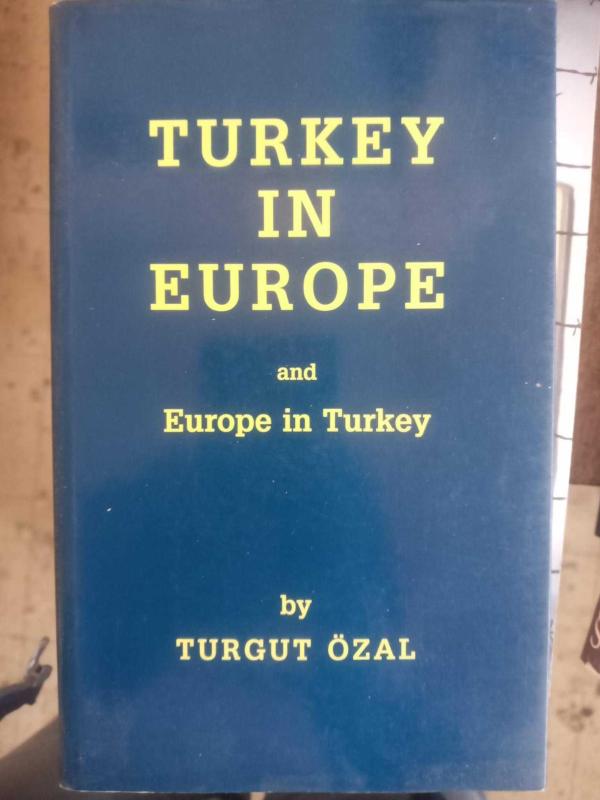
Turgut Özal, Turkey in Europe, Europe in Turkey
Nezih Basgelen, The Garden of the Sun, Istanbul, 1996
Anna G.Edmonds, The Religious Sites of Turkey, Istanbul, 1997
John Noble Wilford,  Tracing Origins of Farming, International Herald Tribune 20.11.1997
Pasabahçe A Brief History of Glass

Contact for BooksonTurkey..

Conclusions: Turkey and Europe, by Turgut Özal

Anatolia

The Turks, living in this territory for a thousand years, have inherited some part of the culture of
every civilization which flourished here since prehistory. They have evolved a synthesis derived
from the cultural legacy of Anatolia, from the culture they brought with them from Central Asia,
and from the Muslim religion. Their talent for synthesis and their ecumenical character have
enabled them to blend these three strands together. The imprint of these heritage’s is readily
visible in the cultural fabric of Turkey today. You yourselves accept that your own civilization
originated in Mesopotamia (where civilization flowered for the first time), then Anatolia, the
Aegean basin, and Rome. We have at least as much right as you to adopt these ancient civilizations as our own, since they are those of our own land. In looking at our history as an insider of Anatolia, we can claim to have lived on this land since the beginning of the Anatolian civilizations, for both culturally and demographically the preceding civilization has each time been carried over, at least to a certain extent, into the succeeding one.
It was we, therefore, who brought about the Neolithic revolution. The Sumerians were also a
people whose language was agglutinative like ours and had the most important word, namely God, in common with us. The Anatolian Civilizations were created by indigenous peoples, Hattis,
Hurrians, Lydians, Lycians, Sea Peoples, and Minoan Cretans. Indo-European peoples such as the Hittites, the Luvians, and later the Ionians and the Phrygian s, were assimilated by the indigenous peoples, who had been already civilized.
The Hittites succeeded in establishing an empire which was the first Anatolian political union. It
had the same geopolitical core as the Byzantine and Ottoman Empires, and suffered the same fate.
At Troy it was we Anatolians who resisted the foreign aggressor, with “the help of the Anatolian gods” and of men gathered from all corners of Anatolia, who did not even speak the same language.
Later we defended ourselves against the crusaders, then in 1915 against the Allies invading the
Dardanelles.
Homer – our countryman – in the ninth century BC signalled the beginning of what would later be
called `the Greek miracle’ in Anatolia. This `miracle’, which was created in the first place by
Anatolian `physicists’, crossed the Aegean Sea to mainland Greece. Science and knowledge of the cosmos developed on our shore of the Aegean; ethos, philosophy, and theatre on the other shore.
Both shores gave rise to cities which nurtured political and economic liberties.
The appearance of the Greek miracle in Anatolia following Crete, which was the cultural extension
of Anatolia, was predictable since civilization had been born in the East and moved to the West.
The Greek Revolution in 1820 prompted European historians to regard mainland Greece as the
starting point of their civilization, overlooking the cradle of the miracle. They did so because the
source was Anatolia, our country inhabited by Turks.
After the Greek miracle Anatolia was occupied by the Persians coming from one side and the
Macedonians coming from the other. Eventually they brought nothing but ruin and caused Anatolian science to lie dormant until the Renaissance. The remnants of this cultural heritage can be found today in Anatolian folklore, myths, fables, dances, clothes, houses, carpets, cooking, music, and common words. In this sense no one in western Europe can claim to be as Aegean as ourselves. To accept this fact, however, means that one first has to give up an ethnocentric perspective of history.
Later came the Roman Empire. Anatolia was its most important province, and her culture and
civilization revived accordingly. She became aware of belonging to the whole Mediterranean basin.
Christianity, which was just beginning at this time, received its name at Antioch, and by the efforts
of Paul of Tarsus-another of our countrymen -was spread throughout Anatolia where the first seven churches were built. The apostle John lived at Ephesus and his Gospel begins with a reference to the logos, a concept of Heraclitus. The pioneers of the new monotheistic religion encountered the superior rational culture of pagans for the first time in Anatolia. The classical culture was swept away by Christian humanism but only after Christianity had absorbed the ideas of the Greek philosophers Plato, Aristotle, and Plotinus, as well as the folk culture.
With the advent of the Eastern Roman Empire, monotheism became the State religion, and
Anatolian political unity was restored. This Empire had to struggle against the Sassanids to the east, the Muslim Arabs to the south, and the barbarians to the west. The Balkans became converted to Orthodoxy. The Christian religion, which had been born here, underwent an internal evolution. With time it became differentiated from Catholicism whose evolution unfolded in a different social, political, and cultural context.
The system of pronoia (fief-timar), an original creation of the Eastern Roman Empire, eventually
degenerated, resulting in the ruin of its agriculture. The Capitulations weakened its economy and
bubonic plague decimated its population. In the end the Empire was surviving only through the
efforts of its shrewd diplomacy. Everything changed in 1071 with the arrival of the Seljuk Turks,
followed by the Franks in the role of crusaders. Both of these groups wanted to fill the void left by
the decline of Byzantium.
Ostensibly the aim of the Franks was to liberate the Holy Places and Byzantium from the Muslim
Turks. Indeed, they captured the Holy Places but held them only for a short time, and soon showed scant sympathy towards the Orthodox Christians. In 1204 the fourth crusade captured
Constantinople. Throughout this period of two hundred years the Turks had gradually been settling
in Anatolia. The Anatolian peoples and the Muslim Turks, by living together on the same land during this time, gradually achieved a new cultural synthesis. A large contribution to this process was made by the Turkish mystics, Mevlânâ and Yunus-our countrymen.
Turkish philosophers had preceded Turkish warriors in the Middle East by two centuries, and the
conquest of Constantinople by five centuries. AI-Fârâbî, the first of these philosophers, was an
Aristotelian. Both he and, later, Avicenna attempted to create a synthesis between Greek
rationalism and Koranic dogma. Their method was dialectic, teaching as they walked with their
students.
Other Muslim philosophers included not only celebrated Platonists and Aristotelians but also natural scientists, influenced by the Anatolian Physicists. Muslim mystics were also influenced by
Neoplatonism.
The works of all these philosophers, who kept Greek philosophy alive and enabled it to develop,
were translated into Latin and, through Spain and Sicily, reached the rest of western Europe, where they contributed much to the Renaissance. Had Europe been fair, it should have added the word Islam to the equation which represented its cultural background to make it ‘Judeo-Christian-Islamic, Graeco-Roman’.
Islam, like the two other monotheistic religions, bears witness to Abraham. In spite of their
universal nature all three were revealed to the Semites and, though different, have points in
common. The Turks, just as much as the Indo-Europeans, were foreigners to the Semites. Islam, like Judaism and Christianity, was eastern Mediterranean in origin.

Ottoman Empire

That is why, when the Ottomans prevailed, the Byzantine philosophers were convinced that the
members of the two creeds could be reconciled. The hostility shown by the crusaders towards the
Orthodox Church merely facilitated the transmission of the Byzantine legacy to the Ottomans. The
Ottomans subsequently inherited many Byzantine institutions, either directly or through
intermediaries such as the Sassanids-Samanids, Omayyads and Abbasids, Grand-Seljuks, and
Anatolian Seljuks.
If the Roman Empire represented the extent of the spread of Western culture, it also played a no
less important part in the structure of the Ottoman Empire. In addition to the contribution of the
Greeks, whether converted to Islam or not, the Ottomans received from the East Roman Empire
the entire Balkan heritage, including Greece herself.
By 1517 the Ottoman Empire included all the European territories which had previously been
Byzantine, except for the south of Italy. The Patriarchate, newly endowed with political powers and
uniting previously separate Churches, became more powerful than it had ever been in the time of
Byzantium.
The zenith was reached at the end of the sixteenth century when the decline of the Empire began.
Factors which contributed to the downward trend were the growth of maritime trade by European
countries following voyages of exploration, the Capitulations, inflation, deterioration of the
ecosystem, the collapse of fundamental institutions such as the fief and the corps of Janissaries,
and the prohibitive cost of defending an oversized Empire.
In an attempt to regain the grandeur of the time of Suleyman the Magnificent, the first reforms in
the seventeenth century proposed a restoration of the previous conditions by strengthening the
central authority. Westernization reforms began only after the defeat by the Russians in 1774,
ratified by the treaty of Küçük Kaynarca.
The real basic cause of the decline of the Ottoman Empire was the fact that western Europe
managed to push forward its own evolution-by means of the Renaissance, the Reformation, the
French Revolution, liberalism, and the industrial revolution-to the stage of the nation-State, a
development process different from and more successful than that pursued by the Ottoman Empire.
Like Byzantium, the Ottomans never experienced a Renaissance period, for both remained loyal to the mission and the nature of the universal state.
The initial power of the Empire was itself the cause of delay in launching westernizing reforms.
When they eventually came they began with the army. The judicial system was then modernized by gradually withdrawing the administration of justice and education from the control of the religious authorities. Then ideas of homeland and liberty made their appearance, and an attempt was made to limit the power of the Sultan. However, the reforms were not carried through due to the rebellions of Christian communities in the Balkans, inspired by nationalism and stirred up by Russia, and the wars which followed.
The Capitulations evolved into a means of colonization. The Empire found itself in debt and could
not repay what it had borrowed. When bankruptcy came, its revenues were confiscated. Except for a short period, successive governments did not pay enough attention to the economy.
After the loss of the Balkans, Islamism and Westernism competed to give the Empire a new identity.

Turkey and Europe

The pro-Western faction won the day. Our War of Independence following the end of the First World War, under the leadership of Mustafa Kemal, resulted in the foundation of our nation-state, the final victory of secularism, and the breaking of ties with the Islamic and Ottoman past.
Despite Atatürk’s liberal approach, after the crisis of 1929 governments attempted to develop the
country under State control.
At the end of the Second World War there was a move in favour of economic liberalism, but the fear left by the Capitulations was such that it was impossible to adopt a truly liberal economic policy, and the Ottoman tradition of economic interventionism continued.
Distrust of the provinces tended to reinforce centralization. The habit of seeing the businessman as the non-Muslim merchant of the Empire who had collaborated with the foreigner prevented the
development of the private sector. By the middle of the nineteen-seventies a planned economy
based on import-substituting industrialization has been in place. The world economic crisis triggered by two oil shocks made the failure of this policy inevitable.
The reforms implemented by those in power, both at the time of the Ottomans and after the
proclamation of the Republic, had the effect of producing a certain polarization between the
various factions and political parties. This became more apparent during the democratic regime.
Despite advocating basically similar economic policies, the two principal parties became engaged in a rivalry so violent that it ultimately led the young people to throw themselves into an armed
struggle. With the subversive activities of external forces, the economic crisis turned itself into a
political crisis in which the authority of the State was negated by terrorism. It was in these
circumstances that the military intervention of 1980 took place.
Since then, and particularly since 1983, we have radically changed our economic policy. We have
liberalized foreign trade and exchange regimes, and abolished price controls. We have invested
State revenues exclusively in developing a national infrastructure. We have facilitated the activities of entrepreneurs and the private sector. We have begun a policy of privatization, encouraged foreign capital to invest in our country, and increased savings by improving the return that they yield. We have given preferential support to exports by maintaining realistic exchange rates.
Thus the energies which for centuries had been repressed are now released, enabling Turkish
businessmen and engineers to establish themselves in the outside world. Economic stability is
assured by the operation of market forces. The healthy growth of our economy is demonstrated by
the rapid increase in exports. This has allowed us at last to overcome the balance of payments
deficit which had existed ever since the Ottoman era. We have also accelerated urban development by the transfer to local authorities of large and regular financial resources.
Westernization reforms have thus been fully implemented.
As a country which developed relatively late, what should have been done at the beginning, namely liberal economic reforms, could only be realized at the end of the process. Westernization reforms in general, and economic reforms in particular, have provided us with the rationalist culture that escaped us at the time of the Renaissance. By westernizing, our country has become modern, and by modernizing it has become westernized. Attaining the same economic level as Europe is now only a matter of time, and perhaps only a short time.
During the decline of the Ottoman Empire the Western image of the Turk deteriorated badly. The
Turk, who had been feared and respected during the sixteenth century, became despised in defeat.
By degrees the West came to regard the Ottoman as ignorant and barbaric, and began to direct its policy towards the `liberation’ of `oppressed’ Christians. In fact, there has never been a shortage of reasons to attack a country in decline. Religion merely served as a camouflage for the true reason which was basically political. Moreover, as a result of the new currents created by the French Revolution, Christians had begun to want their national independence. Multinational states were passing into history.
It is clear that wars between western Europe and the Turks gave rise to a particular view of us. But
has not the West made war upon itself, especially in the name of religion, more often than we
have? Leaving aside the eight million and twelve million men who met their death on the
battlefields of the First and Second World Wars respectively, let us remember that the Thirty Years
War cost two million lives and the Napoleonic Wars two and a half million. The number of victims of a thousand years of Turco-European conflicts is in no way comparable with these figures.
Why then is our image in the West so bad? I believe that the answer to this question is to be found
in the West itself.
The development of western Europe after the Renaissance soon made it profoundly different from
Ottoman society. Montesquieu used this difference as an instrument on behalf of the evolution of
French society. According to him, it was clear that France must follow a path opposite to that of
Ottoman despotism. The economic and political forces for change in France defined the kind of
State and society they wanted as the antithesis, the negation, the inverse of the Ottoman model.
They represented the Turk as being what they must not be, and choosing him as their `negative
identity’.
Ethnocentrism grew in western Europe, notably during the eighteenth and nineteenth
centuries, as a result of progress and the growth in material power. Together with it there
developed an intellectual movement away from religion and faith. The resultant self-idolization
increased the need for, and reinforced the negative identity attached to the Ottomans. Historical
studies based on race and language also made their contribution. The Westerner took for granted
that all good and positive values were the product of his own society, whereas the Turks possessed all the undesirable and negative qualities. This Manichean attitude gathered additional strength each time there was a crisis in Europe, sometimes directed against the Turks, sometimes against other ethnic groups.
The reforms undertaken by the Turks for their survival were interpreted as being efforts to correct
faults in themselves which they had finally recognized. The crisis of identity suffered by the Turks
at the end of the Empire and under the Republic, and the fact that certain occidentalists perceived
Western society as the ideal model to imitate, confirmed the division of roles: on the one hand the
Turks were struggling to be accepted by the West; on the other the Europeans, refusing to be
satisfied by any effort towards westernization whatsoever, were convinced that the Turk could
never become a Westerner, and criticized him unceasingly in order to prove it.
After the intervention of the army in 1980 Turkey’s image has further deteriorated. The socio-
political segments with left leanings, whose historic mission seemed to come to an end in the West, raised the banner against Turkey on the grounds of violations of human rights in general and ethnic rights in particular. It is far from me to defend the military regime. But I cannot help noting that at more or less the same time some people in the member-states of the Community were conceiving the process of integration as concomitant with the disintegration of their societies into regional and ethnic fundamentals which they sometimes qualified as retribalization. As a reaction to this development, ultra-right parties and movements sprouted, soon directing their racial hatred at guest workers. The atavistic feelings thus aroused in Europe were not admitted by the majority, but were instead projected on to the Turks. Those Europeans who failed to love their next-door neighbour of different race started defending the human rights of those who were too far away to be visualized, while supporting the so-called oppressed ethics in or out of their country in a redemptive effort.
It is our sincere desire that this false image of us should be put right. It neither corresponds with
reality, nor does it reflect the truth. To build relationships between western Europe and ourselves
on such a foundation could only be the source of dangerous instability. If one thinks back to the
terrible events prior to and during the Second World War, one would expect from Europe a little
more self-criticism.
Despite the injustices inflicted on us during our long history, Turkey’s full membership of the European Community would not cause any major difficulties for us. The reforms in Turkey
secularized not only relations between the State and religion but also our manner of viewing history and life. Great sufferings matured us. The role previously played by religion in political and social life was reduced by the adoption of secularism, with religion becoming internalized within
individuals in the form of increased faith. Helped by the moderate nationalism of Atatürk, this put
an end to our crisis of identity.
Secularism has given us an intellectual and moral steadfastness which is capable of welcoming all culture and all technology without threat to our identity. Our full membership of the Community should not cause any particular difficulties for you either.
Our country, its culture, its religion, its institutions, its regime, and its economy are all now
sufficiently comparable with your own. Moreover, Turkey is physically part of the geopolitical area
of the West. As Edgar Morin commented, Europe is a continent without fixed borders which have
been changing constantly during the course of history.
According to him, Europe is:
………… a complex whose attribute is to bring together the greatest diversities without confusion,
and to associate opposites in a non-separable manner… there is nothing that was hers from the
beginning, and nothing which is exclusively hers today.. That which underlies the unity of European culture is not the Judeo-Christian-Graeco-Roman synthesis, but the not only complementary but also competitive and antagonistic interplay between these separate traditions, each of which has its own logic.
When integrating itself with a greater whole each country brings with it its experience of life. If, for
a man, the best and worst moments of his life constitute the value of his experience, perhaps the
same is true for nations. No country has ever experienced such magnificence and glory, nor such
trials and suffering, as we have.
To embrace Turkey, Europe’s view of her own history and perception of the world will need to be as secular and universal as ours is. The Europe capable of accepting Turkey as a full member of the Community will have risen above ethnocentrism. No longer needing to project her own negative aspects to other countries, she will be at peace with herself, will renounce all Manicheism, and, encompassing within herself both good and bad, will arrive at a global vision appropriate to her enlarged geographic borders. She will understand how illogical it is for a Europe not to include Anatolia, the cradle of civilization in the northern Mediterranean. She will recognize the Aegean Sea as a stretch of water which unites the two coasts on which appeared one of the greatest civilizations of the world.
Today Turkey is the first country with a Muslim population which has established a republican
regime, created a nation-state, founded a secular society, become truly democratic, and is
industrializing rapidly.
I am confident that, unless it diverts from the course on which it has set out, Turkey will soon
become a fully developed country with the creativity generated by its cultural heritage duly
preserved and reinvigorated in line with the requirements of our time. Thanks to its geopolitical
location this development will not fail to have an impact on the Middle-East, the Balkans, Central
Asia, and eastern Europe.
Turkey has knocked at the door of the EC, fully aware that both the Community and Turkey can
survive without our full membership. However, the significance of the answer will be no less
profound.
Turgut Özal, Turkey in Europe, Europe in Turkey